
Introduction
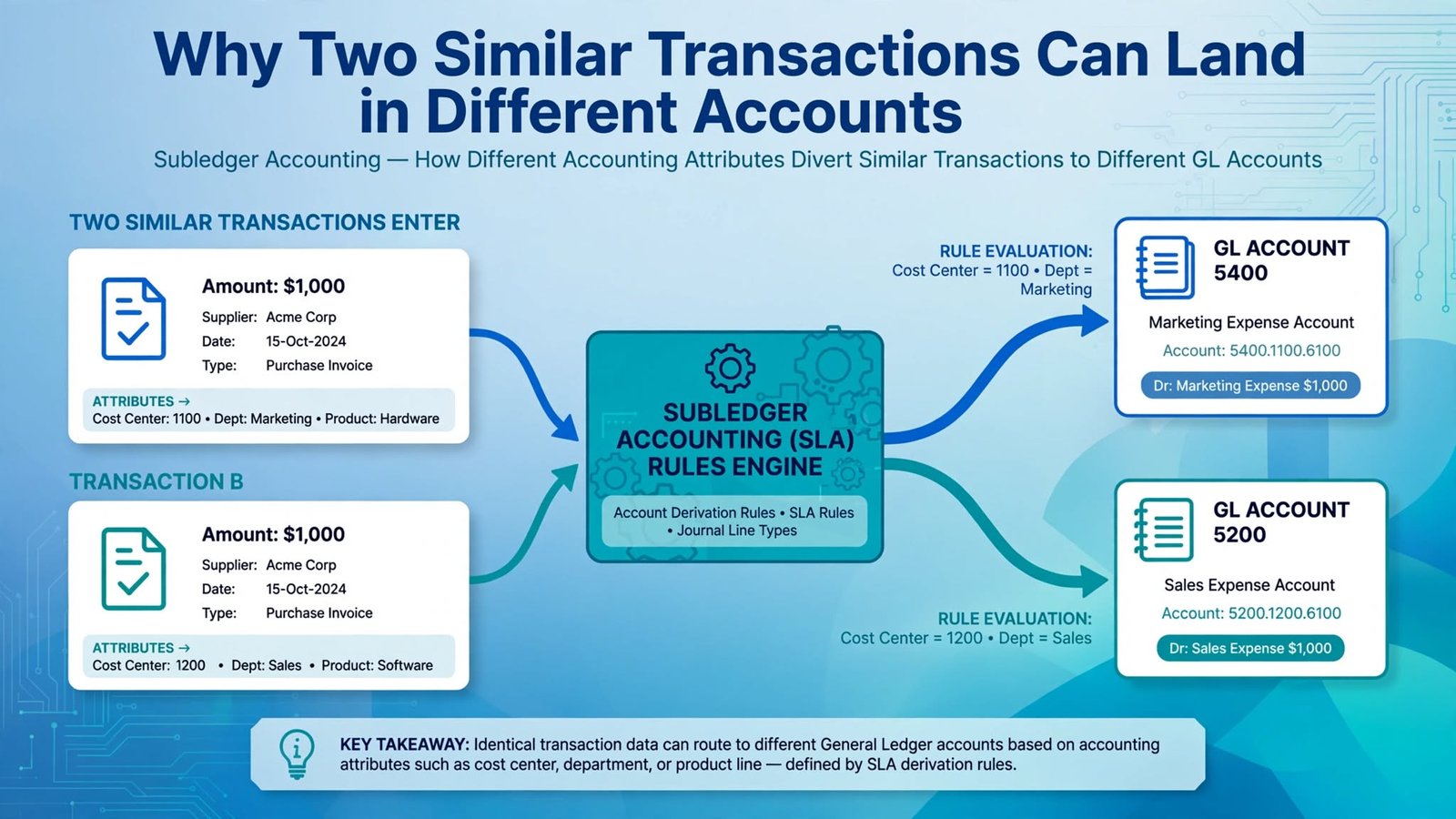
Two transactions can look nearly identical and still post to different accounts. At Soft Online Training, our Oracle Fusion Financials Training in Bangalore shows you why that’s rarely a bug, and how to trace a pair of similar transactions from ledger setup to the final account, so you can separate planned variation from a real setup conflict.
Four questions guide the whole exercise. Which accounting method does the ledger use? Which rule set applies to this event? Which journal line gets created? And how is its account derived? Work through them in that order, and the final account stops feeling like a mystery.
Start at the Top: The Configuration Hierarchy
The ledger sits at the top of the path. Its options point to an accounting method, and that method groups rule-set assignments across subledger applications. Inside one application, an assignment links a Subledger Journal Entry Rule Set to an event class and an event type. When you run Create Accounting, it picks the active assignment that matches the event, and the rule set defines the whole journal entry.
That’s why checking an account rule on its own doesn’t get you far. If the ledger uses a different accounting method, or the event resolves to a different assignment, your carefully checked rule never runs.
Specificity matters too. A rule-set assignment can cover an event class, while a particular event type inside that class gets its own treatment. When you document a problem, capture the application, ledger, accounting method, event class, event type, assignment status, and effective dates. Don’t guess the path from a rule set’s name. The active assignment is what counts. Also remember that related ledgers can produce different results, since each may use an accounting method that reflects its own reporting needs.
Line Creation and Account Derivation Are Two Separate Jobs
Within the chosen rule set, header assignments handle journal header details, and line assignments handle each line. A line assignment can include a journal line rule, an account rule, a line description rule, and supporting references.
The Journal Line Rule decides whether an eligible line gets generated and what type it is, debit or credit. The Account Rule then decides which account that line receives. One answers “does this line exist, and what kind is it?” The other answers “where does it post?”
Oracle’s guidance on Subledger Journal Entry Rule Sets adds some constraints worth knowing. The journal line rule must belong to the same event class as the rule set, and the sources used in account rules must be available to that event class. The rule set and any account rule built for a chart of accounts must also share the same chart of accounts. A copied setup can look selectable and still fail to resolve properly, so check compatibility before you start mapping results. Check the line type as well. A perfectly good account rule attached to the wrong debit or credit line can’t explain what you’re seeing.
What Each Account Rule Actually Returns
This is where many people trip up. An Account Combination Rule returns a complete account combination, drawing on an account source, a constant, a mapping set, or another account rule. A Segment Rule returns just one segment, such as company, cost center, or natural account.
When a line uses both, the segment result overrides the matching segment in the full combination. If none of the segment rule’s conditions are met, that segment can simply stay as the combination rule derived it.
So when you compare two transactions, first find out which type of rule is assigned. With an Account Combination Rule, compare the entire combination each one returns. With a Segment Rule, compare the target segment and find where the other segments come from. A different natural account doesn’t prove two full combinations were mapped. It may just be one segment override sitting on a shared base account. The reverse mistake is just as costly: assuming an override when the rule returns a complete combination can hide changes in company, cost center, or intercompany segments. Label each rule by type in your test notes and record the value it resolved.
A Worked Example With Two Freight Invoices
Picture two invoices in the same business unit, ledger, currency, and period, each with a 600 freight line. Invoice A is classified Capital, and Invoice B is Operating. Both use the same rule set and the same debit Journal Line Rule. Its Account Combination Rule supplies base account 01-410-7990, and a natural-account Segment Rule maps Capital to 1510 and Operating to 6210.
So Invoice A debits 01-410-1510, and Invoice B debits 01-410-6210. Only the natural account changes. It isn’t duplicate rules or random selection, just one path with different source values. A blank or unmapped classification needs its own test for fallback behavior.
Building a Repeatable Test Through Oracle Fusion Financials Training in Bangalore
A good test keeps everything nonessential identical and changes only the one source you care about. For each run, write down:
- Transaction identifiers
- Event class and event type
- Ledger and accounting method
- Active rule-set assignment
- Journal line rule and line type
- Account rule type
- Source value and the matched mapping row
- The final account combination
Run draft accounting where your setup allows it, open the subledger journal lines, and compare the results side by side. Then test an unmapped value and the effective-date boundaries. Those two checks tell you whether the account came from the mapping you expected, a fallback, a copied account, or some other active assignment you didn’t know about. This kind of hands-on lab is what makes Oracle Fusion Financials Training in Bangalore valuable for finance and functional consultants. You learn to prove an outcome with evidence rather than explain it from memory.
Fix the Lowest Component That’s Wrong
When something does turn out to be wrong, resist the urge to patch the top. Correct the smallest piece responsible:
- A wrong source-to-value relationship: fix the mapping row.
- A rule aimed at the wrong segment: fix the Segment Rule.
- The wrong account rule attached to a line: fix the line assignment.
- The wrong rule set serving an event: fix the accounting method assignment.
Then activate whatever setup you changed, as required, and rerun both positive and negative cases. Be careful with replacing an entire rule set to fix one account. It can change every dependent line and event. The hierarchy doubles as an impact map, showing you exactly where to focus regression testing.
Conclusion
Different accounts make sense once you can see the resolution path. The ledger selects an accounting method, and that method supplies the rule-set assignment by application, event class, and event type. Then the rule set assigns the line-level controls. The Journal Line Rule creates the debit or credit line, and the Account Rule derives a combination or one segment.
In our paired invoices, one classification changed only the natural account: capital freight went to construction in progress, and operating freight went to expense. Examples like this, worked through in Oracle Fusion Financials Training in Bangalore, turn an inconsistency into an accounting decision you can reproduce.