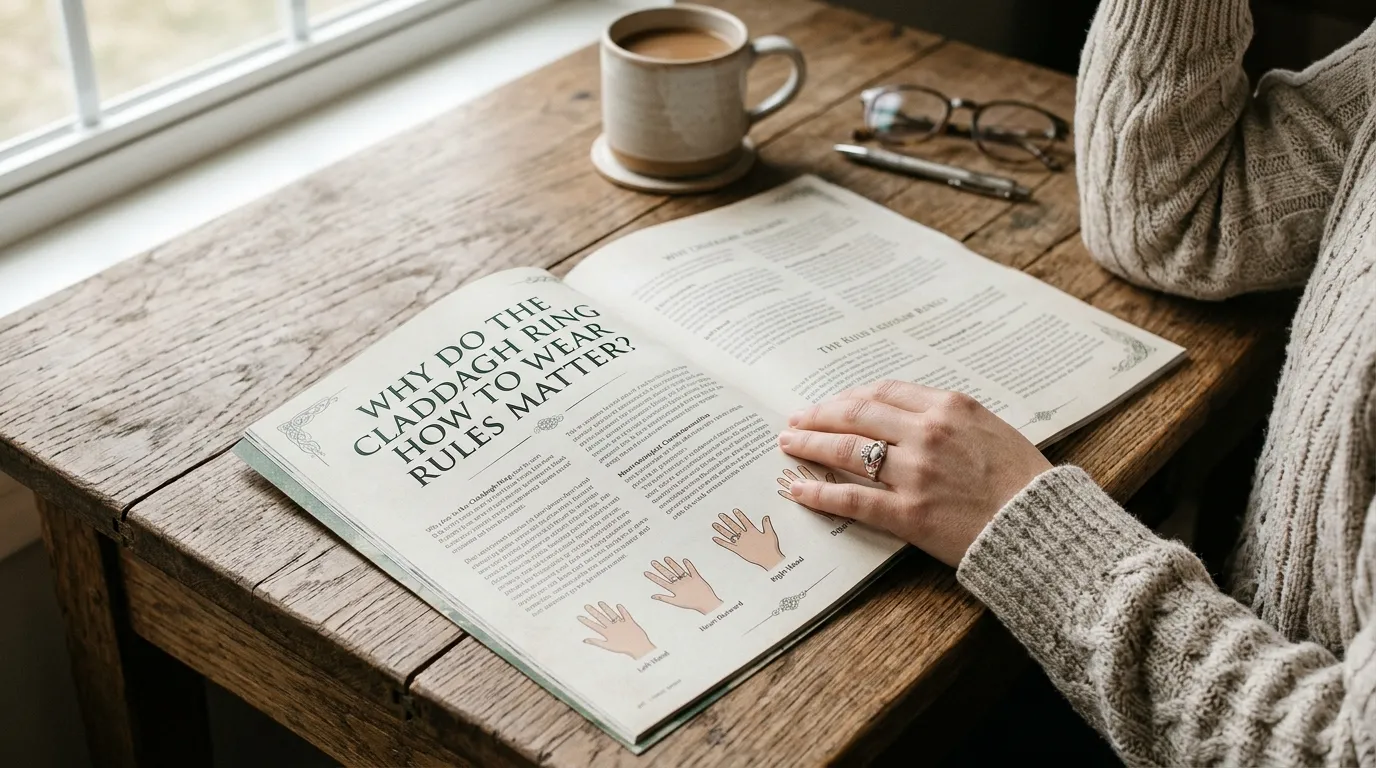
People notice the Claddagh ring. Something about it makes you stop mid-sentence and ask. It is not just the design—though two hands cradling a crowned heart is striking on its own—it is the quiet sense that the ring is saying something. And it is. Knowing the claddagh ring how to wear it rules is not about being pedantic or overly traditional. It is about the fact that the same ring, on the same finger, rotated 180 degrees, tells a completely different story—and in Irish communities around the world, plenty of people know how to read it.
The Three Symbols That Make the Rules Necessary
The design has three parts, and none of them are decoration. Two open hands represent friendship. A heart represents love. A crown on top of the heart represents loyalty. There is an old Irish saying attached to it: “With these hands, I give you my heart and crown it with my love.” Every placement rule attached to this ring grows out of those three things. This is not arbitrary jewelry etiquette. It is a small, portable vocabulary—one that developed over centuries in a fishing village outside Galway and then spread across the world without losing much in translation. When a ring works like language, the rules around how to use it start to make a lot more sense.
What the Claddagh Ring How to Wear System Actually Looks Like
Two variables do all the work: which hand the ring is on, and which direction the point of the heart faces. That combination produces four clear meanings, each tied to a different relationship stage.
Wear it on the right hand with the heart pointing outward toward your fingers, and it signals that you are single. Rotate the heart inward toward your wrist on that same right hand, and it says you are in a relationship. Move to the left hand with the heart pointing outward, and you are engaged. Left hand, heart pointing inward toward the wrist, married. Four positions. Four stages. The whole system takes about thirty seconds to learn and a lifetime to actually use, which is part of what makes it stick.
Why the Heart’s Direction Matters More Than the Hand
Most people assume the hand distinction carries the most weight—left versus right, like a conventional ring. But within each hand, the direction of the heart is what does the real communicating. “Outward” means “open.” Inward means taken. That inward-outward logic maps onto something genuinely human: an open heart faces outward toward the world, a claimed heart turns inward toward the person holding it. Nobody sat down and invented that logic from scratch. It developed the way most good traditions do—gradually, through use, until it felt obvious. That is probably why the system has lasted as long as it has. It is not clever for its own sake. It makes sense.
The Origin Story Behind the Rules
The Claddagh ring is widely credited to Richard Joyce, a man from Galway who, by most accounts, had a rough few years before the ring existed. Shortly before his planned wedding, he was captured by pirates and sold into slavery in Algeria, where he apprenticed under a goldsmith. He got good enough at the craft that his owner did not want to let him go, even after William III secured the release of English subjects from Algerian captivity in 1689. The owner apparently offered Joyce half his goldsmith business and his daughter’s hand in marriage as an incentive to stay. Joyce said no, went back to Galway, found his long-suffering bride-to-be still waiting, and gave her the ring.
That story, true or embellished or some combination, matters because it explains the emotional weight the ring carries. It was not designed as a fashion statement. It came out of years of separation, patience, and a very specific kind of longing. The wearing traditions developed around something people treated as genuinely meaningful, which is why they held it.
Who Can Wear It and What the Rules Mean for Non-Irish Wearers
The Claddagh ring crossed cultural borders a long time ago. It is worn by people with no Irish ancestry who simply respond to what it represents. The wearing traditions travel with it. If you show up in an Irish community with the heart facing inward on your left hand, people familiar with the tradition will read you as married—regardless of your background and regardless of whether that is what you intended. That is not a problem if you know the system going in. It is an awkward situation if you do not. Wearing it with at least a basic understanding of what each position communicates is the most practical approach, not because tradition demands it, but because the ring works better when it means what you want it to mean.
When Personal Meaning Takes Over From Tradition
Plenty of people wear the Claddagh ring in ways that do not map neatly onto the four traditional positions. Someone might wear it as a gift from a parent, a grandmother’s ring passed down through generations, or a reminder of a specific time in their life. Those uses are entirely legitimate. The ring’s history includes mothers passing it to daughters for generations, often with meaning tied to that specific relationship rather than romantic status. What holds across all of these uses is intentionality. Wearing it because it looks nice is fine. Wearing it with some awareness of what it carries is better. And wearing it because it actually means something to you—in whatever way that plays out—is probably what it was always for.
The claddagh ring how to wear it rules exist because the ring itself was built to communicate, not just to sit on a finger. Following those rules is one way of honoring what someone once poured into a small piece of metal in a workshop in Algeria, far from home, thinking about a person he hoped was still waiting. That is a tradition worth understanding, even if you wear it your own way.