Every day, thousands of beginners enter the world of digital marketing and quickly encounter a common challenge: two acronyms that are widely used, yet rarely explained, and that appear almost identical on the page. Learning the SEO and SEM full form is not a vocabulary test you pass and move on from. It is the foundation that everything else in online visibility is built on. If you are starting a small business, transitioning to a new career, or trying to figure out why your website appears on page four of Google, it’s essential to understand these two terms and their interrelationship. Understanding these terms is an important first step in your digital marketing journey. Step into your digital marketing journey.
What Does SEO Stand For?
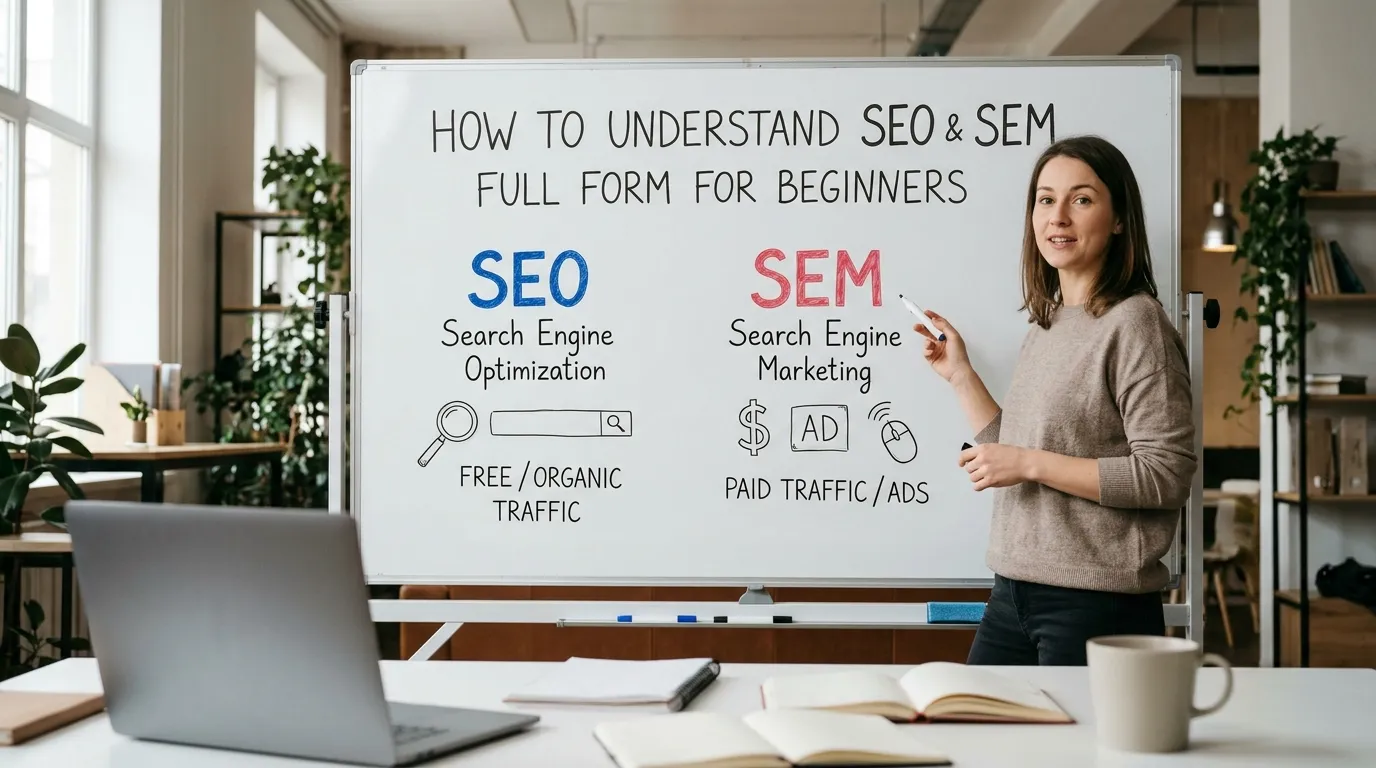
SEO is search engine optimization. It is the work you put into your website so it ranks higher in unpaid search results on Google, Bing, or any other search engine. When someone searches “best running shoes under $100,” Google scans millions of pages in milliseconds and decides which are most useful. SEO is how you make your site one of them.
The work falls into three areas. On-page SEO covers what is on your pages: the words you use, how you structure headings, whether your images have descriptive labels, and whether a first-time visitor can follow the page without confusion. Off-page SEO is about your site’s reputation across the web, mostly through backlinks, which are other sites linking to yours. A link from a respected publication carries more weight than ten from low-quality directories. Technical SEO is the layer underneath: page loading speed, mobile compatibility, and whether search engine bots can crawl your site without running into dead ends.
The appeal of SEO is that you do not pay for each click that finds you. You invest time and effort into content and improvements upfront, but every visitor who arrives through organic search costs nothing directly. The tradeoff is patience. Depending on competition in your field, meaningful rankings can take three to six months to show up. When they do, they tend to hold.
What Does SEM Stand For?
SEM is search engine marketing. Where SEO focuses strictly on organic search, SEM includes both organic efforts and paid advertising in search results. In practice, many marketers use SEM specifically to mean paid search campaigns run through Google Ads, where businesses pay to appear above organic results for specific keywords.
Paid search has been around longer than most people realize. The first pay-per-click ads were created by OpenText Corporation, and the term “search engine marketing” was not formally used until 2001, when journalist and technologist Danny Sullivan introduced it. Since then it has become a standard part of how businesses buy visibility online.
With paid SEM, you bid on the keywords your potential customers type into search. When someone searches that term, your ad can appear at the top of the results page with a small “Sponsored” label. You only pay when someone clicks, which is the pay-per-click model (PPC). You can set a fixed daily budget, control who sees your ads by location and device, and measure exactly what each dollar produces. That level of control is part of why paid search is appealing for campaigns with specific deadlines or revenue targets.
How SEO and SEM Actually Differ
SEO drives organic traffic through website optimization, while SEM encompasses both organic work and paid advertising, with the paid side operating on a PPC model.
One way to picture the difference: SEO is a long investment that pays off slowly and then keeps paying. Paid SEM is renting space in search results. It is there the moment you find it and gone the moment you do not. Neither is better in an absolute sense. They address distinct challenges on varying timelines.
The cost structures differ, too. SEO requires upfront work in content and technical improvements, but clicks from organic results cost nothing per visit. A paid SEM campaign can send traffic within hours of going live, but every click has a price, and in competitive industries that price adds up fast.
Why Beginners Should Learn the SEO and SEM Full Form Together
Most beginners pick one approach and ignore the other. That often results in lost revenue. Businesses using both SEO and paid SEM consistently see more than 25% additional clicks and more than 27% higher profits compared to those relying on a single channel.
The two work well together in a straightforward way. When you launch a new site and need traffic fast for a product launch or seasonal push, paid SEM gets you that traffic immediately. While you simultaneously focus on SEO, you should be creating valuable content, establishing backlinks, and addressing any technical problems. Months later, as organic rankings improve, you can pull back on ad spending because your site starts pulling in visitors without it. The initial paid campaigns buy you time while the slower, more durable organic work catches up.
Knowing both also makes you a more versatile hire. An SEM professional typically has skills in both SEO and PPC. An SEO professional may not. Getting familiar with both sides of the search early gives you a fuller picture of how traffic actually works and more options in a job market that tends to reward people who can do more than one thing.
Practical Steps to Get Started
Starting with SEO does not require a budget. Free tools such as Google Keyword Planner and Ubersuggest assist in identifying the phrases that your audience uses when searching. Write content that answers those questions directly, use clear headings, and check that your pages load quickly on a phone. Those three things alone put you ahead of a large portion of websites competing for the same searches.
For paid SEM, Google Ads has a relatively low barrier to entry. You can set a firm daily spending cap, choose exactly which searches trigger your ads, and pause everything whenever you want. Even a modest amount spent on specific, high-intent keywords teaches you a lot about how your audience phrases what they are looking for, which feeds back directly into your SEO content work.
Bringing It All Together
Most of digital marketing, stripped down, is about two questions: how do you earn visibility in search, and how do you pay for it when you need it faster? Getting a solid grip on the SEO and SEM full form, Search Engine Optimization and Search Engine Marketing, gives you a real framework for making decisions rather than just collecting terminology. Start with one, understand the other, and you will find that the two inform each other more than most introductory guides let on.