
Introduction
Bank reconciliation sits at the heart of every financial close, yet even seasoned finance teams run into lines that simply won’t match, even when the amount and the date appear identical on both sides. Anyone who has gone through Oracle Cloud Financials Online Training with Tech Leads IT knows the textbook version of automatic matching: the system compares a handful of fields, finds agreement, and closes the line. Real transaction data, however, rarely behaves that neatly. A single stubborn exception can ripple outward into a delayed close, an audit finding, or friction with a banking partner. To understand why two data points that look equal on the surface can still fail to reconcile, you have to look past the obvious fields and into the structural, timing-related, and configuration layers that actually govern how a matching engine behaves.
Matching Is Multi-Dimensional, Not Just Amount and Date
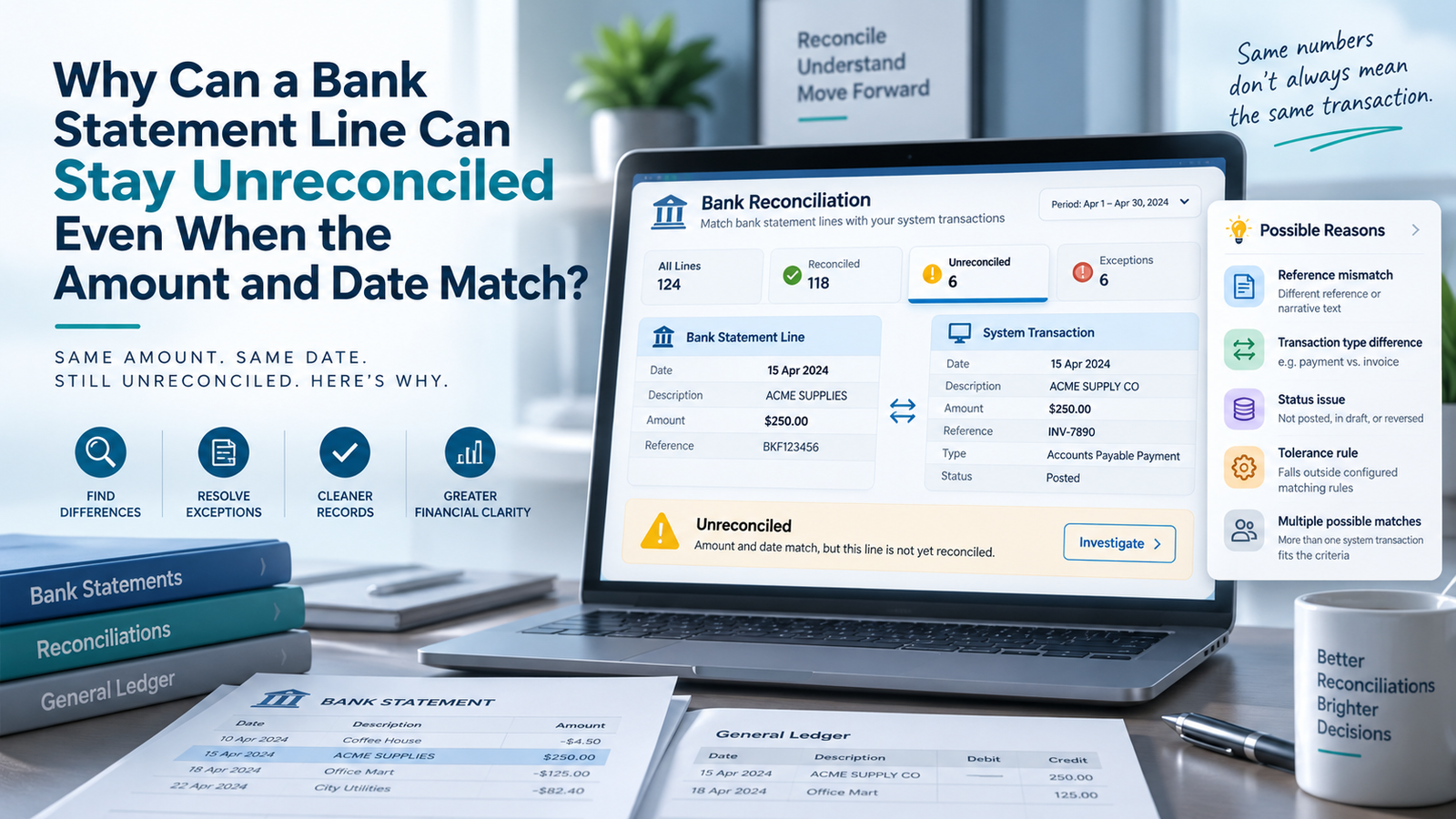
Most reconciliation engines don’t just check the amount and date; they evaluate several dimensions at once, including transaction type, reference numbers, and, increasingly, fuzzy-logic comparisons on free-text description fields. If any single dimension falls outside its allowed tolerance, even a one-character discrepancy in a reference field, the system may deliberately withhold the match. That’s by design: a false positive (an incorrect match that gets accepted) generally causes far more downstream cleanup than a false negative (a correct match that gets flagged for review). The problem is that tolerance settings are frequently left at their default values instead of being tuned to how a specific organization actually transacts. A bank that tacks a unique settlement identifier onto every outbound wire, for example, will consistently break reference-based matching unless someone configures the rule to ignore or strip that suffix. This is exactly the kind of nuance that a structured program like Oracle Cloud Financials Training Online tries to prepare learners for, even though every organization’s bank file quirks are ultimately unique to its own banking relationships.
Timing Differences That Equal Dates Can’t Fix
Even when two dates look the same, timing can still create a mismatch. A payment initiated on the final business day of the month may not clear the bank until the first day of the following month, while the general ledger books it in the prior period. Viewed side by side, the two dates seem fine, the 30th and the 1st but the period boundary sitting between them is enough to trigger an exception. Payment method adds another layer of timing complexity: ACH transactions might take two business days to settle, wire transfers usually clear same-day, and checks can take anywhere from five to seven days. If the reconciliation window is hard-coded to a three-day lookback, wire transfers will match cleanly while checks pile up as unresolved items. In these cases, the engine isn’t malfunctioning; it’s applying one uniform rule across payment instruments that behave very differently from each other.
Bank File Data Quality Problems
A surprising number of unreconciled lines trace back to imperfections in the bank file itself rather than any flaw in the matching logic. Banks sometimes send the same transaction through twice: once as a pending authorization and again as the posted settlement, with matching amounts and value dates but different internal sequence numbers. When the engine encounters two nearly identical lines, it may match the first one and leave the second sitting as an orphan. The reverse problem also happens: a bank might truncate a reference field at forty characters while the ERP system stores up to sixty, quietly cutting off the exact detail that would have distinguished one transaction from another. These aren’t configuration mistakes in the traditional sense; they’re mismatches in the interface contract between the bank and the ERP, and they typically require either preprocessing the incoming file or adjusting the matching rule on the ERP side.
One-to-Many and Many-to-One Matching Scenarios
Matching gets considerably more complicated when a single bank transaction corresponds to multiple ledger entries, or vice versa. Imagine a $10,000 bank deposit that actually represents five separate customer payments of $2,000 each. If the ERP has five open AR invoices of $2,000 sitting open, the system has to decide whether to match the bank line against just one of them (leaving the other four unmatched) or split it across all five. That decision hinges on whether split matching has been enabled, whether a batch identifier is present in the reference field, and whether the tolerance rules permit partial allocation at all. When split matching is turned off, or the batch reference simply isn’t there, the engine is right to leave the line unreconciled even though, from a business user’s point of view, the amount and date look like a perfect match. The structural gap is invisible unless someone knows to look for it.
Currency Conversion and Rounding Quirks
Currency handling introduces yet another layer of complexity, particularly for cross-border payments. When an intermediary bank deducts a handling fee along the way, the amount that lands in the beneficiary’s account can differ from what the originator actually sent, sometimes by only a few dollars or euros. If the ERP is recording the gross amount while the bank statement reflects the net amount after fees, the two won’t line up. Occasionally, a rounding difference elsewhere in the transaction happens to offset the fee almost exactly, so the totals appear to match even though the underlying economics don’t. Some reconciliation engines try to account for this by comparing dedicated net-of-fees fields, but those fields aren’t consistently included in common bank statement formats like BAI2 or MT940, which limits how much automated detection can actually catch.
Investigating the Matching Engine’s Configuration
A sound investigation starts by preserving the evidence on both sides before anyone touches the item or forces a manual match. That means exporting the bank line with its value date, posting date, transaction code, sequence number, currency, reference, and raw description, alongside the candidate ledger entries with their document status, source, accounting date, reconciliation status, and any prior match history. It’s worth confirming the applicable matching rules and tolerance settings against the currently active rule version, rather than relying on what was covered in a training session or on what someone remembers being configured months ago. From there, analysts can rerun the rule in a test or preview environment, changing a single condition at a time to isolate the cause. If removing the reference criterion suddenly surfaces several plausible candidates, the exception is really about ambiguity, not a broken engine. If nothing appears at all, it’s worth checking whether the ledger item was reversed, already cleared, excluded at the account level, or simply posted after the bank extract’s cutoff time. Documenting exactly which criterion failed and what evidence was reviewed gives the rule owner something reproducible to work from, rather than letting a quick manual match paper over the real cause.
Exception Handling as a Workflow, Not a Fire Drill
Whether an unreconciled line becomes a genuine bottleneck or just a routine item in a queue depends heavily on the exception-handling workflow surrounding it. Well-designed systems route unmatched lines to a dedicated worklist, where analysts can apply a manual match, record a write-off, or escalate the item to treasury for a bank file correction. How efficient that process feels comes down to the context available to the analyst: a side-by-side view of the ERP and bank fields, the ability to drill through to source documents, and suggested matches ranked by confidence. Teams that invest time in building out these worklists, adding custom fields for payment method, customer tier, or dispute status, tend to resolve exceptions in minutes instead of hours.
Why Period-End Discipline Matters
Pressure at period-end tends to magnify every one of these friction points. Under a hard close deadline, teams sometimes force matches by loosening tolerances, overriding dates, or posting manual journal entries that hide rather than resolve the underlying issue. Those shortcuts create real technical debt: the next period opens with reconciled balances that look better than they actually are, hidden breaks waiting to resurface, and an audit trail that won’t reconstruct cleanly if anyone asks questions later. A more sustainable approach treats each unreconciled line as useful information, a signal to refine the matching rules, raise a file-format issue with the bank, or revisit the ERP’s cash management setup. The objective isn’t to drive exceptions to zero; it’s to make sure the exceptions that remain are understood, properly categorized, and resolvable within the normal course of business.
Conclusion
Mastering bank reconciliation ultimately means accepting that matching amount and date is necessary, but never sufficient on its own. The configuration decisions, data contracts between systems, and process discipline surrounding the matching engine are what actually determine whether the close runs smoothly or stalls out on exceptions that look solved but aren’t. Whether learned through structured Oracle Cloud Financials Online Training or built up through hands-on experience with a live close cycle, the underlying lesson is the same: treat reconciliation as a living ruleset that gets continuously tuned to real transaction behavior, not a one-time setup exercise. Teams that take this approach, often reinforced by ongoing Oracle Cloud Financials Training Online, spend far less time firefighting exceptions and far more time actually analyzing their cash position.