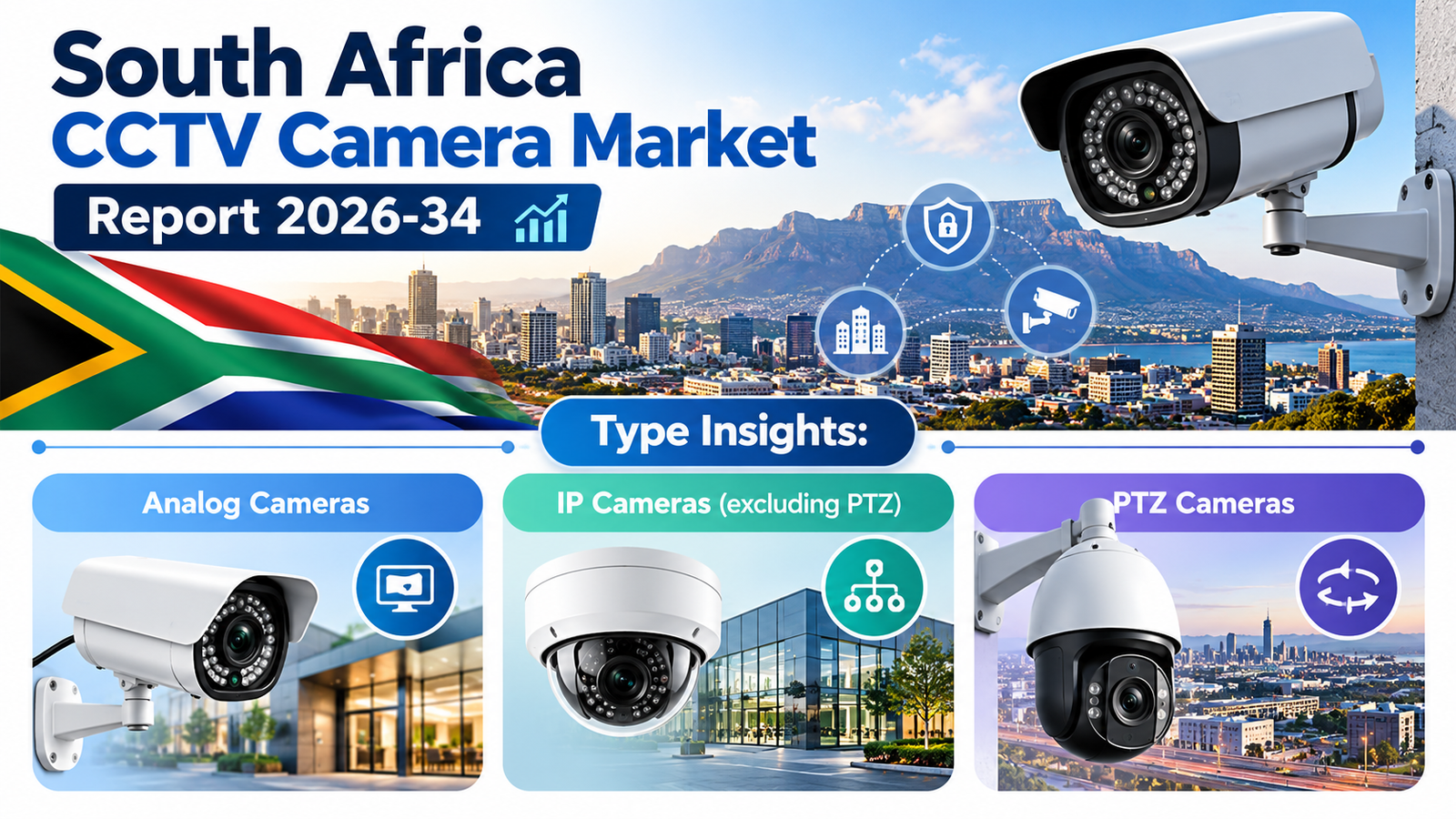
The South Africa CCTV camera market supported by rising security concerns, public sector investment in crime prevention, and the shift toward IP-based and AI-enabled surveillance systems. South Africa CCTV camera market size reached USD 179.9 Million in 2025. Looking forward, the market is projected to reach USD 579.2 Million by 2034, exhibiting a growth rate (CAGR) of 13.46% during 2026-2034. Provincial and municipal programs are a major demand driver. The Gauteng Provincial Government alone has contracted access to 7,271 cameras through Vumacam, and the City of Cape Town has allocated a record R6.8 billion to safety and security, with CCTV, drones, and real-time data systems central to the plan.
How AI is Reshaping the Future of South Africa CCTV Camera Market?
- AI-powered video analytics are turning standard cameras into proactive security tools. Features such as object classification, behavior analytics, and number plate recognition help operators detect suspicious activity in real time and cut false alarms. Cape Town’s network of more than 1,200 cameras detected 3,078 incidents in a single month, leading to 52 arrests, which shows how analytics-led monitoring can translate into policing outcomes.
- AI-based search tools are shortening investigation time. Local solution providers such as Safeza are offering systems that let investigators search archived footage by face, object, or appearance description almost instantly, replacing days of manual review.
- AI-enabled PTZ cameras are strengthening perimeter security for commercial and industrial sites. Axis AI-powered PTZ cameras with 1080p and 4K UHD resolution can track and classify objects automatically, helping retail, banking, transport, and industrial users reduce alarms and respond faster.
- Cloud-connected and mobile-enabled platforms are making large camera estates easier to manage. Users can store, access, and analyze footage remotely, receive alerts on smartphones, and scale systems without heavy on-site hardware, which suits both businesses and homeowners.
- Smart city and safe city programs are linking cameras into centralized control rooms. Johannesburg’s Integrated Intelligence Operations Centre has been equipped with 512 cameras on several separate networks, and AI is increasingly used to index and interpret the video pooled into such hubs.
Grab a sample PDF of this report: https://www.imarcgroup.com/south-africa-cctv-camera-market/requestsample
Market Growth Factors
The South Africa CCTV camera market is driven by persistent concerns over violent crime, robbery, and infrastructure theft, which push government agencies, businesses, and households to invest in visible deterrence and faster evidence gathering. Government spending is a key catalyst. The Gauteng government awarded a R78.63 million contract in February 2024 for access to 6,000 cameras, followed by a further R61.96 million contract from April 2026 for access to 7,271 cameras, while its own provincial network has grown to 960 cameras. In Cape Town, the Metro Police Strategic Surveillance Unit is overseeing nearly R14.4 million of camera and infrastructure installations in the current financial year, and a long-term project is planned for areas with no fibre network.
Technology upgrades are reshaping what buyers expect from surveillance systems. Demand is moving from analog cameras toward IP and PTZ models with higher resolution, wider coverage, and built-in analytics, while cloud storage reduces infrastructure costs and improves access to footage. Wireless and mobile-enabled systems are gaining traction because they avoid extensive cabling, which suits temporary sites, remote locations, and residential users who want to monitor properties from a smartphone. These shifts are expanding the addressable market across retail, banking, transportation, industrial, and residential applications.
Regulation and public accountability are also shaping the market. In February 2025, the City of Johannesburg enacted a by-law requiring CCTV camera registration to support law enforcement and deter crime, while keeping data confidential and respecting privacy rights. The Protection of Personal Information Act also governs how footage of identifiable individuals is stored and used, which encourages demand for secure, encrypted, and well-managed video platforms. At the same time, public scrutiny of costs, camera placement, and uptime is growing. Cape Town has reported that between 90 and 95 percent of its cameras are operational, and partnership models such as Johannesburg’s and Gauteng’s use of private infrastructure are opening new opportunities for solution providers, integrators, and service companies.
Market Segmentation
Type Insights:
- Analog Cameras
- IP Cameras (excluding PTZ)
- PTZ Cameras
End User Vertical Insights:
- Government
- Industrial
- BFSI
- Transportation Vertical
- Others
Regional Insights:
- Gauteng
- KwaZulu-Natal
- Western Cape
- Mpumalanga
- Eastern Cape
- Others
Recent Development & News
- May 2026: Cape Town-based Safeza was reported to be seeking a commercial rollout of AI-enabled CCTV technology adapted to South African conditions such as extreme lighting and high-density environments. Its investigation tool lets users search archived footage by face, object, or appearance description, supporting faster crime resolution.
- April 2026: The Gauteng Provincial Government began a further contract worth R61.96 million for access to 7,271 Vumacam cameras across the Gauteng City Region, alongside a provincial CCTV network that has grown to 960 cameras.
- March 2026: The City of Cape Town reported that its CCTV network has grown to more than 1,200 cameras, with nearly R14.4 million of new cameras and infrastructure being installed. In January alone, the network detected 3,078 incidents and supported 52 arrests.
- July 2025: Duxbury Networking introduced Axis AI-powered PTZ cameras to South Africa, featuring 1080p and 4K UHD resolution, automatic object classification, reduced false alarms, and integration with existing surveillance systems.
- February 2025: The City of Johannesburg enacted a new by-law requiring CCTV camera registration to enhance law enforcement and deter crime, covering various surveillance technologies while safeguarding data confidentiality and privacy rights.
- February 2024: The Gauteng Provincial Government partnered with Vumacam to deploy 6,000 CCTV cameras to strengthen crime-fighting across the province, under a contract worth R78.63 million that also extends to underserved communities.
If you require any specific information that is not covered currently within the scope of the report, we will provide the same as a part of the customization.
About Us
IMARC Group is a global management consulting firm that helps the world’s most ambitious changemakers to create a lasting impact. The company provides a comprehensive suite of market entry and expansion services. IMARC offerings include thorough market assessment, feasibility studies, company incorporation assistance, factory setup support, regulatory approvals and licensing navigation, branding, marketing and sales strategies, competitive landscape and benchmarking analyses, pricing and cost research, and procurement research.
Contact Us
IMARC Group,
134 N 4th St. Brooklyn, NY 11249, USA,
Email: sales@imarcgroup.com,
Tel No: (D) +91 120 433 0800,
United States: +1-201971-6302