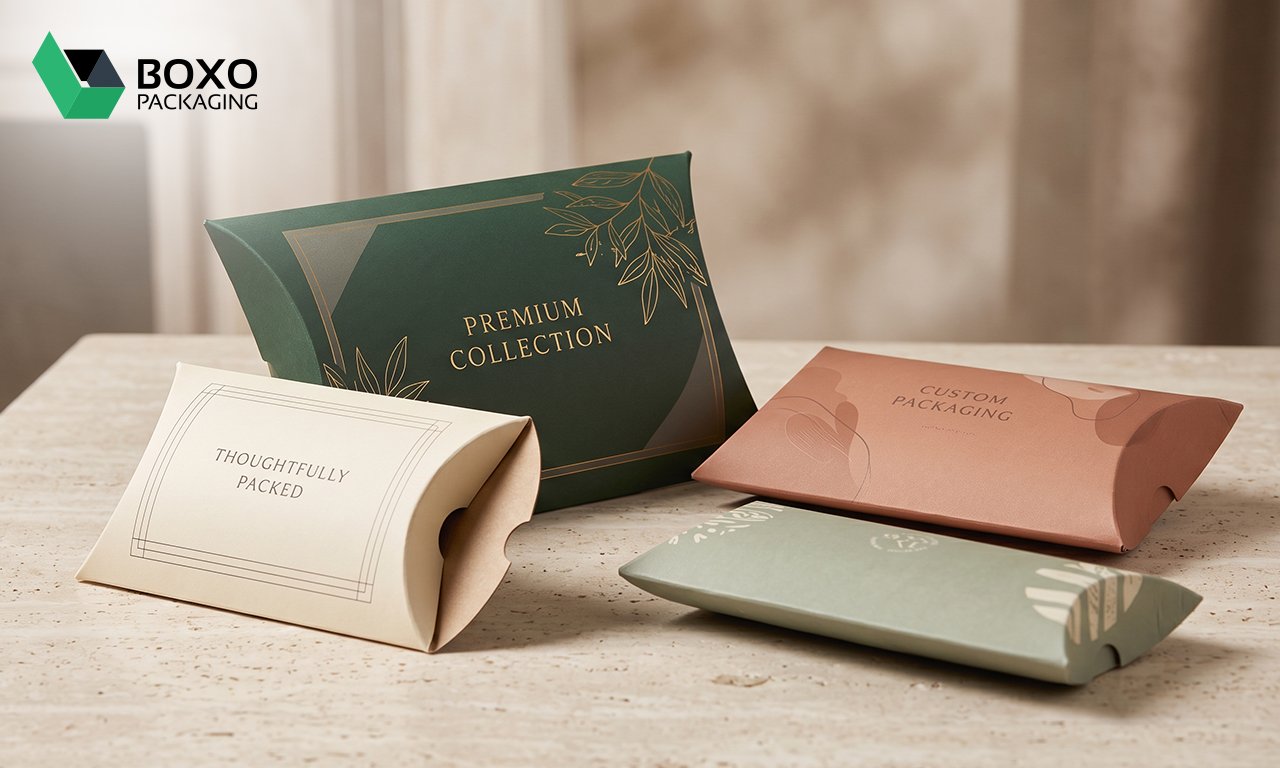
Pillow packaging has a curved top and bottom on either side. It also has a fold-over closure on each end of the package. Pillow packaging is most commonly used for light-weight products including but not limited to, accessories, smaller clothing items, party favors, sample sizes, and smaller gift items. This type of packaging provides an elegant look while maintaining simplicity.
Understand the curved shape
The curved panels create the distinctive look of the package, however, the panels reduce the amount of flat surface that can be used for labeling or other types of large graphic displays. The item being packaged must be placed into the central opening of the package and cannot cause the curved panels to expand outward. When packaging bulky or fragile items, it might be more beneficial to use a rectangular shaped box that has predictable inside dimensions.
Choose board for weight and finish
Lightweight paperboard is acceptable for most small favors, but a heavier weight of paperboard will provide greater support to products that create more pressure on the curved panels. Kraft board gives a subdued, natural appearance; coated white board supports brighter color and detailed illustrations. Coatings and specialty finishes should be tested on the selected board, especially near the curved folds where cracking may be visible.
Design the opening for easy access
Pillow cartons often use tuck-in end flaps or folded tabs. The closure should stay shut during ordinary handling but remain easy for the recipient to open. If the contents are delicate, use a paper wrap or small insert to stop movement. A pillow carton is generally a presentation pack, not a protective shipper for fragile items sent through parcel networks.
Useful details for small packs
A few choices can make the format more functional:
- A paper belly band when a short message or product name needs a separate panel.
- A small insert for jewelry, pins, or other pieces that could shift.
- A hang hole only when the package will be displayed on a suitable hook.
- A recyclable paperboard grade that still provides enough stiffness for the item.
Applications beyond gift favors
Pillow cartons can package socks, fabric accessories, lightweight stationery, promotional samples, handmade soaps, or small event keepsakes. The format is less suited to heavy glass products or items that need a precise rectangular cavity. If the contents are scented or oily, verify that the board and any inner wrap are suitable for the intended contact.
Check storage and assembly
Because the cartons typically ship flat, they can be stored efficiently before an event or product launch. Boxo Packaging can advise on board and print options for a proposed run. Before ordering a large quantity, assemble a sample and confirm the ends fold cleanly, the contents slide in without damage, and the finished carton fits the display tray or mailer. Test the printed artwork on the curved surface rather than judging it only on a flat proof.
Tuck Boxes for Organized Small-Product Packaging
Tuck cartons use folding end flaps that insert into the body of the box, creating a compact enclosure for lightweight retail products. Tuck Boxes are common for cosmetics, soap, small accessories, stationery, sample packs, and other goods that need printed panels but do not require a rigid box.
Select a closure style that fits the product
Straight-tuck cartons close at both ends in the same direction, while reverse-tuck cartons use opposing flap directions. The choice affects the dieline, panel layout, and assembly sequence. A lock-bottom construction may suit a heavier product better than a basic tuck base. Measure the product with any wrap or insert instead of choosing dimensions from the outer product alone.
Board and printing considerations
Coated white paperboard supports fine text and full-color graphics, while kraft board can suit a restrained or natural look. Leave enough space around creases and glue seams so product names and instructions remain visible after folding. Matte coating, gloss, foil, or embossing can be used selectively, but each finish should be compatible with the board and the intended handling.
Add-ons should solve a clear problem
A window can reveal the product, an insert can prevent movement, and a hang tab can support peg displays. Each addition affects the dieline and may change the cost or strength of the carton. Avoid adding a window to a product that needs protection from light, dust, or exposure. The finished package should support both shelf presentation and safe handling.
Common options to compare
The product and sales channel should guide the specification:
- A fitted paperboard insert for bottles, devices, or delicate accessories.
- A hang tab for products sold on pegboard displays.
- A window cutout when visual inspection is part of the buying decision.
- An auto-lock or reinforced base when assembly speed or support matters.
Know when a tuck carton needs an outer pack
Retail cartons can look tidy on a shelf but may not withstand parcel sorting or compression on their own. Products sent directly to customers should normally be protected by a suitable mailer or corrugated shipper. If the item is fragile, test the complete packed system rather than relying on the carton alone.
Review the dieline before printing
The flat dieline shows the panel order, flap locations, glue areas, and folds that a 3D mock-up can hide. Check barcode contrast, legal or care text, and the position of product details. Assemble a printed sample to confirm that the flaps close securely and the product can be removed without tearing the carton.