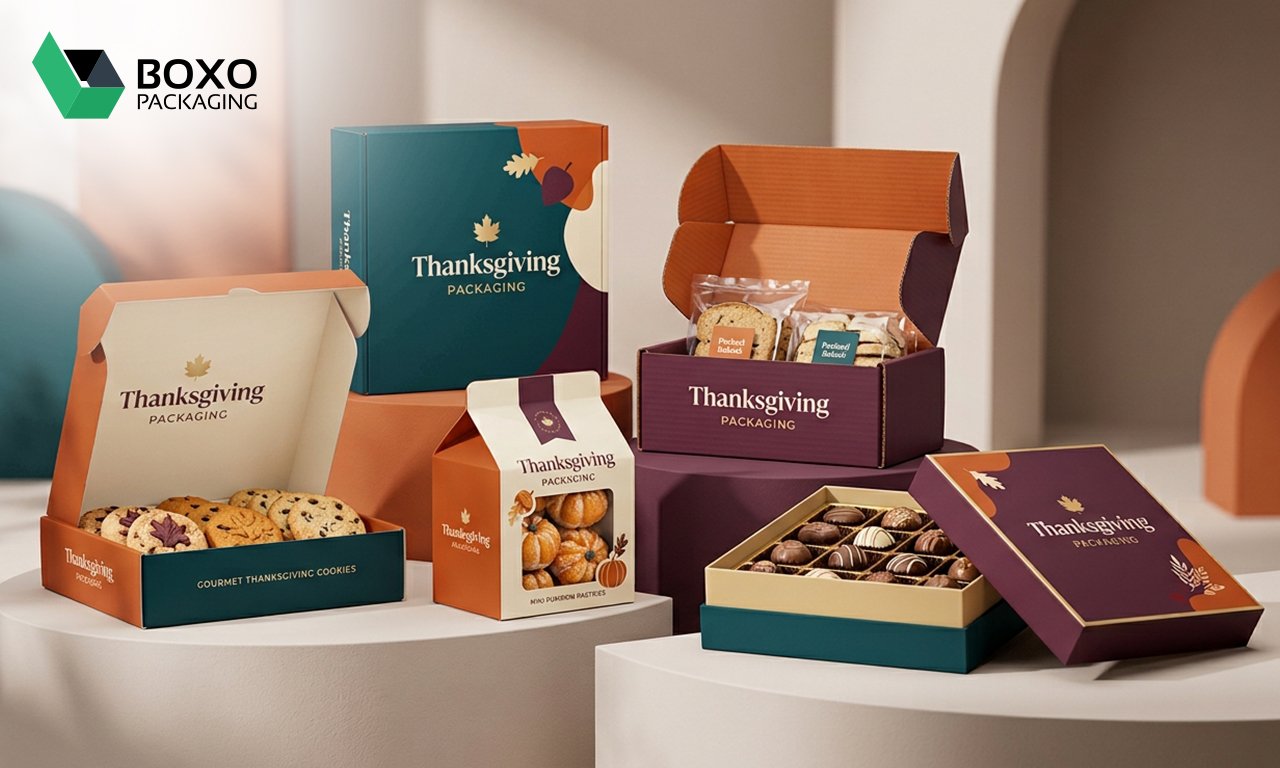
Not every harvest SKU wants the same cavity. A whole pie needs a square with sidewall height above the crimp and a lid or tuck that does not sit on the pastry. Dinner rolls want ventilation more than a tight seal. A dry stuffing mix wants a liner and a carton that does not pick up kitchen humidity. Custom Thanksgiving Boxes should be drawn per food type, then grouped onto as few dielines as the line can stand. One holiday carton for pie, bottles, and cookies produces crushed pastry or a rattling bottle.
Gravy and other wet condiments do not belong in an unlined paperboard cavity. Put them in a jar or a food pail and, if they must sit in the gift set, give them their own cell.
Warm kitchens and cold porches both show up in the same week. Board that leaves the plant dry can pick up steam at the table and then sit in a car. Clay coat that was never varnished fingerprints and then scuffs.
Grease, Steam, and Window Film on Holiday Cartons
Butter, meat drippings, and sugary glaze migrate. A window that looks generous on a drawing fogs from steam and then spots from grease. If the product must be seen, keep the film off the food and specify a grease-resistant board or an inner tray. If the product does not need to be seen, skip the window and print the pie.
Lid-and-base bakery cartons vent better than a fully glued tuck when the food is still warm. A closed tuck on a hot pie collapses the top. Let the pack cool, or choose a structure that can breathe.
Foils and heavy harvest graphics look rich on a photo and crack on cheap recycled board at the folds. Match finish to caliper. A one-colour kraft face with a small printed band often survives the season with fewer scuffs than a full-bleed autumn scene.
Print Windows on a Harvest Calendar
Retail wants cartons on shelf in October. That means dielines frozen in summer and print queued behind other seasonal work. Late art changes hit the handle cut, the window patch, or the tuck flap, not just the leaves on the front.
Short runs belong on digital if the dieline is already cut. New structure does not. Cutting a pie-depth carton from a cookie-depth die to save time is how corners go empty and lids sit on icing.
Formats that usually sit around a harvest food set:
- Windowed pie boxes with sidewall height above the crust
- Paperboard food pails for wet sides that would stain a gift carton
- Kraft gift boxes with a separate lid for dry mixes and bottled items
- Sleeve boxes that change a harvest face without a new inner tray
A converter can hold generic pie geometry and swap only the printed sleeve. That is often the only way a late graphic still ships on time.
Boxo Packaging jobs in this window tend to freeze food depth first and artwork second, because a reprint of ink is cheaper than a second die.
Why Custom Tuck Boxes Return After the Holiday
The Tuesday after the holiday, grocery still has stock. Staff need a carton they can open, count, and close without tape. A reverse or straight tuck survives restocking. A glued gable or a sealed bakery lid does not. Custom Tuck Boxes keep that restock path open when the endcap comes down.
The same SKU may move from an endcap in November to a clearance shelf in December. A squared face still planograms. A peaked handle wastes peg space and looks like last month’s event.
Leftover dry goods (mixes, crackers, tea) never needed a pie cavity. Using the harvest pie dieline for those SKUs wastes board and looks oversized on the shelf.
Board Caliper for Pie and Dry Goods
Pie is heavy and round. Dry mix is light and rectangular. Caliper that holds a pie is overbuilt for tea sachets. If the brand insists on one board for the whole harvest line, the light SKUs will look bulky and the pie SKUs will still need a tray.
On the line, crease memory has to survive storage. Board that sat in a humid trailer all October will bounce. That is a warehouse problem that shows up as a packing-room complaint. Custom Tuck Boxes stored dry erect the way the dieline promised.
Closing copy can be plain: which flap to pull, whether the pack is recyclable as paperboard, and the allergen line the food already requires. The tuck is a closure. It is not a cooking method.
Restock-friendly details that belong on a leftover grocery carton:
- Reverse-tuck faces that still planogram after the holiday art comes off a sleeve
- Dust flaps long enough to hold crumbs when a shopper opens the pack in the aisle
- Unvarnished date patches so inkjet lot codes do not smear on clay coat
- Shared caliper across dry-good SKUs so changeover time stays short on the erector
Reverse Tuck Faces on a Grocery Endcap
Reverse tuck hides the glue seam on a side and leaves one clean billboard. That billboard is where the holiday art earns its keep for six weeks and then has to live as a generic food carton if you planned the copy that way. Seasonal art that covers every panel, including the tuck, dates the leftover stock.
Straight tuck matches both ends, which helps if the pack may sit either way in a bin. Most grocery endcaps still want one dedicated face.
Dust flaps are not optional on a food carton that will be opened in the aisle. Short flaps save board and then spill crumbs.