The growing demand for convenient meat products has created opportunities for food manufacturers and entrepreneurs interested in Packaged doner production. Restaurants, wholesalers, supermarkets, and food distributors increasingly look for consistent products that are easy to store, transport, and prepare. Establishing a successful packaged doner operation requires more than production machinery. It involves careful project development, factory layout planning, suitable equipment selection, food safety procedures, packaging solutions, and trained staff. With the right consultancy and production strategy, businesses can develop a facility designed around their target market and manufacturing goals.
Understanding Packaged Doner Production
Packaged doner products can be developed in different formats depending on customer requirements and the intended market. These may include raw doner cones, cooked and sliced doner meat, chilled portions, frozen products, or ready-to-heat packaged options.
Each format requires a suitable manufacturing process. For example, raw doner products need appropriate preparation, forming, packaging, and temperature-controlled storage. Cooked and sliced products require additional cooking, portioning, cooling, and packaging stages designed to maintain product safety and quality.
Before investing in a production facility, manufacturers should identify which products they want to supply and understand the expectations of their customers.
Planning a Packaged Doner Production Facility
A well-planned factory supports an organised workflow, efficient use of space, and consistent production. Project development should begin with a clear understanding of the business model and expected output.
1. Define Your Product Range
The first step is deciding what type of doner products the factory will manufacture. Consider the meat varieties, product sizes, seasoning profiles, packaging formats, and customer requirements.
A business supplying restaurants may focus on bulk packs, while a retail-focused manufacturer may need smaller consumer packages with detailed labelling. Defining these requirements early helps determine the equipment and production processes needed.
2. Develop the Factory Layout
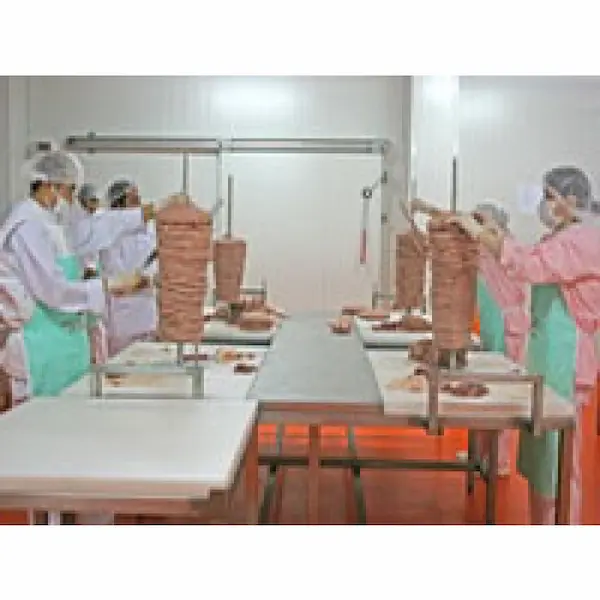
Factory layout planning should support a logical movement of ingredients and finished products. A typical production facility may include:
- Raw material receiving and inspection
- Chilled and frozen ingredient storage
- Meat preparation and trimming
- Mixing and marination
- Doner forming and shaping
- Cooking, if producing cooked products
- Slicing and portioning
- Packaging and labelling
- Finished product storage and dispatch
The layout should also consider staff movement, cleaning access, drainage, ventilation, utilities, and separation between raw and cooked processing areas.
3. Select Suitable Machinery
Machinery should match the intended product range and production capacity. Depending on the process, equipment may include meat preparation machines, mixers, marination systems, doner forming equipment, cooking systems, slicing machines, weighing equipment, and packaging machinery.
When evaluating equipment, consider production capacity, hygiene design, cleaning requirements, maintenance, operator training, and compatibility with the factory layout.
Choosing machinery based only on price can create operational challenges. Equipment selection should be based on the complete production process and the manufacturer’s long-term requirements.
Packaging, Storage and Product Quality
Packaging plays an important role in protecting doner products during storage and distribution. The appropriate packaging format depends on whether the product is raw, cooked, chilled, or frozen.
Manufacturers should evaluate packaging materials based on food contact suitability, sealing performance, storage conditions, transport requirements, and applicable labelling regulations. Vacuum or modified-atmosphere packaging may be considered where suitable and supported by a validated process.
Storage conditions must also be established for each product. Temperature control, shelf-life validation, batch identification, and traceability procedures are important parts of a responsible manufacturing operation. Shelf-life claims should be supported by appropriate testing rather than assumptions.
Food Safety and Production Standards
Meat processing requires a structured food safety management system. Every stage, from receiving ingredients to dispatching packaged products, should have defined hygiene and quality controls.
Important considerations include:
- Supplier approval and raw material inspection
- Personal hygiene and staff training
- Temperature monitoring and record keeping
- Prevention of cross-contamination
- Cleaning and sanitation procedures
- Allergen identification and control
- Batch coding and product traceability
- Packaging and label verification
Factories must follow the relevant food safety and manufacturing regulations in their operating country. Professional food safety advice can help establish suitable procedures and documentation.
Why Professional Doner Factory Consultancy Matters
Developing a packaged doner manufacturing project involves several interconnected decisions. Factory design, equipment selection, production capacity, workflow, staffing, and packaging must work together.
Professional consultancy can help businesses approach these decisions in a structured way. Services may include project development, production planning, factory layout design, machinery recommendations, and guidance on establishing efficient manufacturing processes.
Chef and staff training is equally important. Employees need to understand product preparation, machinery operation, hygiene procedures, quality standards, and the production workflow. Practical training can help teams work consistently and understand their responsibilities.
Develop Your Doner Production Project with Experienced Consultants
Starting or expanding a packaged doner operation requires practical knowledge and careful planning. From the first project concept to factory layout, equipment selection, and staff training, experienced guidance can help businesses make informed decisions.
With consultancy experience across more than 50 factory setup projects, we provide doner kebab factory consultancy, project development, layout planning, and chef and staff training. Whether you are planning a new manufacturing facility or improving an existing operation, contact us today to discuss your project requirements and develop a production plan suited to your business goals.