
Introduction
An invoice on hold is never just one kind of problem. At Tech Leads IT, we see that a hold can come from a validation failure, a business decision, missing evidence, or a control built to stop the transaction. Anyone who goes through Oracle Fusion Financials Course learns that diagnosis must come before any release action.
Some holds can be released manually by an authorized person, while others stay until the cause is fixed and validation runs again. Whether you study through Oracle Fusion Financials Training or an Oracle Fusion Financials Online Training, the lesson is the same. The wrong response affects more than queue speed, because a hold blocks payment and, depending on its type, can block accounting too.
Why Holds Call for Diagnosis First in Oracle Fusion Financials Training
Every hold should be examined with three questions. What caused it? What does it block? Which release path keeps the intended control intact? Teams that use Oracle Fusion Financials Training as a process reference can build their whole triage routine around these questions, and doing so keeps analysts from treating every obstacle as a request for manual release.
Consider a close-week invoice that sits on an urgent-pay list but still carries a hold. The pressure to clear it is real. A shipment may depend on payment, a discount may be about to expire, or the supplier may be escalating. None of that tells you why the invoice is held. It may have failed a matching condition, be waiting for review, contain invalid data, or have been deliberately stopped by someone.
So the analyst should capture a snapshot before touching anything:
- The invoice number
- The hold name and reason
- Who or what applied the hold, and when
- The current validation status
- The current approval status
This snapshot gives the eventual decision maker enough context to tell remediation apart from override.
Automatic and Manual Holds Tell Different Stories
Both kinds of hold need interpretation, but they point in different directions. An automatic hold comes from a rule or a validation result. The analyst should follow it back to the underlying transaction data and the configuration that triggered it. A manual hold often carries information from outside the invoice, such as a dispute or a request from another business function. It should be traceable to an owner and a reason, not an unexplained label.
In both cases, the hold record is a symptom as well as a control state. Releasing it without understanding the cause can hide a recurring data defect, bypass a required review, or let the same condition return at the next validation cycle. An analyst who clears holds quickly but never asks why they appeared is moving the queue and leaving the problem behind.
Separate Correction From Authorization
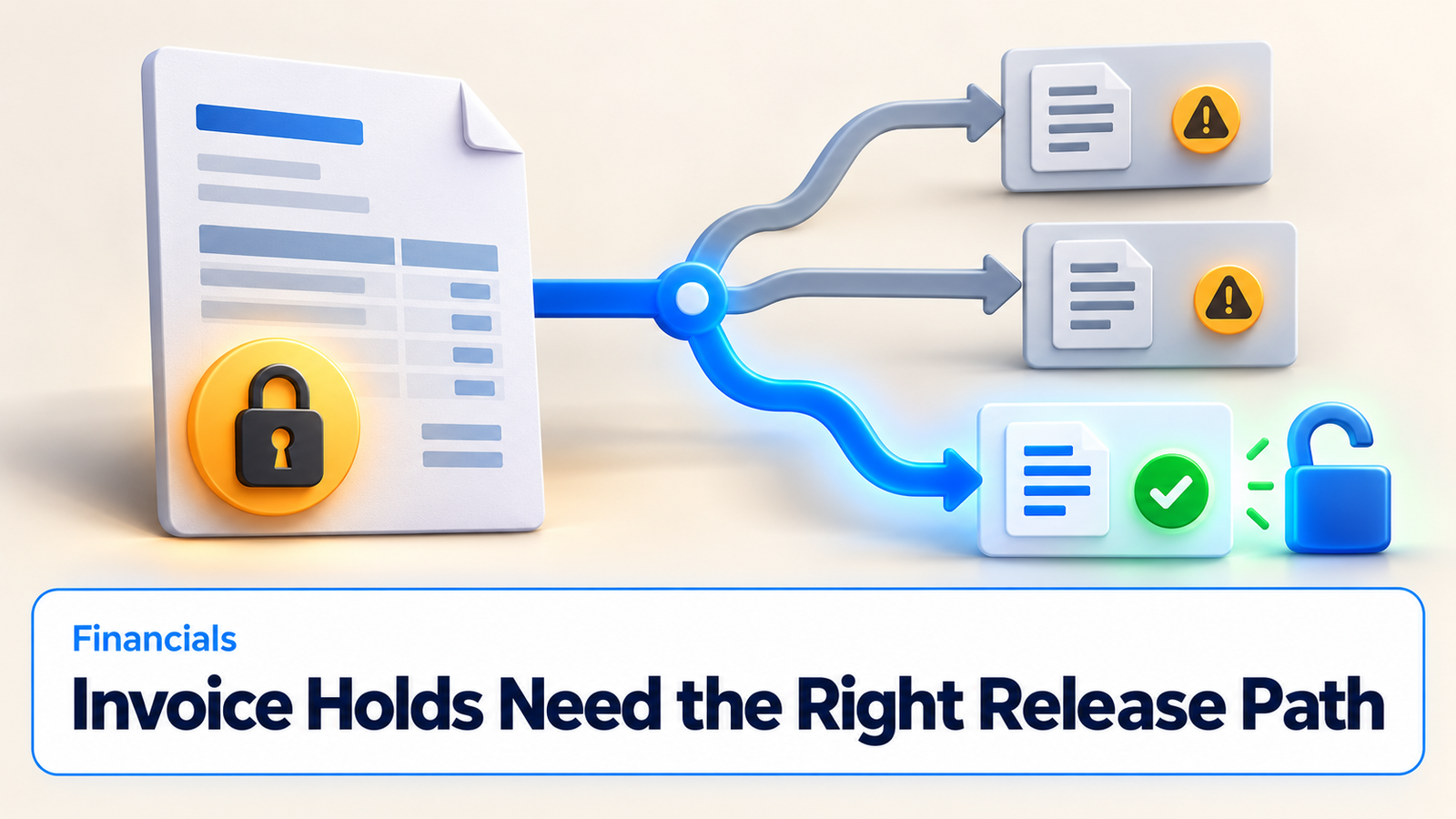
The first branch in a useful triage model asks whether the hold may be released or whether the underlying condition must be corrected. If correction is needed, the work belongs to someone who can repair the condition. That might be an issue in invoice entry, the purchase order, the receipt, supplier data, accounting information, or another input. After the fix, validation is often the mechanism that reevaluates the invoice and removes the hold once its requirements are met.
A releasable hold still demands reasoned authorization. The fact that a page shows a release control does not mean policy allows its use in a given situation. System capability and business authority are two separate questions, and both need an answer before anyone acts.
Oracle’s 26C guidance on how invoice holds work draws this line clearly. It separates holds that users can release from holds whose underlying condition must be corrected. It also describes several ways hold processing can happen: invoice pages, dashboard work, validation, workflow, and REST services. These routes are not interchangeable shortcuts. They are different execution paths that should all satisfy the same policy and evidence requirements. A release made through an integration deserves the same scrutiny as one made on screen.
For each route, teams should document:
- Which hold types the route can address
- Which role is authorized to act
- What reason or comment is mandatory
- How the result is verified afterward
Building Skills Through an Oracle Fusion Financials Online Training Lens
Professionals who learn Payables through Oracle Fusion Financials Online Training often meet holds as a configuration topic first. In daily operations, though, the more useful view is behavioral. A hold is a decision point where the system asks a person or a process to prove that the invoice is fit to proceed. Learning to read that decision point, instead of memorizing where the release button sits, is what separates a confident Payables practitioner from someone who clicks through screens.
That view also helps with the pressure of urgent payments. When an escalation arrives, the practitioner who understands the control purpose can respond with precision. They can explain what the hold is protecting, name who can resolve the cause, and say how quickly the work can realistically finish. That is a better answer for the supplier and for the auditor than a quiet manual override.
Route Work to the Owner of the Cause
A central Payables queue gives visibility, but the person who can resolve a hold often sits somewhere else:
- A buyer can address a purchase order issue.
- A receiving team can investigate receipt evidence.
- A requester can confirm business acceptance.
- A tax or accounting specialist can assess coding.
Assigning every hold to invoice processors encourages workarounds. Those processors are measured on throughput, yet they may have no authority over the cause.
A better design is a routing table by hold category. Each row should name a primary resolver, a backup, a target resolution time, an escalation point, and the evidence that proves completion. Keep financial impact, payment urgency, and accounting blockage as separate priority indicators. A low-value invoice can expose a systemic defect, while a high-value invoice does not automatically justify bypassing a control.
Privileges Shape the Routing Model
Privileges belong inside the routing design from the start. A user may be able to investigate but not correct, correct but not release, or release only within a defined area of responsibility. Granting broad access to eliminate handoffs weakens segregation of duties. Assigning work to someone who lacks the necessary access creates ceremonial ownership and delay. Neither extreme works.
Review privileges alongside hold procedures, and test them with real job roles rather than administrator accounts. An administrator account will make almost any process look smooth.
Automated and REST-based handling needs the same discipline. Govern the integration identity, the permitted operations, input validation, and error responses. Service access should never become an opaque path around controls that are visible in the user interface. When a technical account performs the system action, record who made the business decision behind it, so the trail leads back to a person with authority.
Prove the Invoice Is Ready With an Oracle Fusion Financials Course Checklist
A successful click or a clean response does not prove the invoice can proceed. After a correction or release, confirm the resulting hold status and rerun or inspect the relevant validation outcome. Check whether other holds remain, and whether payment or accounting eligibility changed as expected. An invoice can carry several independent constraints, so clearing one does not make the whole transaction ready.
The same decision trail works well as a practical checklist during an Oracle Fusion Financials Course. It connects each system action to its control purpose, which is how learners move from knowing the screens to understanding the reasoning behind them.
The evidence package should link these elements:
- The original cause
- The corrective or authorizing action
- The actor
- The time
- The stated reason
- The final status
If payment is exceptionally urgent, keep the expedited approval and the post-action verification. Urgency should never replace documentation. A complete package lets reviewers understand what happened without reconstructing chat messages or asking people to remember details weeks later.
Report on Holds in a Way That Drives Better Decisions
Operational reporting should distinguish between holds that were applied, corrected, manually released, repeatedly reapplied, and still aging. A single total encourages the wrong response because it lumps valid control activity together with preventable defects. A falling count looks like progress, but it may simply mean that more holds are being released without proper review.
Look for clusters across several dimensions:
- Supplier
- Business unit
- Hold type
- Entry source
- Requester
- Resolution route
Repeated correction may point to poor source data or unclear procedures. Repeated manual release may mean that a threshold or policy needs review, but it can also expose habitual override. Examine samples before changing any configuration, because the same number can have very different causes. The goal is not zero holds. The goal is timely resolution through the proper path, with automatic checks continuing to stop invoices whenever their conditions are genuinely unmet.
Conclusion
Invoice holds are control states, so every resolution needs diagnosis, ownership, and evidence. Start by identifying the hold, its origin, and whether it blocks payment, accounting, or both. Then decide whether policy and system behavior require correction of the underlying condition or allow an authorized manual release. Oracle Fusion Financials Online Training helps professionals build this habit, so they treat each hold as a decision point rather than a button to click.
Route the cause to a resolver with the right privileges, and govern page-based, validation, workflow, and service-based actions by the same standards. Verify the invoice afterward, because another hold may remain. Whether learners choose Oracle Fusion Financials Training, the goal is the same: trend the causes and release patterns instead of celebrating a shrinking queue. The right release path resolves the actual condition without erasing the reason the control stopped the invoice.