
Introduction
A bank statement line can resemble several system transactions without being safe to reconcile to any of them. At Tech Leads IT, we find that a matching date, an equal amount, or a familiar reference is helpful evidence, yet none proves intent in every payment channel. That is why Oracle Cloud Financials Online Training stresses an ordered search strategy over loose, plausible rules.
Precise conditions should clear the obvious cases first, leaving cautious rules for vague data. A broad rule run too early can swallow transactions a sharper rule would have caught, leaving a messy audit trail. Learners in Oracle Cloud Financials Training Online can practice ranking competing matches before writing any condition.
Start With the Population: Oracle Cloud Financials Online Training for Rule Designers
Before choosing any criteria, describe the bank activity in operational terms. Payroll disbursements, supplier payments, customer receipts, bank fees, transfers, and manual journals do not share the same identifiers or grouping patterns. Document which transaction sources are expected for each bank account, which statement codes can be trusted, how the bank transforms references, and where timing differences normally appear. This profile defines the population a rule is allowed to consider. It also stops a rule built for one channel from being copied to an account with different data.
Rules belong to rule sets, and rule sets are assigned to bank accounts, so account scope is part of the control. A condition can be logically sound and still wrong for an account with thinner statement data or more varied sources. Keep an inventory that lists each account, its rule set, its expected sources, its significant statement identifiers, and the team that owns exceptions. Review it after bank-format changes, acquisitions, payment-factory changes, or new transaction sources.
A rule-set name rarely explains its purpose, so add short design notes. They should state the population covered, why each criterion is trusted, and which circumstances should stay unmatched. Practitioners working through Oracle Cloud Financials Online Training can use this exercise to see why ranking competing matches comes before writing conditions.
Matching Types Change the Question Being Asked
The available matching types describe different relationships: one statement line to one transaction, one line to many transactions, many lines to one transaction, many lines to many transactions, and zero-amount transactions that never appear on a statement. Choosing a type is not a cosmetic setup step. It decides whether records must be grouped and what the rule is trying to prove.
A one-to-one rule asks whether two individual records correspond. A one-to-many rule asks whether a collection of system transactions belongs together and explains a single bank line. Many-to-one reverses the grouping need, and many-to-many requires coherent groups on both sides. Start from the business event, then pick the type that represents it faithfully.
Grouping Attributes in Oracle Cloud Financials Training Online
Grouping attributes set the boundaries of those collections. In grouped matching, agreement on amount is not enough if transactions from unrelated batches, dates, references, or sources can be combined. The attributes should express why records belong together before any matching criteria compare the resulting groups.
Some criteria, including date, transaction type, and reconciliation reference, depend on corresponding grouping choices in the relevant grouped scenarios. That dependency deserves explicit testing, not trial-and-error configuration. Learners following Oracle Cloud Financials Training Online can build test samples full of tempting false combinations:
- Equal totals across two payment files
- Repeated references
- Split bank postings
- Partial batches
- Transactions that cross a date boundary
A grouping design is credible only when it rejects the wrong combinations as reliably as it accepts the intended one.
Treat Multiple Sources as a Deliberate Pool
The Oracle 26C Reconciliation Matching Rules guidance describes an important source behavior. With multiple sources in one-to-one or many-to-one matching, the process looks across the selected sources for a matching transaction. With one-to-many or many-to-many matching, the available transactions from those sources form a data pool before grouping is applied. A resulting group can therefore contain transactions from different sources unless Transaction Source is included as a grouping attribute.
Neither outcome is automatically wrong. A genuine settlement may combine sources, while another process may need source-homogeneous groups for ownership or audit reasons. Record the decision and test it. It should never be an accidental side effect of ticking several source check boxes.
This choice also shapes exception analysis. If cross-source grouping is allowed, reviewers need enough information to understand why a combination is legitimate. If it is prohibited, separate rules or a source grouping attribute can preserve the boundary. Avoid widening the source pool just to raise the automatic match percentage, because that figure does not show whether the selected records form a sensible accounting event.
Watch for reversals, manual unreconciliations, repeated near-matches, and cases where analysts must rebuild mixed groups. These signals show a rule that works technically but confuses the people using it. The goal is a defensible link between statement activity and system activity, not the largest volume cleared without attention.
Sequence From Distinctive to Cautious: Oracle Cloud Financials Online Training in Practice
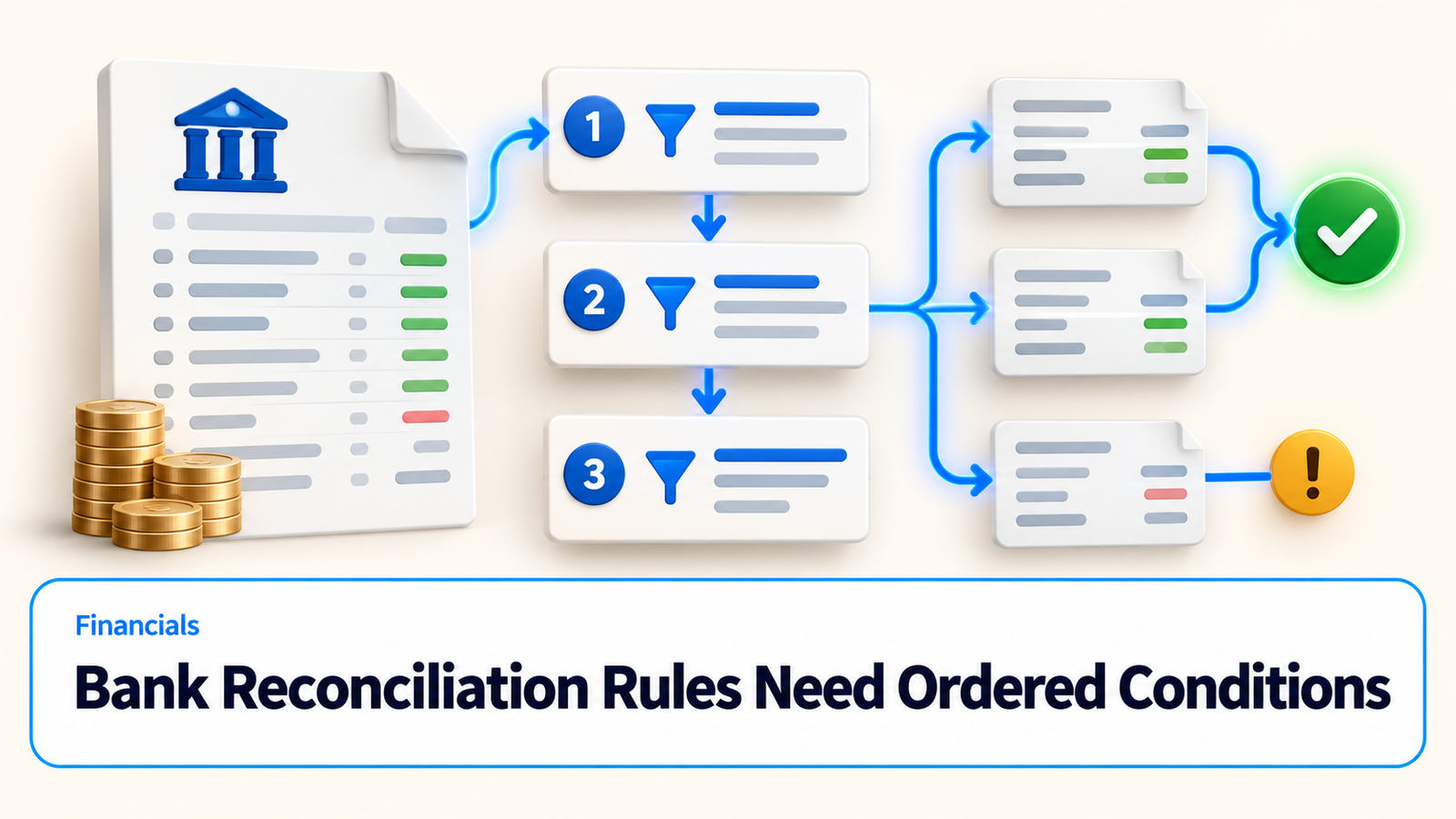
A practical sequence usually opens with conditions built on distinctive, stable identifiers and a narrow scope. Later rules can combine amount, date tolerance, transaction type, or reference once the population has been constrained. This narrow-to-broad pattern is a design principle, not a guarantee that one ordering suits every account. Data quality decides what is truly distinctive.
Profile historical statement and transaction pairs before ranking rules, including the pairs analysts rejected. Then simulate the whole set in order. A broad condition tested alone may look acceptable but behave differently once earlier rules have removed some candidates. It may also starve a later specialist rule of the transactions it needs.
Test boundaries as carefully as successful matches. Include these cases:
- Duplicate amounts and repeated references
- Dates just inside and just outside tolerance
- Missing identifiers
- Mixed currencies, where relevant
- Reversed items
- Groups with one member omitted
For each result, record which rule matched, what evidence supported it, and why the alternatives were excluded. Version every change and approve it with before-and-after samples instead of judging it by aggregate match rate alone.
After deployment, compare expected volumes by rule against actual volumes and investigate sudden shifts. A rise may mean better processing, or it may mean a condition became too permissive after an upstream format change. Exception queues and manual decisions are feedback for rule maintenance, not residue to hide.
Conclusion
Defensible bank reconciliation starts with the account population, then moves through matching type, grouping boundaries, and rule order. Decide deliberately whether transactions from multiple sources may share a group. Put precise, trustworthy conditions ahead of cautious fallbacks, while accepting that real data decides what “precise” means.
A rule-design checklist used alongside Oracle Cloud Financials Online Training can give teams a practical way to document those choices and the evidence behind them. Test the complete sequence with false candidates and incomplete groups, then monitor rule-level outcomes whenever formats and processes change. A lower automatic match rate with understandable exceptions can be healthier than a higher rate built on ambiguous combinations. Speed matters, but reconciliation quality rests on explainable matches and usable audit context.