To relocate a factory in India, you plan the move in phases: audit your machinery and layout, secure approvals for the new site, schedule the shutdown, dismantle and pack equipment, transport it with insurance and compliant documents, reinstall and test it, and restart production in stages. A well-run factory relocation typically takes several weeks to a few months depending on plant size, and the goal is to keep downtime as short as possible. Hybrid Shifting, a corporate relocation and logistics company and the parent of Pikkol, manages this end to end under one accountable team.
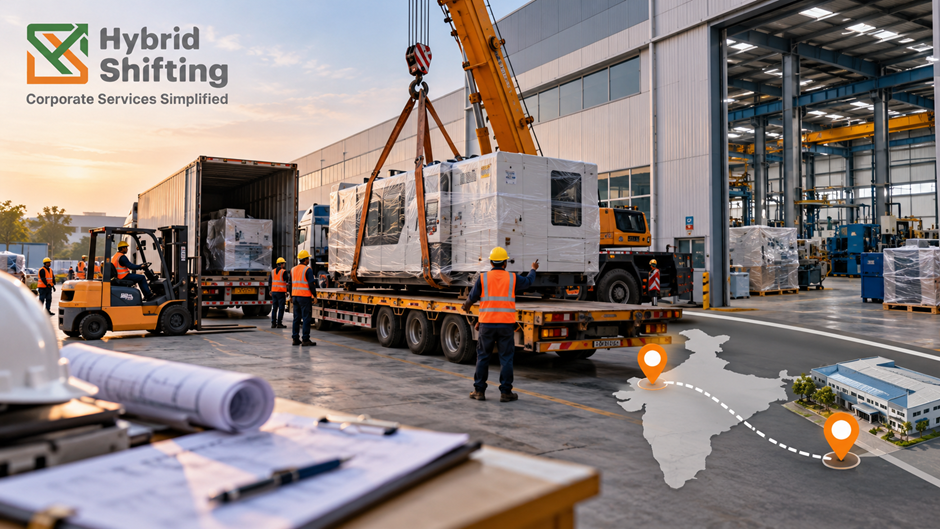
What Is Factory Relocation, and How Is It Different from an Office Move?
Factory relocation is the planned shifting of a manufacturing unit, including heavy machinery, production lines, utilities, raw material, finished stock and records, from one site to another. It differs from an office move because the equipment is heavy and precision-calibrated, production stops while the move happens, and the new site needs its own statutory approvals before operations can restart. If you are moving an office rather than a plant, see our corporate office relocation services.
When Should a Company Relocate Its Factory?
Companies usually relocate a manufacturing unit when:
- The current site has no room to expand capacity.
- Lease or land terms are ending or becoming costly.
- They want to move closer to suppliers, ports or customers.
- They are consolidating plants or shifting to an industrial park or special economic zone.
- Urban zoning or local regulations no longer suit the operation.
How Do You Relocate a Factory Step by Step?
Step 1: Audit and map everything you are moving
Prepare a complete asset register covering every machine, tool, spare part, panel, tank, conveyor and fixture, with make, model, weight, dimensions and condition. Photograph and tag each item. Decide what to move, sell or scrap. This register drives your packing plan, vehicle selection, insurance value and reinstallation sequence.
Step 2: Plan the new layout before anything moves
Design the floor plan, power load, foundations, compressed air, water, drainage, ventilation and material flow at the new site. Machines that need special foundations or pits should have them ready before arrival. Placing equipment in production order cuts commissioning time.
Step 3: Get approvals and registrations for the new site
Requirements depend on your state, industry and the nature of your operation, so confirm them with your legal or compliance advisor early. Commonly involved are:
- Factory licence and plan approval under the Factories Act, 1948 (read the full text on India Code), administered through your state factories inspectorate.
- Pollution control consents (Consent to Establish and Consent to Operate) from your State Pollution Control Board, under the framework of the Central Pollution Control Board (CPCB).
- GST registration update for the new place of business on the GST portal.
- Udyam registration update if you are an MSME, on the Udyam Registration portal.
- Electricity connection, fire safety clearance and any special licences for your industry.
Step 4: Create a phased relocation schedule
Move in phases so that part of the plant keeps producing while another part moves. Build up buffer stock before shutdown, inform customers of expected delivery impact, and fix a firm shutdown window. Schedule the move around holidays, monsoon conditions and your peak order periods.
Step 5: Shut down, disconnect and dismantle safely
Certified electricians and technicians should disconnect power, drain fluids, depressurise systems and label every cable, pipe and part. Match-mark components and photograph assemblies. Where machines are complex or calibrated, involve the original equipment manufacturer (OEM) or its service engineer.
Step 6: Pack machinery and materials for heavy transit
Use custom crating, anti-rust treatment, shock-absorbing material, moisture protection and strapping suited to each machine. Control panels, electronics, tooling and precision parts need protective packing and secure cushioning. Mark every crate with item code, weight, handling instructions and its position in the new layout.
Step 7: Move it using the right equipment, vehicles and insurance
Machinery relocation needs cranes, forklifts, hydraulic trailers, low-bed vehicles and trained riggers. Choose vehicles by weight and dimension, check the route for height and weight restrictions, and secure transit insurance for the full asset value. For goods moving between states, make sure invoices or delivery challans and, where applicable, e-way bills are in order.
Step 8: Reinstall, align and commission
Place machines on prepared foundations, level and align them, reconnect utilities and calibrate. Run dry tests first, then trial production, and check output quality against your pre-move standards before full-scale production.
Step 9: Restart production in stages
Restart one line or section at a time, monitor quality and throughput, and fix teething issues before scaling up. Brief your team on the new layout, safety rules and emergency exits.
Step 10: Update records, compliance and communication
Update your address with customers, suppliers, banks, insurers and statutory bodies. Close the move by reconciling the asset register against what arrived, filing any insurance claims promptly and documenting lessons for future moves.
How Long Does a Factory Relocation Take?
It depends on the size of the plant, the number of machines, the distance and how quickly approvals come through. A small unit may take a few weeks. A large multi-line plant can take several months from planning to full production. Most of the time goes into planning, approvals and commissioning rather than the actual transport.
What Does Factory Relocation Cost in India?
There is no fixed rate. Cost depends on the weight and number of machines, dismantling and reinstallation complexity, packing material, distance, vehicle type, insurance value and the need for cranes or specialised riggers. The most reliable way to budget is a site survey followed by an itemised quotation. For a quote, you can reach Hybrid Shifting.
What Are the Biggest Risks in Moving a Factory, and How Do You Reduce Them?
- Extended downtime: plan phased moves, build buffer stock and prepare the new site before shutdown.
- Machinery damage: use custom crating, trained riggers and the right lifting equipment.
- Loss or mix-up of parts: tag and photograph everything and keep a live asset register.
- Compliance gaps: start approvals early and confirm state-specific rules with your advisor.
- Uninsured loss: insure the full value of assets in transit.
Why Choose Hybrid Shifting for Factory Relocation?
Hybrid Shifting is a corporate movers and relocation company that handles packing, loading, transport, documentation, delivery and reinstallation under one accountable team. The group has been recognised by ET Now and Times Network with the “Excellence in Integrated Logistics & Relocation Services” award, and its brand Pikkol is FAIM, IAM and ISO certified. This integrated approach means you deal with one team instead of coordinating separate vendors for rigging, packing, transport and installation.
Factory Relocation Checklist
- Asset register with photos, weights and dimensions
- New layout, foundations and utilities ready
- Approvals, licences and registrations started
- Phased schedule and customer communication plan
- OEM and technician support booked
- Custom packing and labelling completed
- Vehicles, cranes and route survey confirmed
- Transit insurance and transport documents in place
- Reinstallation, calibration and trial run plan
- Records, address and compliance updates
Frequently Asked Questions
How do you relocate a factory in India?
Audit your assets, plan the new layout, obtain approvals for the new site, schedule a phased shutdown, dismantle and pack machinery, transport it with insurance and correct documents, reinstall and commission it, and restart production in stages.
How long does it take to relocate a manufacturing unit?
A small unit may take a few weeks, while a large plant can take several months. Planning, approvals and commissioning usually take longer than the physical move.
What approvals are needed to shift a factory in India?
Typically a factory licence and plan approval under the Factories Act, pollution control consents from the State Pollution Control Board, and updates to GST and Udyam registrations. Exact requirements vary by state and industry, so confirm with your compliance advisor.
How do you move heavy machinery safely?
Use custom crating, trained riggers, cranes, hydraulic trailers and low-bed vehicles, and insure the machinery for its full value during transit.
How can you reduce downtime during a factory relocation?
Move in phases, build buffer stock, prepare the new site before shutdown, and restart production line by line.
Do I need an e-way bill to move machinery between states?
Goods moving between states generally need valid documents, and an e-way bill may be required depending on the nature and value of the goods. Check the rules on the e-way bill portal or with your tax advisor.
Does Hybrid Shifting handle factory and plant relocation?
Yes. Hybrid Shifting provides corporate relocation and logistics services, managing packing, transport, delivery and related coordination under a single team.