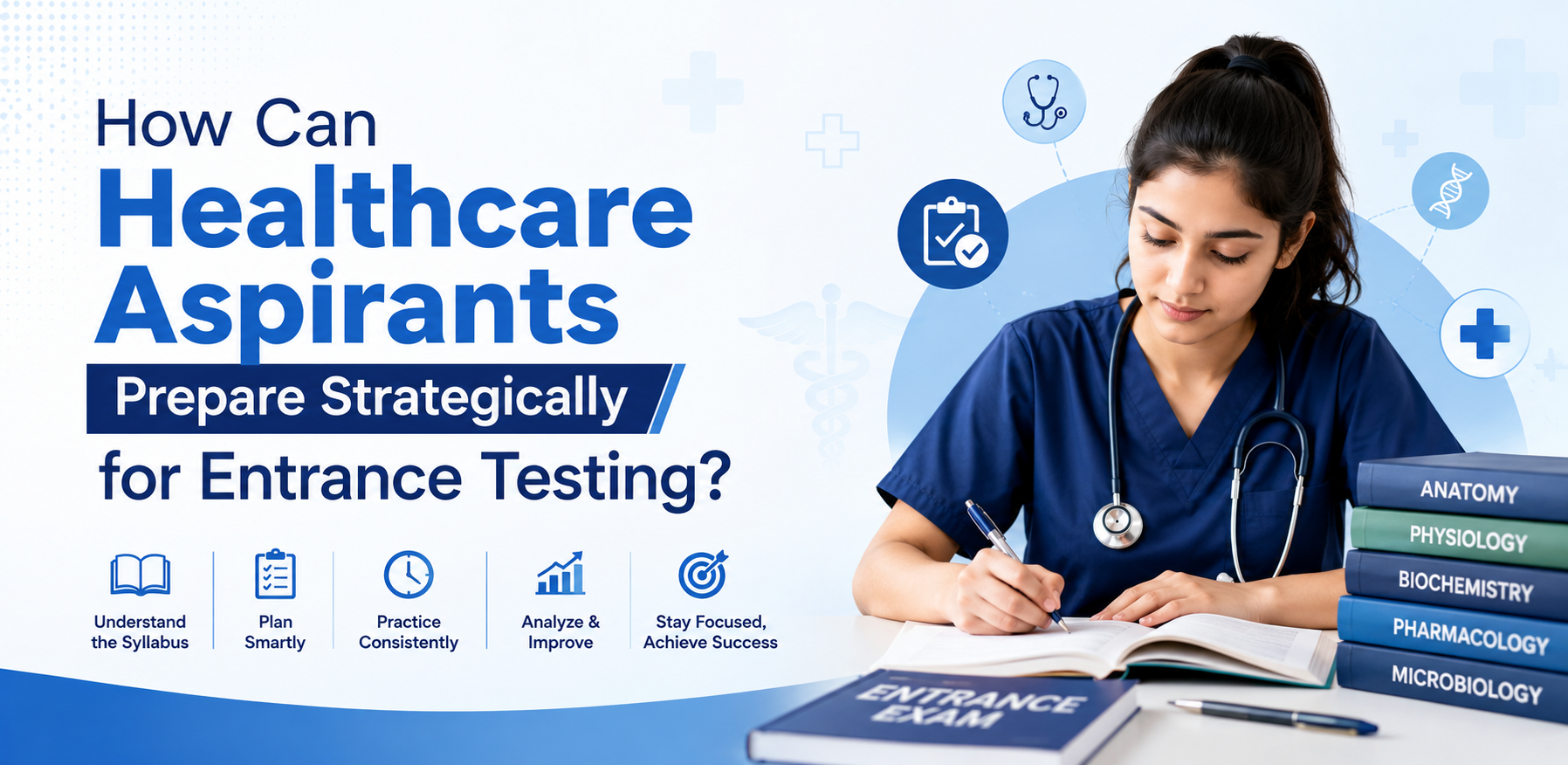
Preparing for the healthcare entrance test is not easy and requires more than just theoretical knowledge. Whether it is medicine, pharmacy, or biochemistry, all fields require strong practical skills along with a strong grasp of theoretical concepts; in this case, merely cramming is not enough, and a strategic approach must be adopted by medical aspirants.
A strategic approach helps students avoid the last-minute stress and helps them better prepare for their healthcare entrance exam. Students who understand the exam format earlier and stay focused throughout the journey often perform better than those who just rely on intensive cramming.
Understand the Exam Format & Pattern
The first step in strategic preparation is understanding the exam format and pattern, which helps students get to know what will probably come in the exam. This way, students can carefully cover subjects on time, understand marking schemes, question types, and time limits. Comprehending the syllabus by breaking it down into manageable pieces helps set realistic study goals instead of getting overwhelmed by daily targets.
Whether you are doing nursing test preparation or pharmacy entrance test preparation, knowing the weightage of each topic helps students assess which section they have to focus on more. This organization prevents confusion and supports a focused study strategy throughout the preparation period.
Creating a Realistic Study Schedule
The next step is to make the timetable. After you have understood the format, you have to make a schedule so that you do not easily burn out or get stressed. Students should strategically divide the study hours between anatomy, physiology, chemistry, and statistics, so that they can get to know which subject they have to focus on more. Daily goals should be reasonable enough to achieve, and achieving those goals keeps you motivated throughout your study session.
A balanced timetable should spare some time for rest as well, so that you cannot get stressed out and better focus on further things that contribute to effective learning.
(helpwithdissertation,2021)
Building Strong Conceptual Understanding
For competitive healthcare entry exams, memorization is not sufficient. Pupils should concentrate on comprehending ideas and how they apply to real-world situations. Long-term information retention is strengthened by attentively reading textbooks, going over class notes, and answering conceptual questions.
Developing conceptual clarity also strengthens the educational foundation by lowering reliance on memorization and preparing pupils for academic difficulties beyond the entrance exam.
Practice Questions Regularly
Accuracy, quickness, and confidence are all strengthened by regular question practice. Students can get reliable practice questions from take my exam for me like services. After finishing each chapter, completing topic-specific tasks promotes learning and identifies knowledge gaps early on. While continuing to revise often, students should progressively raise the difficulty level. Additionally, practicing several question formats enhances flexibility in the real test.
Recurring errors can be avoided by documenting common mistakes and regularly evaluating them. Regular practice gradually increases knowledge with test requirements and improves problem-solving skills under time constraints.
Use Mock Tests to Improve Performance
Mock exams let students judge their preparedness objectively by simulating actual testing situations. Completing lengthy exams under allotted time constraints enhances endurance and time management abilities. To find weak points, thoughtless errors, and patterns of wrong responses, a thorough study is necessary following each mock exam.
Students should focus on ongoing growth via review and correction rather than just scores. Frequent practice exams help students become more confident and less anxious before the real test.
Strengthen Time Management
Effective time management both in the test room and during preparation has a big impact on the outcome. Spending too much time on individual questions may be avoided by creating techniques for section-wise completion. Setting timers during study periods reduces distractions and promotes concentrated attention.
Improved time management enables students to accurately answer more questions while remaining calm under exam pressure and preventing needless anxiety.
Maintain Consistent Revision Habits
Learning material is transformed into enduring knowledge through revision. Rather than waiting until the last several weeks before the test, students should constantly review crucial formulae, diagrams, definitions, and critical ideas. There are only platforms that provide easy revision charts and flashcards to students preparing for high-stakes exams, such as those like “take my teas for me” services.
Revision may be made more efficient and interesting with the use of flashcards, summary notes, and brief tests. Prior to the test, ongoing review lessens information overload and boosts confidence by exposing students to key content on a regular basis.
Take Care of your Mental & Physical Health
Physical and mental health are just as important to academic performance as study time. Concentration and memory are supported by getting enough sleep, eating healthily, staying hydrated, and exercising frequently. By upholding balanced routines and reasonable expectations, students can prevent excessive stress.
Hobbies, quick relaxation exercises, or talks with encouraging family members might help clear the head. Throughout the preparation process, avoiding bad study habits like nocturnal cramming helps conserve energy and boosts long-term productivity.
Learn From Your Mistakes
Every wrong answer offers worthwhile educational chances. To document misconceptions, computation errors, and commonly overlooked ideas, students should keep an error journal. Before the test, it is helpful to go over these notes frequently in order to get rid of any recurrent flaws. If one study technique doesn’t work, swiftly changing tactics can greatly enhance outcomes.
Long-term uncertainty can also be avoided by asking mentors or professors for advice while ideas are still unclear. Successful candidates are frequently distinguished from mediocre performers by their adaptability and ongoing development.
Conclusion:
For passing the healthcare entrance test, simply cramming the sheets is not enough; strategic preparation is important to pass these tests. Students who focus on creating organized schedules, understanding the exam format earlier, getting professional assistance, and focusing on factors like time management and mental and physical health are always more successful than those who don’t follow a strategic path.
Every little daily effort adds up to long-term success, putting students one step closer to realizing their dream of working in healthcare and giving back to their communities.
References:
- HWD. 2021. Time Management Tips. Available at < https://www.helpwithdissertation.co.uk/blog/time-management-tips/ >
- Jernigan, M.A. and Carbonneau, K.J., 2025. Available at < https://www.tandfonline.com/doi/full/10.1080/10872981.2025.2486979 >