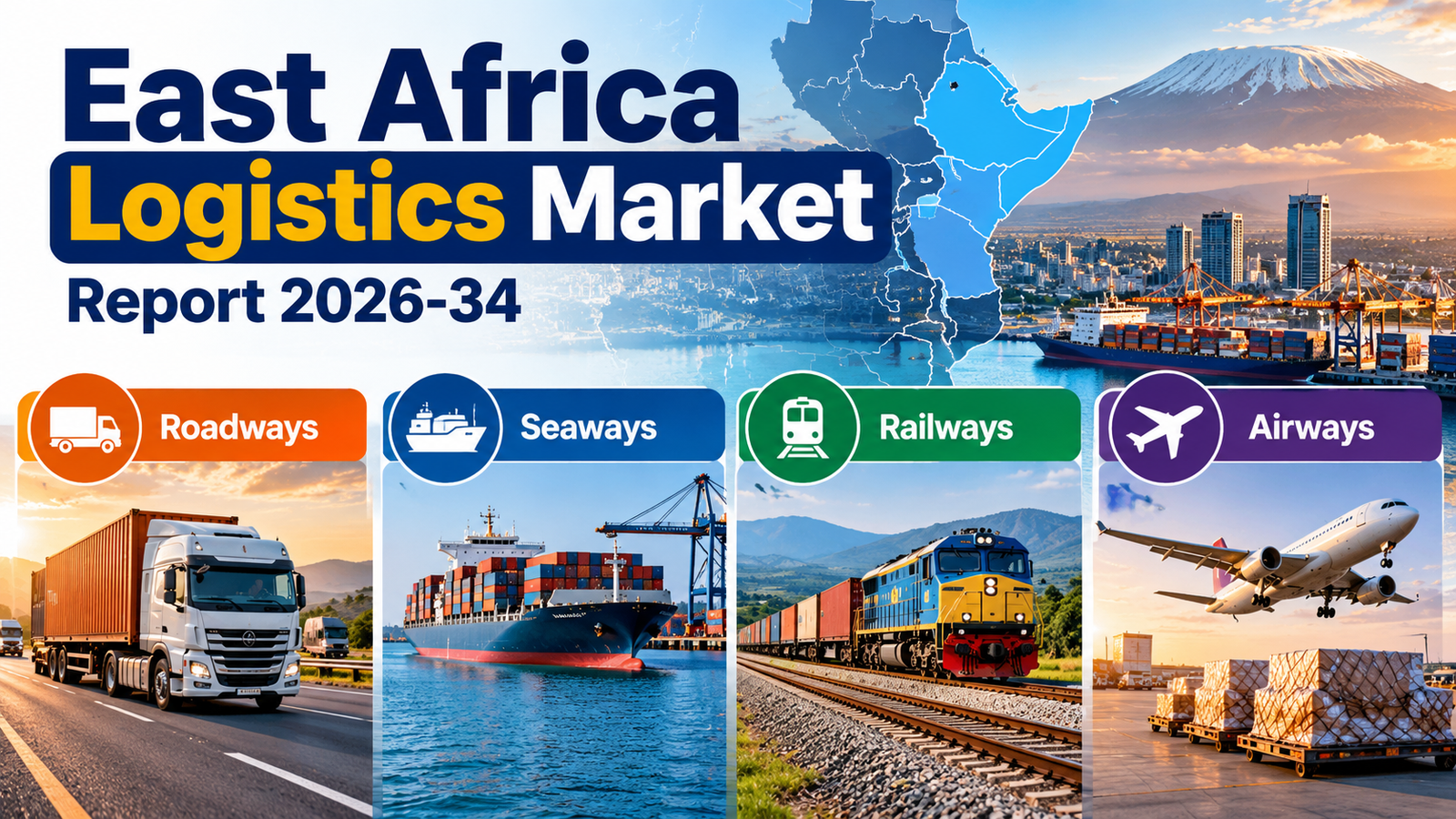
The East Africa logistics market size driven by Large-scale infrastructure programs spanning standard gauge railways, modernized ports, and cross-border corridors are the main force behind demand. Rapid expansion of e-commerce and modern retail, along with trade facilitation measures such as streamlined customs procedures and regional trade agreements, is further strengthening logistics activity across Kenya, Tanzania, Ethiopia, Uganda, and Rwanda. East Africa logistics market size increased from USD 25.1 Billion in 2025 to USD 26.3 Billion in 2026. Looking forward, IMARC Group expects the market to reach USD 37.8 Billion by 2034, exhibiting a growth rate (CAGR) of 4.67% during 2026-2034.
How AI is Reshaping the Future of East Africa Logistics Market?
- AI-powered route optimization and fleet analytics are helping trucking operators on the Northern Corridor and Central Corridor cut empty-running distances, fuel use, and delivery times on long-haul cross-border routes.
- Machine learning tools at ports and inland container depots are improving berth planning, yard allocation, and gate scheduling, supporting efforts to reduce vessel stays at Dar es Salaam from about five days to 24 hours and to ease congestion at Mombasa.
- AI-enabled customs risk profiling and digital single window platforms are accelerating cargo clearance, with Tanzania targeting a cut in clearance time from 60 hours to just minutes at its main port.
- Predictive demand forecasting and warehouse automation are helping e-commerce and retail operators in Nairobi, Kampala, and Addis Ababa manage inventory and scale last-mile delivery for a fast-growing base of online shoppers.
- Real-time freight tracking and IoT-based cold chain monitoring are reducing post-harvest losses and spoilage for perishable exports such as fresh flowers, fruits, and vegetables moving through regional air and sea gateways.
Grab a sample PDF of this report: https://www.imarcgroup.com/east-africa-logistics-market/requestsample
Market Growth Factors
The East Africa logistics market is being driven by large public investments in transport infrastructure. The Lamu Port-South Sudan-Ethiopia Transport (LAPSSET) Corridor, described as the largest infrastructure program in the region, includes a planned 2,900 km standard gauge railway linking Kenya, Ethiopia, and South Sudan, and is expected to open access to markets of roughly 50 to 60 million people in Ethiopia alone. Kenya is extending its standard gauge railway from Naivasha through Kisumu to Malaba to connect with Uganda, while Tanzania is pushing its own standard gauge network westward toward Lake Tanganyika, with its full planned network spanning about 2,561 km from Dar es Salaam to Mwanza and onward links. China-backed rehabilitation of the 1,800 km Tazara railway, valued at USD 1.4 Billion, and a USD 270 Million World Bank program upgrading roads, border posts, and trade systems along the same corridor are also strengthening links between Dar es Salaam and Zambia. These investments are lowering bottlenecks, shortening transit times, and shifting heavy cargo from congested roads to rail.
Port modernization and private participation are the second major driver. DP World secured a 30-year concession to operate berths four to seven at Dar es Salaam port with an initial investment of more than USD 250 Million, and the government expects cargo traffic to more than double over the next decade. Kenya is responding with a KSh 41 Billion expansion program at Mombasa, which is projected to handle more than 2.4 million standard containers annually, supported by partnerships with Afreximbank for the Dongo Kundu Special Economic Zone. Kenya has also invited private bidders to develop and operate assets at Mombasa and Lamu through public-private partnerships. These upgrades are improving container handling, yard efficiency, and hinterland connectivity for landlocked markets such as Uganda, Rwanda, Burundi, and the Democratic Republic of the Congo.
Expanding e-commerce, retail, and trade facilitation continue to raise demand for organized logistics services. Growing online shopping and the spread of modern retail chains are increasing the need for warehousing, last-mile delivery, and third-party and fourth-party logistics providers that can offer integrated services. East African Community (EAC) initiatives to harmonize railway standards, remove cross-border barriers, and digitize customs processes are improving the business environment for logistics operators. Rising exports of agricultural produce, growth in manufacturing and construction, and demand from sectors such as healthcare, telecom, and oil and gas are broadening the customer base, while technology adoption in transport management and tracking is helping providers improve reliability and reduce costs.
Market Segmentation
Model Type Insights:
- 2 PL
- 3 PL
- 4 PL
Transportation Mode Insights:
- Roadways
- Seaways
- Railways
- Airways
End Use Insights:
- Manufacturing
- Consumer Goods
- Retail
- Food and Beverages
- IT Hardware
- Healthcare
- Chemicals
- Construction
- Automotive
- Telecom
- Oil and Gas
- Others
Country Insights:
- Ethiopia
- Kenya
- Tanzania
- Uganda
- Sudan
- Rwanda
- Others
Recent Development & News
- August 2026: DP World advanced the expansion of its Dar es Salaam Terminal 1, with contractor Edecs Group redeveloping seven operational cargo and material-handling yards spanning a combined 90,000 sqm, along with new gates, utilities, and infrastructure for digital yard management. In the same period, China’s CCECC moved ahead with a USD 1.4 Billion rehabilitation of the 1,800 km Tazara railway connecting Dar es Salaam with Zambia.
- July 2026: Construction officially began on the Naivasha-Kisumu-Malaba standard gauge railway extension at Kibos in Kisumu County, and Tanzania started extending its standard gauge railway westward from Dodoma to Kigoma on the shores of Lake Tanganyika, strengthening links to landlocked neighbors.
- May 2026: Kenya and Tanzania signed a bilateral agreement to revive the Voi-Mwatate-Taveta railway line and connect it to the standard gauge railway, aiming to cut freight transit times to northern Tanzania.
- March 2026: President William Ruto presided over the groundbreaking of the Naivasha-Kisumu standard gauge railway extension at Suswa in Narok County, part of Kenya’s plan to link its rail network to Uganda and, eventually, South Sudan and Ethiopia.
If you require any specific information that is not covered currently within the scope of the report, we will provide the same as a part of the customization.
About Us
IMARC Group is a global management consulting firm that helps the world’s most ambitious changemakers to create a lasting impact. The company provide a comprehensive suite of market entry and expansion services. IMARC offerings include thorough market assessment, feasibility studies, company incorporation assistance, factory setup support, regulatory approvals and licensing navigation, branding, marketing and sales strategies, competitive landscape and benchmarking analyses, pricing and cost research, and procurement research.
Contact Us
IMARC Group,
134 N 4th St. Brooklyn, NY 11249, USA,
Email: sales@imarcgroup.com,
Tel No: (D) +91 120 433 0800,
United States: +1-201971-6302