
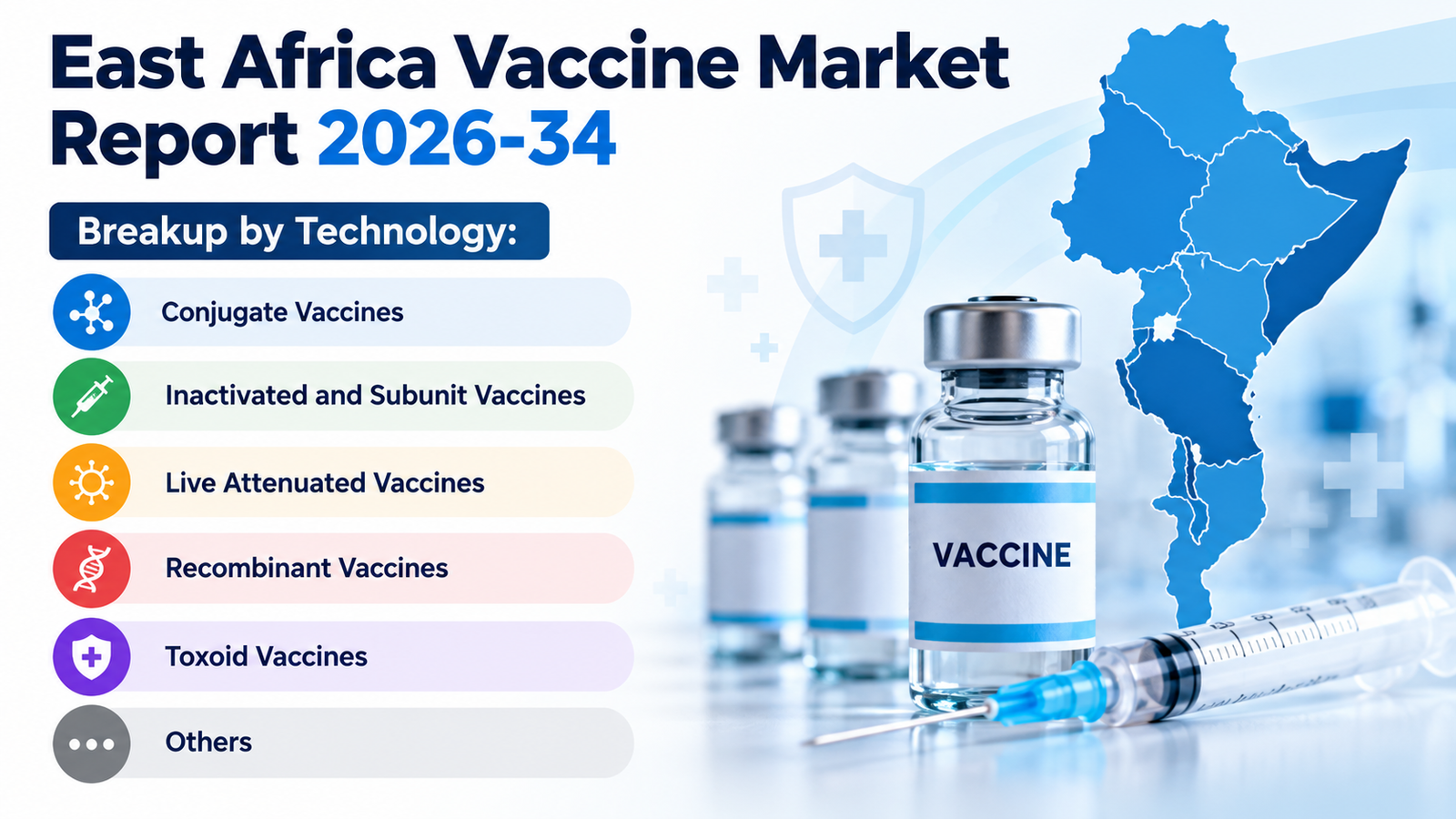
The East Africa vaccine market driven by Rising burden of infectious diseases such as malaria, tuberculosis, hepatitis, influenza and pneumococcal disease, along with high birth rates that expand pediatric immunization demand, is driving vaccine uptake across the region. East Africa vaccine market size reached USD 267.0 Million in 2025. Looking forward, IMARC Group expects the market to reach USD 422.5 Million by 2034, exhibiting a growth rate (CAGR) of 5.23% during 2026-2034. Additionally, sustained backing from Gavi, WHO, UNICEF and the World Bank, together with new efforts to build domestic vaccine production, continues to shape procurement and market visibility.
How AI is Reshaping the Future of East Africa Vaccine Market?
- AI-enabled demand forecasting helps national immunization programs plan vaccine orders, reduce stock-outs and cut wastage. This matters in a region where Africa holds about 20% of the world’s population but produces only 0.1% of global vaccine supply.
- Digital vaccine tracking and AI analytics help health ministries find zero-dose children and low-coverage districts. Uganda, for example, cut the number of zero-dose children from over 104,000 to 36,452 through targeted catch-up efforts.
- AI-supported cold chain monitoring improves temperature visibility in rural clinics, where weak refrigeration infrastructure remains a major barrier to vaccine delivery.
- Machine learning tools support outbreak surveillance and response. In Uganda, outbreak-response vaccination reduced new measles outbreaks by 80% and confirmed cases by 73%, showing how faster data use turns into measurable results.
- AI-driven process control and analytics are expected to support regional fill-finish and manufacturing projects, helping new producers meet quality and regulatory milestones faster.
Grab a sample PDF of this report: https://www.imarcgroup.com/east-africa-vaccine-market/requestsample
Market Growth Factors
The East Africa vaccine market is driven by a heavy infectious disease burden and a young, fast-growing population that keeps pediatric immunization demand high. Routine schedules across Africa now cover 13 vaccine-preventable diseases, compared with 8 in the early 2000s. Governments are adding new antigens, including malaria, HPV, pneumococcal and rotavirus vaccines. Uganda’s routine program protects against 14 vaccine-preventable diseases, and coverage for most vaccines exceeds 90%. The malaria vaccine rollout there reached 105 moderate-to-high transmission districts, with a target of over 1.1 million children and more than 3.1 million doses delivered. First-dose uptake among children aged 6 to 11 months was close to 100%, which shows strong community acceptance when programs are well delivered.
International financing and policy support continue to anchor demand. Gavi, WHO, UNICEF and the World Bank fund and coordinate large purchases, and countries are increasingly taking on co-financing. HPV vaccination programs now operate in 35 African countries, up from 12 earlier in the decade, and coverage has risen from 5% to 47%. This vaccination has helped avert close to 1 million cervical cancer deaths. Malaria vaccines are now offered in 25 African countries, with more than 52 million doses delivered, and Burkina Faso reported a 32% fall in malaria cases after nationwide introduction. Uganda also moved to a single-dose HPV schedule for 10-year-old girls, which reduces cost and eases delivery. Mass campaigns also show the scale of demand: yellow fever vaccination reached over 30 million people in four phases, and mpox vaccination began in 45 districts using over 350,000 doses.
Domestic manufacturing is the next major growth lever. The African Vaccine Manufacturing Accelerator (AVMA), launched with the African Union and Africa CDC, offers up to USD 1 Billion in incentives to manufacturers that meet regulatory approval and supply milestones. Gavi has proposed a further USD 189 Million under AVMA+ to ease regulatory and market-entry barriers. It would support purchase of up to 70 million doses from emerging African producers. Challenges remain, including weak cold chain capacity in rural areas, vaccine hesitancy linked to cultural and religious beliefs, and funding pressure. The malaria vaccine program, for instance, faces a budget shortfall of nearly 30%. Even so, expanding private healthcare, digital tracking and growing public spending on prevention are widening access in Kenya, Ethiopia, Tanzania, Uganda, Rwanda and Sudan.
Market Segmentation
Product Type Insights:
- Multivalent Vaccines
- Monovalent Vaccines
Treatment Type Insights:
- Preventive Vaccines
- Therapeutic Vaccines
Technology Insights:
- Conjugate Vaccines
- Inactivated and Subunit Vaccines
- Live Attenuated Vaccines
- Recombinant Vaccines
- Toxoid Vaccines
- Others
Route of Administration Insights:
- Intramuscular and Subcutaneous
- Oral
- Others
Patient Type Insights:
- Pediatric
- Adult
Country Insights:
- Ethiopia
- Kenya
- Tanzania
- Uganda
- Sudan
- Rwanda
- Others
Recent Development & News
- April 2026: WHO AFRO reported that HPV vaccination programs now run in 35 African countries and that malaria vaccines are provided in 25 countries, with more than 52 million doses delivered. The report also warned of a nearly 30% budget shortfall in the malaria vaccine program.
- May 2026: Gavi proposed a USD 189 Million investment under AVMA+ to support purchase of up to 70 million doses from emerging African manufacturers and to speed up locally made vaccines reaching the market.
- January 2026: Uganda’s Ministry of Health reported immunization coverage above 90% for most vaccines, with zero-dose children down to 36,452 and measles outbreak-response vaccination cutting confirmed cases by 73%.
- April 2025: Uganda launched its malaria vaccine rollout across 105 moderate-to-high transmission districts, targeting over 1.1 million children, in one of the largest introductions to date.
- July 2024: Sudan launched nationwide distribution of the R21 malaria vaccine with UNICEF, WHO and Gavi.
- June 2024: The African Vaccine Manufacturing Accelerator (AVMA) was launched to provide up to USD 1 Billion in incentives to grow vaccine production in Africa.
If you require any specific information that is not covered currently within the scope of the report, we will provide the same as a part of the customization.
About Us
IMARC Group is a global management consulting firm that helps the world’s most ambitious changemakers to create a lasting impact. The company provide a comprehensive suite of market entry and expansion services. IMARC offerings include thorough market assessment, feasibility studies, company incorporation assistance, factory setup support, regulatory approvals and licensing navigation, branding, marketing and sales strategies, competitive landscape and benchmarking analyses, pricing and cost research, and procurement research.
Contact Us
IMARC Group,
134 N 4th St. Brooklyn, NY 11249, USA,
Email: sales@imarcgroup.com,
Tel No: (D) +91 120 433 0800,
United States: +1-201971-6302