
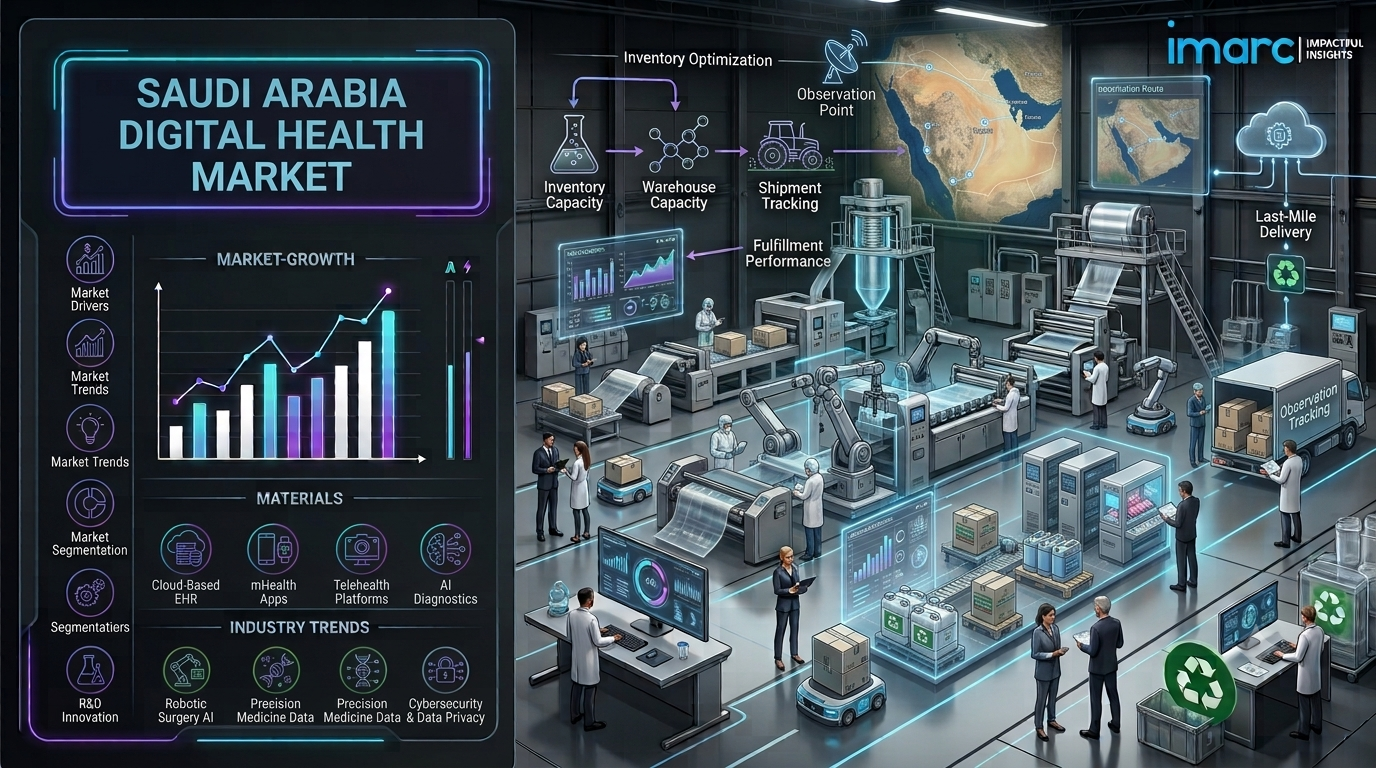
IMARC Group, a leading global market research and management consulting firm, has published its latest market intelligence report on the Saudi Arabia digital health market. The Saudi Arabia digital health market size was valued at USD 5.01 Billion in 2025. Looking forward, IMARC Group estimates the market to reach USD 15.32 Billion by 2034, exhibiting a CAGR of 13.23% from 2026-2034, driven by the government’s comprehensive Vision 2030 healthcare modernization agenda, rapid expansion of telemedicine and AI-integrated clinical platforms, rising chronic disease prevalence including diabetes and cardiovascular conditions, and a young, digitally native population supported by advanced telecommunications infrastructure.
The market is on a sustained growth trajectory as public policy, private capital, and technology innovation converge to modernize healthcare delivery across the Kingdom. Digital health revenue climbed from USD 5.01 Billion in 2025 to USD 5.67 Billion in 2026, and this momentum is projected to nearly triple by 2034 as strategic public-private partnerships and regulatory reforms create a more investable environment for digital health platforms. Telehealth continues to anchor the market on the back of expanding Seha Virtual Hospital infrastructure and government-backed telemedicine initiatives, while software remains the backbone of capital allocation as hospitals modernize electronic health record and analytics systems. Venture funding and structured innovation programs are strengthening the domestic startup ecosystem and accelerating commercialization of new solutions. Sovereign-linked capital, led by initiatives such as the Sanabil Venture Studio, is actively building a pipeline of homegrown digital health companies rather than relying solely on multinational technology vendors. Collectively, these dynamics are positioning Saudi Arabia as a regional and emerging global hub for digital health innovation.
Saudi Arabia Digital Health Market at a Glance:
- Market Size 2025: USD 5.01 Billion
- Forecast Size 2034: USD 15.32 Billion
- Growth Rate 2026-2034: CAGR of 13.23%
- Leading Type: Telehealth, 32.0% share in 2025
- Leading Component: Software, 55.0% share in 2025 (approx. USD 2.76 Billion)
- Dominant Region: Northern and Central Region, with a 34.0% revenue share in 2025
How AI is Reshaping the Future of the Saudi Arabia Digital Health Market
- Deep Clinical AI Across 20 Hospital Clusters: In November 2025, RapidAI partnered with Saudi Arabia’s Health Holdings Company (HHC), the largest healthcare provider in the Middle East, to deploy Deep Clinical AI and radiology solutions across HHC’s network of 20 health clusters, supporting neurology, cardiology, vascular, oncology, and orthopedic care nationwide.
- AI-Powered National Health Coaching: Saudi Arabia integrated an AI-powered health coach into its national Sehaty app, developed with Lean Business Services and Google Cloud, delivering personalized, real-time health guidance through voice, video, and text to a platform used by more than 24 million residents.
- AI-Driven Cancer Screening at Scale: Lunit signed an MoU with Seha Virtual Hospital under Vision 2030’s Healthcare Sandbox to integrate AI-powered cancer detection across 150 hospitals nationwide, beginning with King Saud Medical City, supporting the Kingdom’s national cancer screening program.
Grab a sample PDF of this report: https://www.imarcgroup.com/saudi-arabia-digital-health-market/requestsample
Saudi Arabia Digital Health Market Trends and Drivers:
Telehealth’s dominant 32% share of the Saudi Arabia digital health market in 2025 is anchored by the rapid scale-up of Seha Virtual Hospital, now the world’s largest virtual hospital, which connects over 224 hospitals and has facilitated more than 1.6 million virtual consultations, integrating with the Sehhaty and Wasfaty platforms for appointment booking and prescription management. Rising chronic disease prevalence, particularly diabetes and cardiovascular conditions, is catalyzing demand for remote monitoring and virtual care solutions, while a young, digitally native population combined with advanced telecommunications infrastructure is accelerating adoption of innovative healthcare technologies across both urban centers and remote regions.
Interoperability is emerging as a foundational requirement for the market’s next growth phase, mirroring a global shift the World Health Organization has formalized through the extension of its Global Strategy on Digital Health 2020-2025 through 2027, under which 129 countries have now established national digital health strategies. Saudi Arabia’s own National Platform for Health Information Exchange Services (NPHIES), built on the HL7 Fast Healthcare Interoperability Resources (FHIR) standard, now connects more than 6,600 provider organizations and has processed over 130 million insurance transactions, with 94% of claims approved in under 30 minutes, positioning the Kingdom’s claims and data-exchange infrastructure among the most standardized in the region.
Government investment is directly shaping the pace and direction of digital health deployment, with the Saudi Data and Artificial Intelligence Authority (SDAIA) anchoring a SAR 93 Billion (approximately USD 24.8 Billion) national AI investment commitment for 2026 that spans direct government spending and catalyzed private capital. Strategic public-private partnerships and regulatory reforms spanning data governance, AI adoption frameworks, and health information exchange are creating a dynamic and increasingly structured ecosystem, detailed further below.
Global Regulatory, Trade, and Sustainability Landscape Shaping Demand:
- WHO Global Strategy on Digital Health and Interoperability Standards: The World Health Organization’s extension of its Global Strategy on Digital Health 2020-2025 through 2027 has intensified international focus on standards-based digital health transformation, reinforcing global adoption of the HL7 FHIR standard now embedded in Saudi Arabia’s own NPHIES exchange.
- National AI Governance Frameworks: SDAIA published its AI Adoption Framework as a mandatory public-sector baseline in November 2025, formalizing governance requirements for AI deployment across government-linked healthcare institutions ahead of Saudi Arabia’s designated Year of AI in 2026.
- Data Privacy and Cybersecurity Compliance: Rising cybersecurity exposure across Saudi healthcare infrastructure is driving sustained investment in encryption, intrusion detection, and continuous monitoring, as national data protection regulations tighten requirements around patient data handling.
- Cross-Border Digital Health Cooperation: Regional Gulf Cooperation Council coordination on digital trade and health-data frameworks is aligning with Vision 2030’s positioning of Saudi Arabia as a regional hub for healthcare digitalization and Arabic-language AI infrastructure.
Key Government Schemes and Policy Programs Supporting the Industry:
- Health Sector Transformation Program (HSTP): Launched in 2021 as one of Vision 2030’s Vision Realisation Programmes, HSTP is restructuring the Kingdom’s health system around four strategic objectives, including a public-private partnership drive such as the Altakassusi Alliance Medical radiology PPP across seven hospitals, with privatization plans extending across hundreds of hospitals and health institutions nationwide.
- National Platform for Health Information Exchange Services (NPHIES): Governed by the Council of Health Insurance, NPHIES now connects more than 6,600 provider organizations, has processed over 130 million insurance transactions since launch, and clears 94% of claims in under 30 minutes, standardizing eligibility, pre-authorization, and claims exchange nationwide.
- SDAIA National AI Strategy: The Saudi Data and Artificial Intelligence Authority is anchoring a SAR 93 Billion (approximately USD 24.8 Billion) national AI investment commitment for 2026, of which approximately SAR 38 Billion is direct government spending, funding healthcare-relevant infrastructure including public-sector AI adoption programs.
- Seha Virtual Hospital: Launched under the Ministry of Health, Seha Virtual Hospital is now the world’s largest virtual hospital, connecting over 224 hospitals nationwide and facilitating more than 1.6 million virtual consultations, integrated with the Sehhaty and Wasfaty platforms for care coordination.
- Sehhaty National Digital Health Platform: The Ministry of Health’s Sehhaty application has reached more than 24 million users, representing approximately 68.5% of the population, serving as the national gateway for appointment booking, medical records access, and AI-powered health coaching.
IMARCs report provides a deep dive into themarket analysis, outlining the current trends, underlying Saudi Arabia digital health market demand, and growth trajectories.
Saudi Arabia Digital Health Industry Segmentation:
The report has segmented the market into the following categories:
Breakup By Type:
- Telehealth
- Medical Wearables
- EMR/EHR Systems
- Medical Apps
- Healthcare Analytics
- Others
Telehealth dominates with a 32.0% share of the market in 2025, driven by widespread adoption of virtual consultation platforms, government-backed telemedicine initiatives, and the continued expansion of Seha Virtual Hospital infrastructure connecting healthcare facilities across the Kingdom. Strong government backing, regulatory clarity, and expanding insurance coverage are further reinforcing telehealth’s role in chronic disease management and preventive care.
Breakup By Component:
- Software
- Hardware
- Services
Software leads the component segment with a 55.0% share in 2025, reflecting its central role in enabling telemedicine, electronic health records, data analytics, and remote patient monitoring across public and private healthcare systems. National investments in health IT infrastructure and interoperability standards, combined with rising demand for secure, scalable, and compliant digital solutions, continue to reinforce software’s dominance as hospitals and clinics modernize operations.
Breakup By Region:
- Northern and Central Region
- Western Region
- Eastern Region
- Southern Region
The Northern and Central Region leads with a 34.0% share of the market in 2025, benefiting from a concentration of major hospitals, government healthcare institutions, and technology infrastructure in Riyadh. Higher population density, stronger internet connectivity, and greater availability of skilled healthcare professionals are reinforcing the region’s leading role in digital health adoption and pilot program deployment.
Competitive Landscape:
The report provides a comprehensive analysis of the competitive landscape in the Saudi Arabia digital health market with detailed profiles of key companies, including:
- Cerner Corporation
- Epic Systems Corporation
- Philips Healthcare
- Siemens Healthineers
- GE HealthCare
- Altibbi
- Vezeeta
The competitive landscape is fragmented and increasingly competitive, characterized by global technology corporations, regional healthcare providers, and emerging healthtech startups. Saudi Arabia led Gulf Cooperation Council healthtech funding activity between January 2025 and July 2026, accounting for 17 of 32 disclosed funding deals region-wide out of USD 148 Million in total GCC healthtech investment, while Lunit’s AI-powered cancer detection platform has been integrated across 150 hospitals nationwide through its Seha Virtual Hospital partnership, illustrating the scale at which both global vendors and regional platforms are competing for footprint.
Market Concentration Analysis:
- Moderate but Intensifying Competition: The market exhibits moderate competitive intensity, with global technology corporations and regional healthcare providers competing across telehealth, software, and healthcare analytics segments while continuously expanding digital capabilities.
- Saudi Arabia Anchoring Regional Capital Flows: Saudi Arabia captured 17 of 32 disclosed GCC healthtech funding deals between January 2025 and July 2026, out of USD 148 Million in total regional investment, positioning the Kingdom as the leading capital destination for healthtech within the Gulf.
- Sovereign-Backed Venture Building as a Distinct Model: Government-anchored initiatives such as the Sanabil Venture Studio, targeting at least 20 new healthcare companies, represent a distinct competitive dynamic alongside multinational vendor competition, reflecting the Kingdom’s preference for building domestic champions rather than relying solely on imported platforms.
What Does The Full Report Cover?
- Complete market sizing with revenue forecasts covering the full 2020-2034 projection period
- Quantified growth driver analysis with impact scoring across type, component, and regional markets
- Sub-segment breakdowns for telehealth, medical wearables, EMR/EHR systems, medical apps, healthcare analytics, software, hardware, and services with individual share data
- Region-level data for the Northern and Central, Western, Eastern, and Southern regions of the Kingdom
- Competitive and key company profiles with strategic landscape assessment
- Porter’s Five Forces, value chain analysis, and technology landscape mapping
- Investment and growth opportunity mapping across telemedicine platforms, AI-enabled diagnostics, and health information exchange infrastructure
Recent News and Developments in Saudi Arabia Digital Health Market
- November 2025: Siemens Healthineers and the Saudi Ministry of Health launched the SHIFT Innovation Center in Riyadh to foster collaboration among hospitals, universities, startups, and government bodies, focusing on AI-driven healthtech solutions and capacity-building programs aligned with Vision 2030.
- November 2025: RapidAI partnered with Saudi Arabia’s Health Holdings Company, the largest healthcare provider in the Middle East, to deploy Deep Clinical AI and radiology solutions across HHC’s network of 20 health clusters nationwide.
- November 2025: Saudi Arabia launched the world’s first digital diabetes command center to monitor patients’ vital signs in real time, unveiled by Health Minister Fahad AlJalajel at the Global Health Exhibition in Riyadh.
- November 2025: SDAIA published its AI Adoption Framework as a mandatory baseline for public sector entities, formalizing governance requirements ahead of Saudi Arabia’s designated Year of AI in 2026.
- January 2025: Sanabil Investments, a wholly owned company of the Public Investment Fund, partnered with Redesign Health to launch the Sanabil Venture Studio, targeting the creation of at least 20 new healthcare companies in Saudi Arabia.
- August 2025: Nuxera AI, a Saudi health-tech startup, secured early-stage investment from Sanabil Investments as part of the Kingdom’s push to strengthen its domestic digital health startup pipeline.
Note: If you require specific details, data, or insights that are not currently included in the scope of this report, we are happy to accommodate your request. As part of our customization service, we will gather and provide the additional information you need, tailored to your specific requirements. Please let us know your exact needs, and we will ensure the report is updated accordingly to meet your expectations.
Key Questions This Report Answers
- What is the current Saudi Arabia digital health market size and what is its projected value by 2034?
- Which type and component segments hold the largest share in the Saudi Arabia digital health market?
- What are the key factors driving Saudi Arabia digital health market growth?
- Which region dominates the Saudi Arabia digital health market and why?
- How is Vision 2030 reshaping telemedicine, AI adoption, and health information exchange in Saudi Arabia?
- Who are the top companies in the Saudi Arabia digital health market and what are their competitive strategies?
- What are the major challenges facing the Saudi Arabia digital health market?
About Us:
IMARC Group is a global management consulting firm that helps the world’s most ambitious changemakers to create a lasting impact. The company provides a comprehensive suite of market entry and expansion services. IMARC offerings include thorough market assessment, feasibility studies, company incorporation assistance, factory setup support, regulatory approvals and licensing navigation, branding, marketing and sales strategies, competitive landscape and benchmarking analyses, pricing and cost research, and procurement research.
Media and Sales Contact
IMARC Group
Email: sales@imarcgroup.com
United States: +1-201-971-6302
India: +91-120-433-0800
United Kingdom: +44-753-714-6104