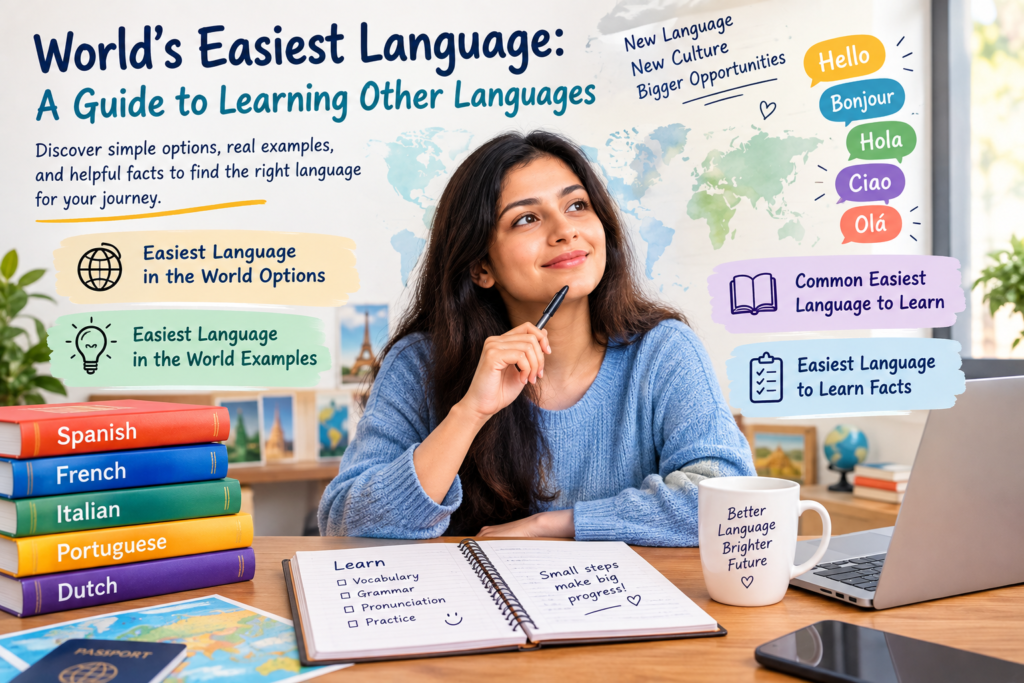
You are having the experience of learning a new language and exploring another culture while, at the same time, addressing your social and communication needs. But all languages do not feel equally easy to everyone. Your native language, the way you pronounce things, grammar, vocabulary, and your way of learning all influence the speed at which you learn a new language.
People searching for the Easiest Language in the World often want simple grammar, familiar vocabulary, straightforward pronunciation, or abundant learning materials. No language is best suited for everyone, but a few languages are widely perceived as easier for beginners.
What Makes a Language Effortless to Learn?
There are many factors that can make a language easy or difficult. The most prominent one is grammar. In the beginning, a language with fewer complexities may be easier to learn.
Pronunciation also matters. Any language that has a sound pattern already familiar to the learner can be relatively easy to pronounce and understand. Another factor is vocabulary, which can be easier if the learner knows words that are similar to those of the new language.
Access to learning materials counts too. Learners can make gradual progress with the support of books, videos, online courses, and apps, as well as opportunities to practise with other speakers.
Most Popular Languages to Try for Beginners
Various languages are often selected when learning a language for the first time, as they can provide easy access to instructional material and have some characteristics that make them simpler to learn early on.
Spanish
Spanish is spoken by many people and has a huge quantity of learning material available. Its pronunciation is fairly straightforward, and there are plenty of media, courses, and conversations for beginners to practise with.
French
Many people learn French as their second language. It is also one of the most spoken languages in the world, and there are tons of books, courses, videos, and other resources available for learners to use along their journey.
Italian
It is one of the more accessible languages because it has a slight musicality to its pronunciation, and its grammar tends to be very regular. This makes it attractive, especially for beginners. Travel, culture, food, or history may also provide a host of reasons for language learners to put their newly acquired vocabulary into practice.
Portuguese
Portuguese is spoken in different parts of the world and shares a reasonable amount of vocabulary with other Romance languages. For someone who knows Spanish or a similar language, some words and structures may already be familiar.
Dutch
Dutch is also a fun option, especially if you already have some knowledge of English or German. Some of the vocabulary may be recognizable, although the pronunciation and grammar can still require practice.
How to Select the Best Language
The easiest language for you might have less to do with a general list and more to do with your background. If you speak another language with close ties to the one you wish to study, you might find some vocabulary and sentence structures familiar.
Consider carefully why you are learning the language before you make your choice. A person learning for travel could select a different language from someone who is interested in studying abroad or communicating with family members.
Also, try to think about how much time you can spare for practising. You are likely to stay committed to learning a language that you feel personally connected to due to your interests.
Easiest Languages in the World for Beginners
There are a lot of Easiest Language in the World options that beginners can consider based on their native language and where they want to go. These could include Spanish, French, Italian, Portuguese, or Dutch, which may be easier for some learners.
Do not pick a language just because it is on a list on the internet. Look at its pronunciation, grammar, vocabulary, and available learning resources. You can even try basic lessons in Brazilian Portuguese or two or three other languages to see if one seems easier than the others.
How to Learn a New Language
Language learning is much simpler when you start with an easy habit. You can start making progress without having to study for hours every day.
Start learning a few words and sentences at a time. Speak them to yourself instead of just reading them. Short dialogues will also allow you to get a better awareness of pronunciation and how such sentences might sound when spoken naturally.
It is also helpful to write simple sentences. When your vocabulary grows, you can gradually move from short sentences to longer conversations.
Above all, do not be afraid to make mistakes. It is easier to make regular practice a habit than to attempt to speak perfectly from the start.
Examples of the Easiest Language in the World
Examples of the Easiest Language in the World differ with different types of learners. Just as an English speaker might find a language with similar vocabulary easier than one with a different writing system and sentence structure, another learner may have a different experience.
For another learner, the experience can be quite different. So, a person who already speaks Spanish, for example, might be more comfortable with Portuguese or Italian than another person who has never studied a Romance language.
This is why you should consider language difficulty not as an absolute rule, but from the learner’s perspective.
How Long It Really Takes to Learn a Language
Learning a language requires time, but there is no set period. The progress a learner makes varies with the language, prior exposure, and study habits.
For example, a person who regularly studies and uses the language in daily life may learn faster than someone who studies occasionally. Listening and speaking practice likewise help learners get used to actual conversations.
You can have an easier time by setting smaller goals. You may start with greetings, small-talk questions, numbers, everyday vocabulary, and basic sentences, then progress to more advanced topics.
Common Easiest Language to Learn
A discussion about Common Easiest Language to Learn tends to bring up languages such as Spanish, French, Italian, Portuguese, and Dutch. However, what is easy depends on the prior knowledge of the learner.
Even if a language is simple in one aspect, it might take longer to learn its pronunciation, grammar, spelling, or listening. This is why we need to view the entire learning experience rather than judging a language based on just one point.
Easiest Language to Learn Facts
Before choosing a language, there are some Easiest Language to Learn Facts you should know.
- Your native tongue will affect how simple other languages seem to be.
- Easier words can make the beginning stage feel more comfortable.
- The way you pronounce words can play a role in building your confidence.
- Building the long-term skills you need requires regular practice.
- Having learning resources could help you practise more consistently.
- Having a personal interest can help with motivation.
- Even a language that appears simple to start with takes considerable practice to master.
Final Thoughts
The easiest language to learn does not have to be one single winner. It all relies on your language background, interests, goals, and willingness to practise.
Spanish, French, Italian, Portuguese, and Dutch are all good languages to consider, but you should base your final choice on your own experience. Learn the basics, practise regularly, and pick a language that gives you a purpose to practise more.
FAQs
What makes a language easy or hard to learn?
Not everyone can choose the same easiest language. Your answer may vary based on the language you speak natively, the size of your vocabulary before starting to learn a new language, and whether you have studied other foreign languages.
What is the easiest language for English speakers?
Spanish, French, Italian, and Portuguese, as well as Dutch, can seem more or less approachable to many native English speakers, although the experience can differ from person to person.
Is knowing one language useful for another?
Yes. Sometimes, if two languages share vocabulary or grammar patterns, knowledge of one language can help you learn the other one.
What tips do you have for learning a foreign language quickly?
Regular practice can help. Pay attention to day-to-day language learning by focusing on listening, speaking, reading, and writing rather than simply memorizing.
Should I learn a language based solely on difficulty?
Not necessarily. Your level of interest in the language and the reason for learning that particular language can equally help with motivation.
Is it possible to learn a language without an actual class?
Yes. Language learning can be facilitated by books, apps, videos, online resources, conversations, as well as regular self-study.