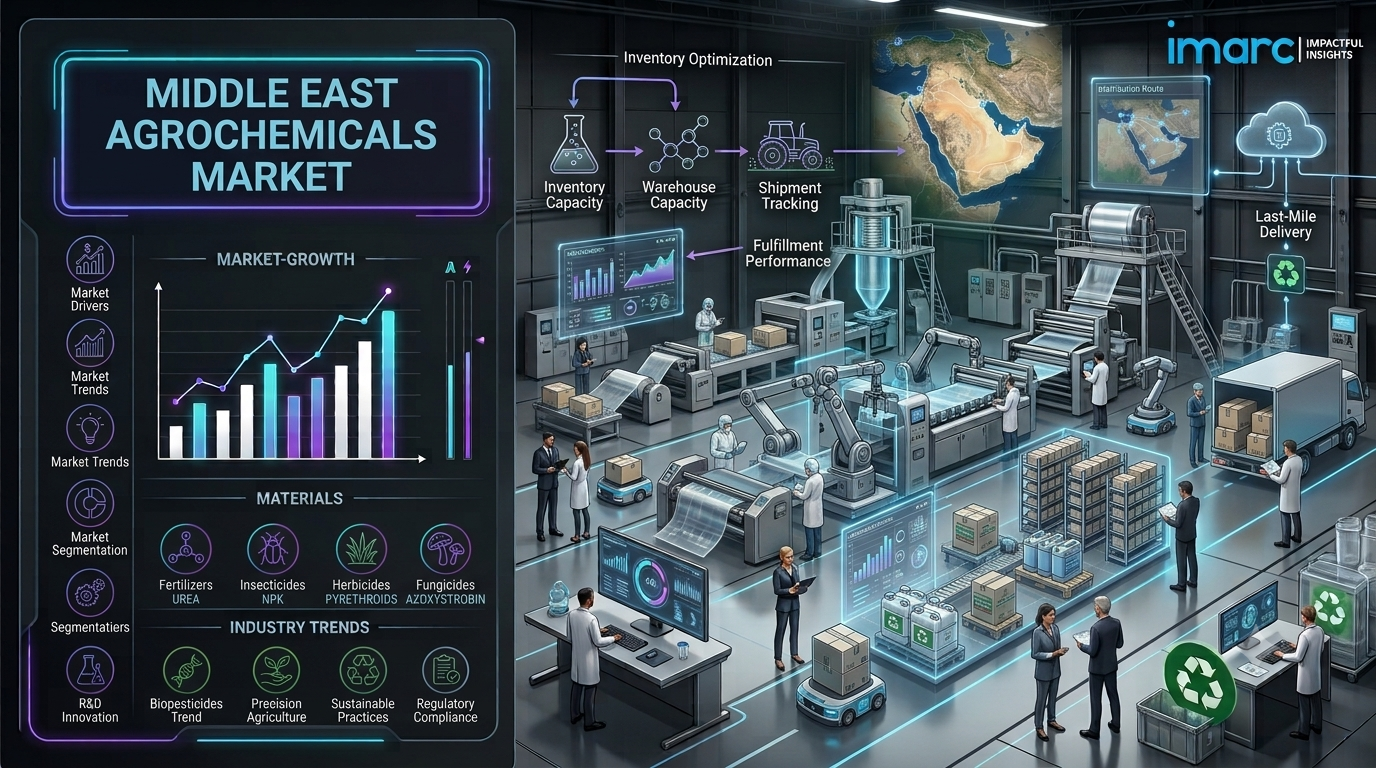
IMARC Group, a leading global market research and management consulting firm, has published its latest market intelligence report on the Middle East agrochemicals market. The Middle East agrochemicals market size was valued at USD 13,523.0 Million in 2025 and is projected to reach USD 17,116.9 Million by 2034, exhibiting a CAGR of 2.65% during 2026-2034, driven by rising farmer awareness of yield-boosting inputs, expanding organic and biopesticide adoption, and the region-wide push toward precision farming and food security.
The market is being reshaped by a structural shift from a purely import-dependent input base toward locally anchored, technology-enabled crop protection and nutrition. Governments across the Gulf are treating agrochemical self-sufficiency as a food security priority, channeling capital into fertilizer capacity, biological inputs, and digital farm management tools, while the region’s arid growing conditions keep water-efficient and controlled-release formulations central to product strategy. Saudi Arabia, Turkey, and the United Arab Emirates anchor demand at the country level, with the Gulf states pairing large public agriculture investment programs with a fast-growing base of protected-cultivation and greenhouse farming that intensifies input use per hectare rather than expanding it through new land alone.
Middle East Agrochemicals Market at a Glance:
- Market Size (2025): USD 13,523.0 Million
- Forecast Market Size (2034): USD 17,116.9 Million
- CAGR (2026-2034): 2.65%
- Base Year: 2025
- Historical Period: 2020-2025
- Leading Fertilizer Segment: Nitrogen Fertilizer
- Leading Pesticide Segment: Fungicides
How AI is Reshaping the Future of the Middle East Agrochemicals Market
- Acoustic AI for Early Pest Detection: Saudi Arabia and the UAE are deploying AI-trained acoustic sensors, adapted from energy-sector monitoring equipment, to detect the faint feeding sounds of red palm weevil larvae inside date palms before visible damage occurs, addressing an infestation that cost Saudi growers more than USD 400 Million in a single year and up to USD 2,200 per infected tree.
- Drone-Based Precision Spraying and Crop Monitoring: Agriculture drone fleets across the UAE and Saudi Arabia are combining multispectral imaging with machine-learning models to flag disease and nutrient stress early and to target pesticide and fertilizer application to the exact zones that need it, cutting input waste in water-scarce growing regions.
- AI-Powered Farm Advisory Platforms: Government-backed tools such as the UAE’s CHAG advisory platform and Falcon-based AgriLLM research assistant are giving farmers data-driven guidance on input timing and dosage, gradually shifting agrochemical purchasing from fixed seasonal routines toward need-based, sensor-informed decisions.
Grab a sample PDF of this report:
Middle East Agrochemicals Market Trends and Drivers:
Rising food consumption on the back of a growing and increasingly urban regional population is the single largest demand driver, compounded by farmers’ deepening awareness of the yield gains, reduced crop losses, and improved profitability that come with systematic agrochemical use. Organic and biological inputs are moving from niche to mainstream, as growers adopt biopesticides and organic fertilizers to serve health-conscious domestic consumers and export markets that increasingly demand chemical-residue-free produce, a shift reinforced by regulatory bodies that are actively subsidizing and promoting modern crop input practices.
Precision farming adoption is compounding this shift directly. Agrochemical suppliers are introducing precision application equipment and bio-based formulations alongside digital tools such as drones and field-level data analytics, letting farmers optimize dosage, cut wastage, and monitor crop health in real time rather than applying inputs on a fixed calendar. Water scarcity is a structural constraint that agrochemical formulation is built around: fertigation-compatible liquid fertilizers and controlled-release, polymer-coated grades are gaining share because they cut the labor and irrigation cycles tied to conventional granular inputs, a trend the Saudi biofertilizer and specialty fertilizer segments are both riding as they scale from a small base.
Government-backed infrastructure is the accelerant behind both trends. Irrigation systems and controlled-environment agriculture facilities are expanding across the Gulf, with protected-cultivation acreage in Saudi Arabia rising roughly 35% between 2022 and 2024 alone as the Kingdom pursues self-sufficiency in high-value produce, and each new greenhouse cluster adds recurring, higher-intensity demand for water-soluble fertilizers and targeted crop protection chemistry rather than one-off input purchases.
Government Initiatives and Food Security Programs Driving Demand:
- National Food Security Strategies: Saudi Arabia’s food security strategy and the UAE’s National Food Security Strategy 2051 are both directing public investment toward reducing import dependence, positioning agrochemical self-sufficiency and yield intensification as strategic, government-funded priorities rather than purely commercial decisions.
- Large-Scale Public Investment in Agriculture: Saudi Arabia’s Ministry of Environment, Water and Agriculture has reported private-sector investment in the Kingdom’s agriculture and food sector surpassing SAR 37 Billion (approximately USD 9.8 Billion), spanning crop production, processing, and input-supply infrastructure aligned with Vision 2030.
- Strategic Sector Partnerships: The Saudi Agricultural and Livestock Investment Company (SALIC), backed by the Kingdom’s Public Investment Fund, signed a Letter of Intent with Syngenta Crop Protection in October 2025 to jointly advance digital agriculture, soil health, and crop protection initiatives, signaling deepening state-level engagement with global agrochemical majors.
- Regional Pest Control Coordination: Gulf governments are coordinating cross-border technology-based responses to the red palm weevil and other high-cost pests, with the Saudi Ministry of Environment, Water and Agriculture working alongside international research bodies to deploy AI-based detection at scale.
- Sustainable and Biological Input Incentives: Subsidies and research collaborations promoting biofertilizers and other green inputs are gaining momentum under Vision 2030-aligned programs, creating a direct commercial channel for low-residue, sustainability-oriented agrochemical producers.
Middle East Agrochemicals Industry Segmentation:
The report has segmented the market into the following categories:
Breakup By Fertilizer Type:
- Nitrogen Fertilizer
- Phosphatic Fertilizer
- Potassic Fertilizer
- Others
Nitrogen fertilizer leads the fertilizer type segment, reflecting its role as the primary input for cereal and grain production, the region’s dominant crop category, and its established supply base anchored by large regional ammonia and urea producers.
Breakup By Pesticide Type:
- Fungicides
- Herbicides
- Insecticides
- Others
Fungicides and insecticides together account for the bulk of pesticide demand, driven by the humidity-related fungal pressure in protected-cultivation facilities and the high economic cost of pest outbreaks such as the red palm weevil in date-growing regions.
Breakup By Crop Type:
- Cereals and Grains
- Oilseeds and Pulses
- Fruits and Vegetables
- Others
Cereals and grains represent the largest crop-type end use given the region’s staple food security priorities, while fruits and vegetables are the fastest-growing category as controlled-environment agriculture expands high-value horticultural output for both domestic and export markets.
Breakup By Country:
- Saudi Arabia
- Turkey
- Israel
- United Arab Emirates
- Iran
- Iraq
- Qatar
- Kuwait
- Oman
- Jordan
- Bahrain
- Others
Saudi Arabia and Turkey lead country-level demand on the strength of large arable land bases and government-backed agricultural modernization programs, while the United Arab Emirates and other Gulf states are the fastest-growing markets as controlled-environment farming and food security investment intensify input consumption per hectare.
Competitive Landscape:
The report provides a comprehensive analysis of the competitive landscape in the Middle East agrochemicals market with detailed profiles of all major companies, including:
- Fertiglobe
- Syngenta Crop Protection
- Yara International
- OCI Global
- Saudi Basic Industries Corporation (SABIC)
- Ma’aden (Saudi Arabian Mining Company)
- Bayer Crop Science
- Others
Market Concentration Analysis:
- Fragmentation: Crop protection distribution remains fragmented across national distributors, while nitrogen fertilizer production is concentrated among a small number of large regional producers.
- Consolidation Trend: Strategic partnerships between regional state-backed investment vehicles and global agrochemical majors are accelerating, exemplified by SALIC’s Letter of Intent with Syngenta Crop Protection.
- Capital Inflows: Sovereign wealth-linked investment and public-private agriculture programs are reshaping competitive dynamics, channeling capital into local fertilizer capacity, biological inputs, and digital agriculture platforms.
What Does The Full Report Cover?
If you are tracking the Middle East agrochemicals market for investment decisions, market entry planning, competitive benchmarking, or strategic advisory, IMARC Group’s report gives you everything in one place:
- Complete market sizing in value terms with forecasts covering the full 2026-2034 projection period
- Quantified growth driver analysis with impact scoring across fertilizer type, pesticide type, crop type, and country markets
- Sub-segment breakdowns for nitrogen, phosphatic, and potassic fertilizers, all four pesticide categories, four crop types, and eleven individual countries plus a residual category
- Country-level data across Saudi Arabia, Turkey, Israel, the United Arab Emirates, Iran, Iraq, Qatar, Kuwait, Oman, Jordan, and Bahrain
- Competitive profiles of leading global and national agrochemical producers with strategic landscape assessment
- Value chain analysis, market concentration assessment, and investment and growth opportunity mapping
- Latest technology trends covering AI-driven pest detection, precision spraying, digital farm advisory platforms, and food security-driven infrastructure opportunities shaping market competition across the region
Recent News and Developments in Middle East Agrochemicals Market
- February 2026: Fertiglobe, the largest nitrogen fertilizer producer in the Middle East and North Africa, reported 2025 revenues of USD 2.8 Billion, up 41% year-on-year, with adjusted EBITDA rising 57% to just over USD 1 Billion on record production levels in Algeria and Egypt.
- October 2025: The Saudi Agricultural and Livestock Investment Company (SALIC) and Syngenta Crop Protection signed a Letter of Intent to collaborate on sustainable farming, digital agriculture, soil health, and crop protection initiatives across Saudi Arabia and other markets.
- December 2025: Saudi Arabia and the UAE began scaling AI-based acoustic detection systems to combat the red palm weevil, an invasive pest responsible for over USD 400 Million in annual crop losses in Saudi Arabia alone, in coordination with the Ministry of Environment, Water and Agriculture.
Note: If you require specific details, data, or insights that are not currently included in the scope of this report, we are happy to accommodate your request. As part of our customization service, we will gather and provide the additional information you need, tailored to your specific requirements. Please let us know your exact needs, and we will ensure the report is updated accordingly to meet your expectations.
Key Questions This Report Answers
- What is the current Middle East agrochemicals market size and what is its projected value?
- Which fertilizer type holds the largest share in the Middle East agrochemicals market?
- What are the key drivers of Middle East agrochemicals market growth?
- Which country dominates the Middle East agrochemicals market and why?
- How are food security strategies, precision farming, and AI-driven pest control reshaping input demand and competitive strategy across the region?
- Who are the top companies in the Middle East agrochemicals market and what are their competitive strategies?
- What are the investment and market entry opportunities across biological inputs, controlled-release fertilizers, and precision agriculture in the Middle East?
About Us
IMARC Group is a global management consulting firm that helps the world’s most ambitious changemakers to create a lasting impact. The company provides a comprehensive suite of market entry and expansion services. IMARC offerings include thorough market assessment, feasibility studies, company incorporation assistance, factory setup support, regulatory approvals and licensing navigation, branding, marketing and sales strategies, competitive landscape and benchmarking analyses, pricing and cost research, and procurement research.
Media and Sales Contact
IMARC Group
Email: sales@imarcgroup.com
United States: +1-201-971-6302
India: +91-120-433-0800
United Kingdom: +44-753-714-6104