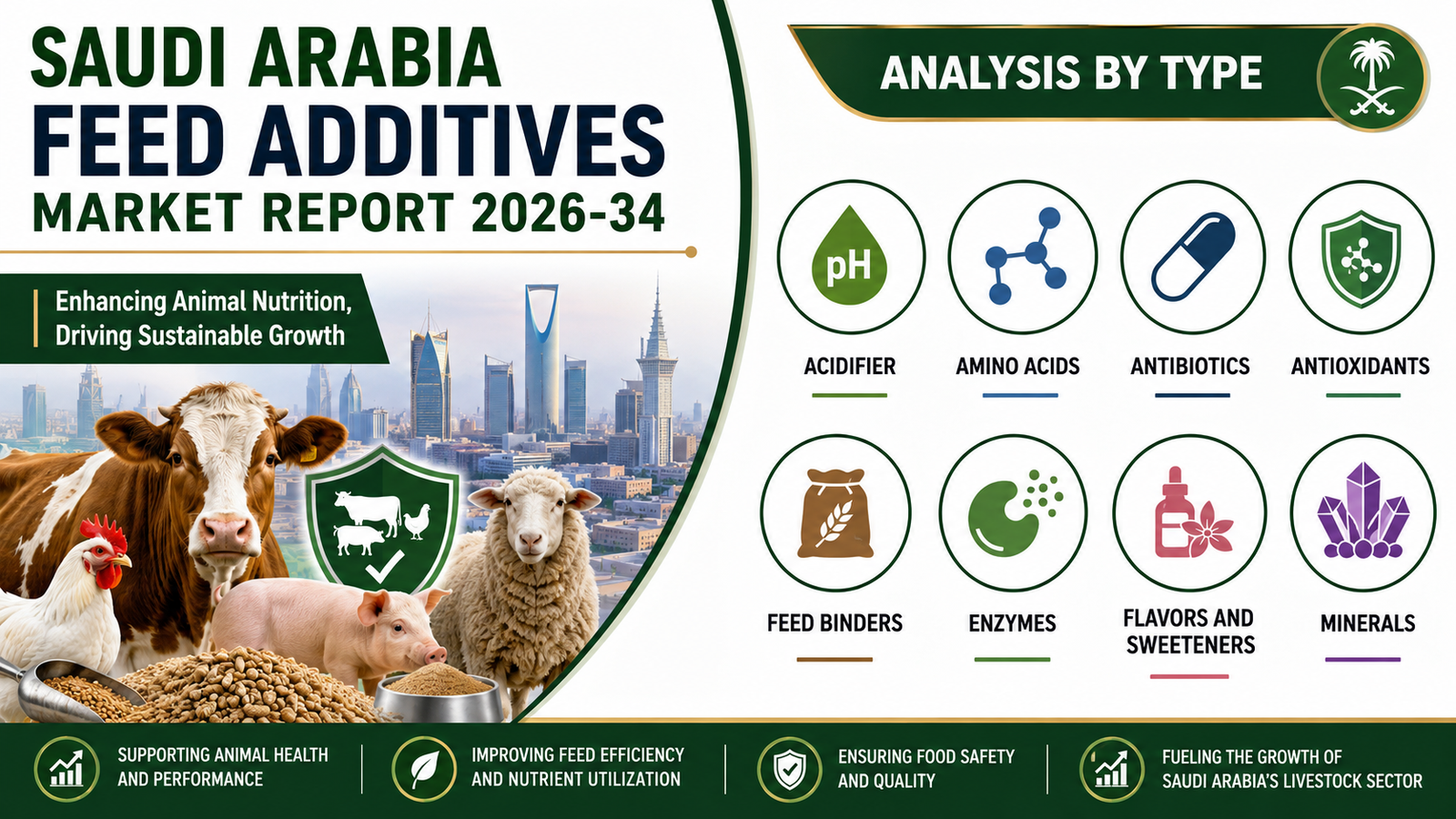
As per IMARC Group, a leading global market research and management consulting firm, has published its latest market intelligence report on the Saudi Arabia feed additives market. Saudi Arabia feed additives market size was valued at USD 471.8 Million in 2025. Looking forward, IMARC Group estimates the market to reach USD 916.0 Million by 2034, exhibiting a CAGR of 7.27% from 2026-2034, driven by rising livestock production, growing demand for nutrient-dense animal protein, expanding investments in the poultry and aquaculture sectors, and a strengthening focus on animal health, feed efficiency, and precision nutrition across the Kingdom.
The market is gaining strong momentum as Saudi Arabia’s livestock sector scales up production to meet rising domestic protein demand while aligning with the Kingdom’s food security priorities under Vision 2030. Poultry integrators, dairy producers, and aquaculture operators are increasingly turning to functional feed additives such as amino acids, enzymes, probiotics, acidifiers, and mycotoxin binders to improve feed conversion ratios, strengthen animal immunity, and reduce dependence on antibiotics. Saudi Arabia produced a record 558,000 metric tons of poultry meat in the first half of 2024, marking a 9% year-on-year rise, underscoring the scale at which feed additive demand is expanding across integrated production systems.
How AI is Reshaping the Future of the Saudi Arabia Feed Additives Market?
- AI-Driven Precision Nutrition and Feed Formulation: Machine learning platforms are enabling Saudi feed manufacturers and integrated poultry producers to analyze livestock growth data, feed conversion ratios, and environmental stress indicators in real time, allowing for the customization of amino acid, enzyme, and probiotic dosing per flock or herd, reducing feed wastage and improving productivity outcomes across large-scale commercial operations in Riyadh, Jeddah, and the Eastern Province.
- AI-Powered Quality Control and Mycotoxin Detection: Computer vision and predictive analytics tools are being deployed at feed mills and premix facilities to detect contamination, monitor ingredient consistency, and flag mycotoxin risks before additives reach the production line, addressing a documented concern after a King Saud University study found mycotoxin presence across poultry feed samples tested in the Kingdom, and helping suppliers meet Saudi Food and Drug Authority quality thresholds.
- AI-Enabled Supply Chain and Import Risk Management: Given the Kingdom’s heavy reliance on imported feed ingredients, AI-based demand forecasting and price-trend modeling tools are helping distributors and integrators manage exposure to global commodity price volatility and euro-denominated amino acid invoices, optimizing procurement timing and inventory levels for critical additive categories including vitamins, minerals, and specialty enzymes.
Grab a sample PDF of this report: https://www.imarcgroup.com/saudi-arabia-feed-additives-market/requestsample
Saudi Arabia Feed Additives Market Trends and Drivers
The Saudi Arabia feed additives market is being propelled by the structural transformation of the Kingdom’s livestock and poultry industries, which are scaling rapidly to reduce reliance on food imports and strengthen national self-sufficiency. Poultry self-sufficiency in Saudi Arabia has climbed to approximately 72%, supported by aggressive expansion from integrated producers. Almarai has announced a USD 1.8 Billion poultry expansion plan aimed at doubling production capacity, while the Ministry of Environment, Water and Agriculture finalized 29 poultry sector agreements worth SAR 5 Billion incorporating advanced production, manufacturing, and marketing technologies. These large-scale commitments are directly expanding the addressable base for feed additives, as integrated operations require consistent, high-performance nutrition programs to maintain flock health and yield across expanding capacity.
Government-backed food security initiatives under Vision 2030 are also reshaping additive adoption patterns. Financial incentives covering up to 70% of capital costs have compressed payback periods for new feed mills and premix facilities, widening the customer base for established additive suppliers capable of navigating Saudi Food and Drug Authority registration requirements. In April 2025, technology provider ANDRITZ secured a contract from Alwadi Poultry Farms Company to build a 90-ton-per-hour capacity feed mill in Riyadh Province, comprising two poultry feed lines and one ruminant feed line, illustrating the scale of infrastructure investment feeding additive demand. Available feed products in the Kingdom increased from 3,141 to 5,022 items within a single year, reflecting the rapid diversification of additive and premix offerings entering the market.
The shift toward antibiotic alternatives is another defining trend reshaping the competitive landscape. Growing regulatory attention on antibiotic use in animal feed is accelerating farmer adoption of probiotics, prebiotics, enzymes, and phytogenic additives that support gut health while reducing antimicrobial resistance risk. Acidifiers are gaining particular traction for their ability to lower digestive pH and suppress harmful bacteria, reducing antibiotic reliance while improving nutrient absorption. Poultry accounts for the largest share of additive consumption in the Kingdom, supported by the rapid growth of integrated producers such as Tanmiah, Almarai, and ARASCO, while aquaculture is emerging as a fast-growing segment as Red Sea coastal fish farming operators adopt species-specific formulations, including seaweed-derived pigments and immunomodulators, to support biosecurity and water-based nutrition needs. Sustainability efforts are reinforcing this shift as well, with initiatives such as Tanmiah’s tree-planting program using treated wastewater to grow Moringa as a local, sustainable feed ingredient, addressing the Kingdom’s high dependence on imported feed materials.
Saudi Arabia Feed Additives Industry Segmentation
The report has segmented the market into the following categories:
Breakup By Type:
- Acidifiers
- Amino Acids
- Antibiotics
- Antioxidants
- Enzymes
- Feed Binders
- Minerals
- Mycotoxin Detoxifiers
- Vitamins
- Others
Amino acids represent a leading share within the type segment, supported by their essential role in optimizing protein synthesis, growth performance, and feed efficiency across poultry and ruminant operations, while acidifiers are witnessing accelerated adoption as producers seek natural alternatives to antibiotics that enhance gut health and reduce pathogen load in the digestive system.
Breakup By Animal Type:
- Poultry
- Ruminants
- Swine
- Aquaculture
- Others
Poultry accounts for the largest animal type share, driven by the Kingdom’s rapidly expanding broiler and egg production base and the reliance of integrated producers on amino acids, enzymes, probiotics, and pigments to improve growth rates, feed conversion, and egg output, while aquaculture is registering the fastest expansion as coastal fish farming infrastructure scales along the Red Sea.
Breakup By Source:
- Natural
- Synthetic
Natural additives are gaining ground as farmers and regulators favor phytogenic, probiotic, and plant-derived solutions that align with animal welfare priorities and reduced antibiotic dependence, though synthetic additives continue to hold a substantial share given their cost efficiency and consistent performance in large-scale commercial feed formulations.
Breakup By Region:
- Northern and Central Region
- Western Region
- Eastern Region
- Southern Region
The Central Region, anchored by Riyadh, stands as the dominant production and consumption hub, combining major dairy operations, poultry farms, feed mills, and national distribution networks, supported by the concentration of integrated producers and premix facilities across the province.
Competitive Landscape
The report provides a comprehensive analysis of the competitive landscape in the Saudi Arabia feed additives market with detailed profiles of major companies, including:
- Alltech Inc.
- Cargill Inc.
- Evonik Industries AG
- BASF SE
- DSM Nutritional Products
- Kemin Industries
- ADM
- Novus International
- ARASCO Feed
- UTRIX
- Tanmiah Food Company
What Does The Full Report Cover?
If you are tracking the Saudi Arabia feed additives market for investment decisions, market entry planning, competitive benchmarking, or strategic advisory, IMARC Group’s report gives you everything in one place:
- Complete market sizing with revenue estimates and growth trajectory
- Quantified growth driver analysis with impact scoring across type, animal type, source, and regional markets
- Sub-segment breakdowns for acidifiers, amino acids, enzymes, mycotoxin detoxifiers, poultry, ruminants, aquaculture, and swine with individual share data
- Regional data across the Northern and Central, Western, Eastern, and Southern regions of the Kingdom
- Competitive profiles of leading global and domestic companies with strategic landscape assessment
- Porter’s Five Forces, value chain analysis, and pricing intelligence
- Latest product innovation trends covering natural and phytogenic additives, precision nutrition adoption, mycotoxin management, and Saudi Food and Drug Authority regulatory developments shaping market competition
Recent News and Developments in the Saudi Arabia Feed Additives Market
- June 2025: International technology company ANDRITZ secured a contract from Alwadi Poultry Farms Company to build a high-capacity feed mill in Riyadh Province with two poultry feed lines and one ruminant feed line, expected to commence operations in early 2026.
- June 2025: Poulta Inc. deployed AI-driven platforms using IoT sensors and analytics across poultry operations to enhance production efficiency and animal welfare, reflecting rising digitalization in feed and farm management.
- January 2025: Tanmiah partnered with China’s Chengdu Design Institute to construct 100 automated broiler houses equipped with Industry 4.0 technologies, expanding capacity for precision-fed poultry production.
- December 2024: UTRIX achieved HALAL certification for its feed additives and mycotoxin binders, strengthening its market access across the Middle East region.
- November 2024: Brazilian food company BRF announced a partnership with Saudi Arabia’s Halal Products Development Company to invest USD 84.3 Million in Addoha Poultry, enhancing local poultry production capacity.
- November 2025: Thailand exported 20,000 tons of pelletized cassava to Dammam port specifically for the Saudi animal feed sector, reflecting the diversification of feed ingredient sourcing supporting additive-enhanced formulations.
Note: If you require specific details, data, or insights that are not currently included in the scope of this report, we are happy to accommodate your request. As part of our customization service, we will gather and provide the additional information you need, tailored to your specific requirements. Please let us know your exact needs, and we will ensure the report is updated accordingly to meet your expectations.
Key Questions This Report Answers
- What is the current Saudi Arabia feed additives market size and what is its projected value?
- Which type segment holds the largest share in the Saudi Arabia feed additives market?
- What are the key drivers of Saudi Arabia feed additives market growth?
- Which region dominates the Saudi Arabia feed additives market and why?
- How are Vision 2030 food security initiatives, antibiotic-alternative regulations, and precision nutrition technologies reshaping product development and competitive strategies in the feed additives industry?
- Who are the top companies in the Saudi Arabia feed additives market and what are their competitive strategies?
- What are the investment and market entry opportunities across poultry, ruminant, aquaculture, and swine feed additive segments?
About Us
IMARC Group is a global management consulting firm that helps the world’s most ambitious changemakers to create a lasting impact. The company provides a comprehensive suite of market entry and expansion services. IMARC offerings include thorough market assessment, feasibility studies, company incorporation assistance, factory setup support, regulatory approvals and licensing navigation, branding, marketing and sales strategies, competitive landscape and benchmarking analyses, pricing and cost research, and procurement research.
Media and Sales Contact
IMARC Group
Email: sales@imarcgroup.com
United States: +1-201-971-6302
India: +91-120-433-0800
United Kingdom: +44-753-714-6104