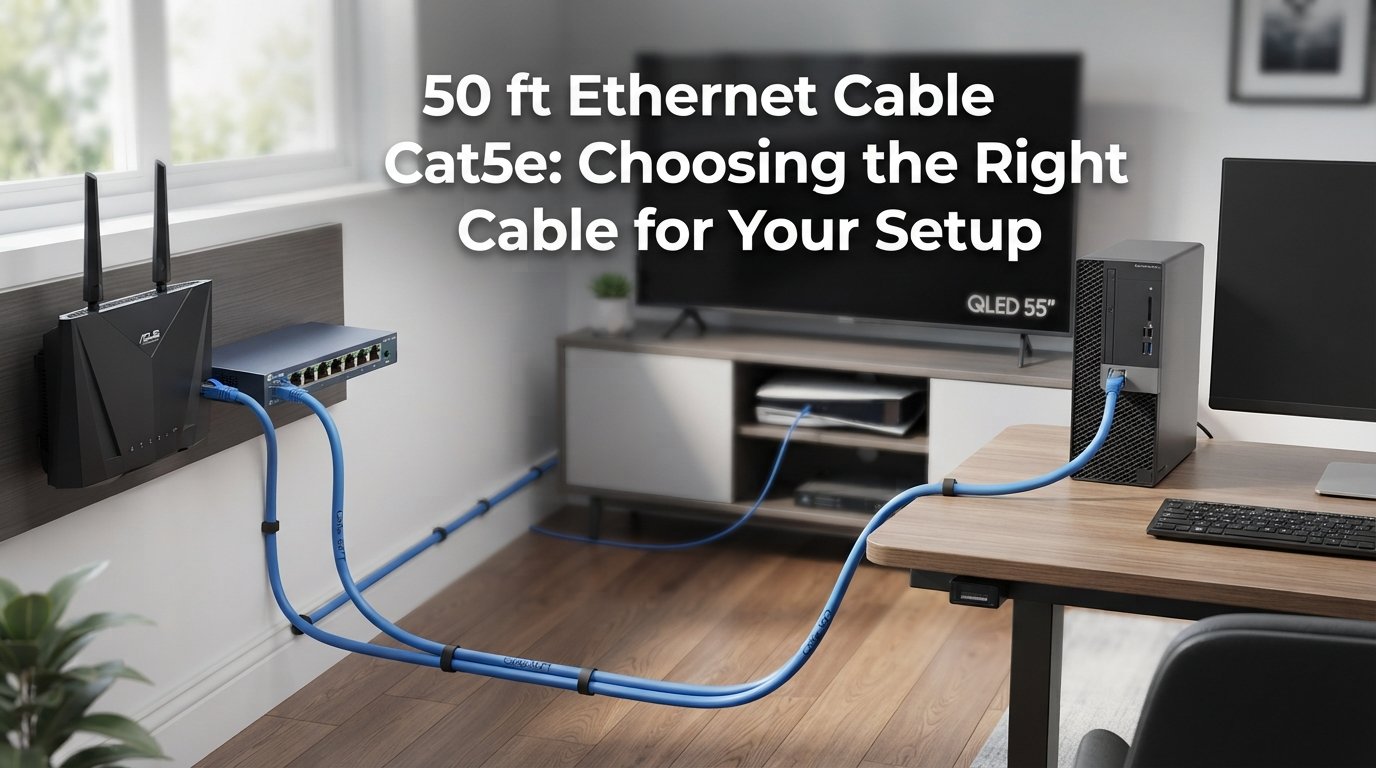
Picture this: your router sits in the living room, but your desktop computer is tucked away in a spare bedroom down the hall. Or maybe your gaming console is across the room from the nearest network jack, and Wi-Fi just isn’t giving you the stability you want during a match. A short Ethernet cable simply won’t reach in situations like these and that’s usually when people start looking at a 50 ft ethernet cable cat5e.
Fifty feet is a common length for exactly this reason. It’s long enough to bridge a room, a hallway, or even a floor, without being so excessive that you’re left with a pile of unused cable. A 50 ft Cat5e Ethernet cable tends to strike a practical balance for a lot of home and office setups.
That said, picking the right cable isn’t just about length. A few other details matter too, and they’re worth understanding before you buy.
What Is a 50 ft Ethernet Cable Cat5e?
The “50 ft” part is straightforward it’s a cable measuring fifty feet from one end to the other, giving you enough reach to connect devices that aren’t sitting right next to each other.
“Cat5e” refers to Category 5, enhanced, a widely used Ethernet cable standard built with twisted copper pairs designed to reduce signal interference. It’s common in both home and office networks, connecting devices like computers, routers, switches, and game consoles.
Cat5e supports Gigabit Ethernet speeds (up to 1000 Mbps), which covers what most typical networks actually need. Combining that capability with a 50-foot length gives you a cable that can handle everyday wired connections across a reasonable distance without requiring a cable category upgrade most home setups don’t need.
Why Choose a 50 ft Ethernet Cable?
Fifty feet covers a lot of real-world situations. Maybe you’re connecting a computer to a router that’s on the other side of the room. Maybe you’re linking a gaming console or smart TV that sits well away from your existing network jack. Or perhaps you’re running a cable between two rooms entirely, or connecting office equipment to a switch positioned across a workspace.
A 50 ft network cable can also come in handy when setting up a home office that isn’t located near the router a common scenario if your router lives near the front door but your desk is upstairs. In these cases, 50 feet often provides enough reach without going overboard on unused length.
Where Can You Use a 50 ft Cat5e Cable?
Home Office: Connecting a desktop computer, docking station, printer, or small switch to a router that isn’t nearby.
Entertainment Setup: Wiring a smart TV, gaming console, or streaming device for a steadier connection than Wi-Fi might offer in that spot.
Small Office: Linking workstations, printers, and switches that are spread across a room or between adjoining spaces.
Home Network Expansion: Extending wired connectivity to a spare room, a workspace, or another area that doesn’t currently have easy access to the network.
Each of these scenarios shares the same basic need enough cable to comfortably reach the destination without cutting corners or forcing a shorter cable to stretch further than it should.
Is 50 Feet Too Long for Cat5e?
This is a fair question, and the short answer is no 50 feet is well within the normal range for Cat5e cabling. Cat5e is rated for runs up to 100 meters (about 328 feet) before signal quality starts to degrade, so a 50-foot run is nowhere close to pushing that limit.
Length alone doesn’t make a connection unreliable. Performance depends just as much on cable quality, the connectors attached to each end, the networking equipment on either side, and how well the cable is installed. A well-made 50 ft Cat5e Ethernet cable, properly installed, should perform just as reliably as a much shorter one proper installation still matters, even at a moderate length like this.
What Type of 50 ft Cat5e Cable Should You Choose?
Not all Cat5e cables are built the same way, even at the same length.
Solid vs. Stranded: Solid conductor cable is generally better suited to permanent, structured installations the kind you set up once and leave in place. Stranded cable flexes more easily, making it a better fit for connections that get moved, adjusted, or patched more frequently.
UTP vs. Shielded: UTP (Unshielded Twisted Pair) is the standard choice for most homes and offices, and it works well in typical environments. Shielded cable adds protection against electromagnetic interference, which can matter near heavy machinery or significant electrical equipment but it isn’t something most home setups actually need.
Cable Jacket: Standard cable suits open, everyday use. Riser-rated cable is designed for vertical runs between floors, and plenum-rated cable is built for use in air-handling spaces like ceilings, where building codes may require it. The right jacket depends on where and how the cable will actually be installed.
What Should You Check Before Buying?
Before adding a cable to your cart, it’s worth reviewing a few things:
- Length: Is 50 feet genuinely enough for your route, including any turns or slack?
- Specifications: Are the Cat5e specifications clearly listed on the product?
- Conductor material: What kind of construction does the cable use?
- Connectors: Are the RJ45 connectors properly built and attached?
- Flexibility: Will the cable handle the bends and routing your setup requires?
- Jacket type: Does it match your installation environment?
- Overall quality: Are you choosing based on more than just the lowest price?
Checking these details upfront can save you from installation headaches or performance issues later on.
How to Plan a 50 ft Ethernet Cable Installation
A little planning goes a long way. Measure the actual route the cable will travel not just the straight-line distance before you buy. Decide exactly where the cable will start and end, and avoid sharp bends that can stress the internal wiring.
Where possible, keep the cable away from potential interference sources like large appliances or power cables. Avoid pinching or crushing it under furniture, and leave a bit of reasonable slack near connection points in case you need to adjust anything later. Basic cable management ties, clips, or simply routing along a baseboard keeps the whole setup tidy and easier to troubleshoot.
Common Mistakes to Avoid With a 50 ft Cat5e Cable
- Buying a cable that’s too short for the actual route.
- Assuming longer is automatically better excess cable just creates clutter.
- Ignoring solid vs. stranded construction, which affects durability and fit.
- Choosing shielded cable without needing it, adding cost with little real benefit.
- Installing the cable in the wrong environment, without checking jacket ratings.
- Bending or physically damaging the cable during installation.
- Choosing based on price alone, which can mean sacrificing build quality.
When Is a 50 ft Cat5e Cable the Right Choice?
A 50 ft Cat5e Ethernet cable tends to make sense for home offices, gaming setups, smart TVs, small offices, desktop-to-router connections, and general network expansion where devices sit a moderate distance apart.
If your route is much shorter, a shorter cable avoids unnecessary slack. If you’re planning for significantly higher bandwidth needs down the road, a higher cable category might be worth considering instead. But for most everyday setups needing extra reach, 50 feet of Cat5e fits the job well.
Final Thoughts Matching the Cable to Your Setup
A 50 ft Ethernet cable Cat5e can be a genuinely practical solution when your network needs a bit more reach than a standard short cable provides. But choosing the right one involves more than just length cable construction, shielding, jacket type, and your specific installation environment all play a part.
The simplest approach: measure your route, understand what your network actually needs, and choose the cable that fits the job not just the one that happens to be nearby or cheapest.