Introduction
Imagine a bank file with statements for several accounts. Tech Leads IT uses this scenario in Oracle Fusion Financials Training because it looks confusing at first. Most statements import cleanly, but one fails on an unrecognized transaction code. The bank corrects it and resends the package, so the repaired statement loads while the earlier ones return duplicate errors.
That is not a contradiction. A single file can hold successful, failed, corrected, and duplicate outcomes together. Learners in an Oracle Fusion Financials Online Training session or an Oracle Fusion Financials Course should keep both files, statuses, and error details, then prove every statement exists exactly once and the repair is complete.
Separate File Status From Statement Status in Oracle Fusion Financials Training
Start by listing what the original file actually contained. For every bank account and statement, note the bank’s statement ID, the opening and closing dates, the currency, the opening and closing balances, the line count, any control totals the bank supplied, and the processing status. Then record the overall file status on its own line.
The two levels tell you different things. A file-level error usually means at least one statement in the package failed, even if others loaded perfectly well. A statement-level error narrows the problem down to the validation of that one statement. Keeping them apart protects you from two opposite mistakes. The first is resubmitting everything because you assume the file produced nothing. The second is treating a handful of successes as proof that the whole package was processed.
This is exactly the habit that good Oracle Fusion Financials Training should build early. Learners tend to look at one status and stop. Reconcile the file manifest to the individual outcomes before you correct anything, and you’ll know precisely which content still needs another chance to import and which content is already sitting safely in the system.
Use the Error to Choose Between Retry, Purge, and Correction
When something goes wrong, there are several ways to recover, and they are not interchangeable. Oracle’s own documentation on bank statement processing and troubleshooting draws a line between types of failure. Some can be restarted from the point where they broke. In other cases, such as when the wrong file was fetched, the bad file may need to be purged before the right one is loaded.
So the first question is always where the failure happened. Was it during retrieval, during load, or during import? Did data reach the interface tables, or did it get as far as the statement tables? The answer shapes the fix.
For an undefined transaction code inside an otherwise healthy statement, ask whether an existing internal code already means the same thing and can simply be mapped. If it doesn’t, a genuinely new code may need to be set up. Whatever you decide, don’t purge a good imported population just because one sibling statement failed. And don’t lean on retry to rescue a file that was the wrong bank delivery to begin with. Write down the stage you observed and the recovery action you chose, side by side, so anyone reviewing the case later can follow your reasoning.
Treat Duplicate Detection as a Boundary in Oracle Fusion Financials Online Training
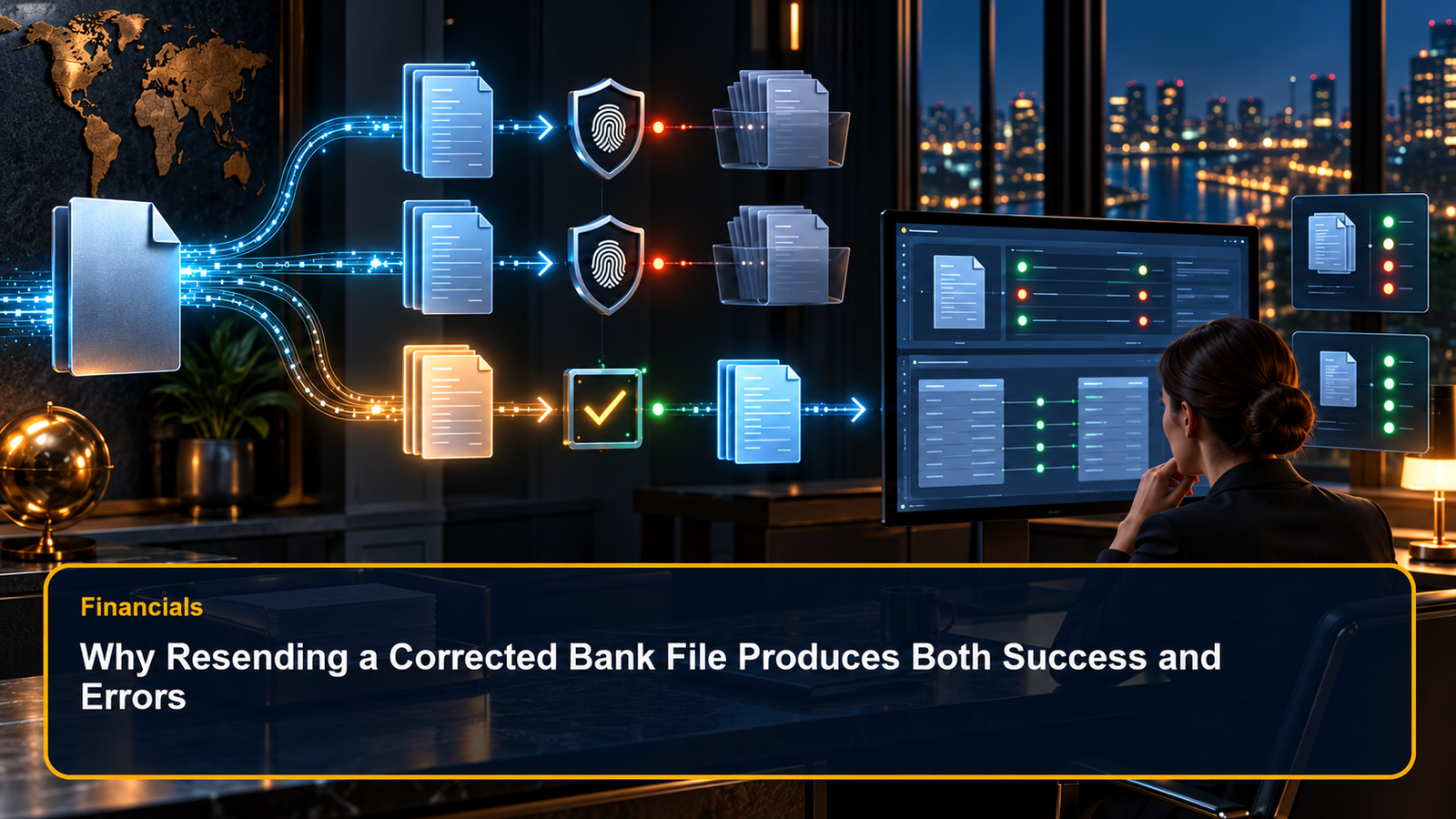
Now to the part that confuses people most. When the corrected delivery repeats statements that were already imported, duplicate detection flags those repeats as errors and lets the new or corrected content through. That isn’t the system misbehaving. It is drawing a line around records it has already accepted.
You shouldn’t try to suppress those warnings just to make the request look clean. Instead, compare the identifying details of each repeated statement against the existing record, and confirm that the lines and balances weren’t loaded a second time. Then find the repaired statement and prove its corrected version is now present.
This is a point worth spending real time on in Oracle Fusion Financials Online Training, because a request showing both success and errors invites the wrong conclusion. File-level success or failure is the wrong thing to reconcile to. The assertion that matters is one complete, accepted statement for each expected account and period.
Keep one trap in mind. If the bank changed an identifier on the corrected statement, simple duplicate recognition may not catch it. You’d then need to check whether the system can see the continuity, or whether both versions need controlled review by a person.
Map Transaction Codes Without Erasing Their Meaning
A new external transaction code is more than a technical string. It stands for bank-reported activity, and it can influence the transaction type, the reconciliation behavior, and sometimes the creation of downstream transactions.
Ask the bank for its definition of the code and a few sample lines. Then compare the economic meaning with your existing internal codes. If one already serves the same purpose, a reviewed mapping lets established processing carry on as it should. If the activity is genuinely different, create and test the new setup under change control, rather than squeezing it into whichever category happens to be convenient.
Look closely at debit and credit orientation, and at charges, interest, returns, and transfers. Check the reference fields your reconciliation relies on, too.
Here’s the part people skip: a successful import only proves the statement passed validation. It says nothing about whether the mapped code leads to sensible accounting or correct matching. Trace at least one line all the way through reconciliation, and through any external transaction generated from it. You want to see that the classification, amount, date, currency, and account treatment still reflect what actually happened at the bank.
Reconcile Two Deliveries as One Business Population
Once the repair is done, stop thinking of the original and corrected files as two separate events. Build one combined control schedule that covers both deliveries.
Begin with the bank’s expected statement manifest, not with whatever the application happened to accept. For each statement, show the first-run outcome, the second-run outcome, the accepted record, how the duplicate was handled, the line count, the balance sequence, and the reconciliation status.
Then add a few checks that catch problems early. Tie each opening balance to the prior accepted closing balance wherever that control makes sense, and look into any gaps or overlaps in statement dates. Compare the repeated statements between the two files as well. A record labeled “duplicate” can hide a revision the bank made, and your organization still needs to understand that revision. If the bank did change a statement you had already imported, follow your governed correction process. Don’t treat the duplicate result as acceptance of the new version.
Finally, confirm that the repaired account didn’t miss a day while the issue sat unresolved. Also make sure no automated reconciliation or cash position quietly consumed incomplete data without an exception being raised.
Design Recovery Tests in an Oracle Fusion Financials Course
The best time to learn all this is before the bank changes something. A well-built Oracle Fusion Financials Course can turn this scenario into a hands-on lab.
Set up a controlled package with several statements. Include one valid statement, one duplicate of a statement already in the system, one with an unmapped transaction code, and one with a deliberately invalid functional attribute. Before running anything, predict the statuses at both file level and statement level. Then run the approved import path and compare what you predicted with what you got.
Next, fix the code issue and resubmit the full package. You should see the repaired statement import while the existing ones stay singular. Also test the wrong-file case, so operators can tell when a purge is truly required and when a retry or corrected resubmission is the better move.
Pay attention to access design as well. The ability to fetch files, purge them, map codes, import statements, and reconcile them shouldn’t collapse into one unreviewed sequence in the hands of a single person. Keep the test manifest and the evidence as an operating playbook, and update it whenever formats, transaction codes, bank accounts, retrieval channels, or reconciliation rules change.
Conclusion
A corrected bank file can produce a repaired import and duplicate errors in the same run. Tech Leads IT teaches this in Oracle Fusion Financials Training by separating file status from statement status, finding where the original failure happened, and reconciling both deliveries to one expected set of statements. Duplicate detection protects accepted records, but you need to compare content, check changed identifiers, and confirm mapped codes keep their meaning.
That makes it an exercise for Oracle Fusion Financials Online Training batch or Oracle Fusion Financials Course. Learners classify outcomes, choose a recovery path, and build a two-delivery schedule. Success isn’t a warning-free run; it’s proof the books are complete.