
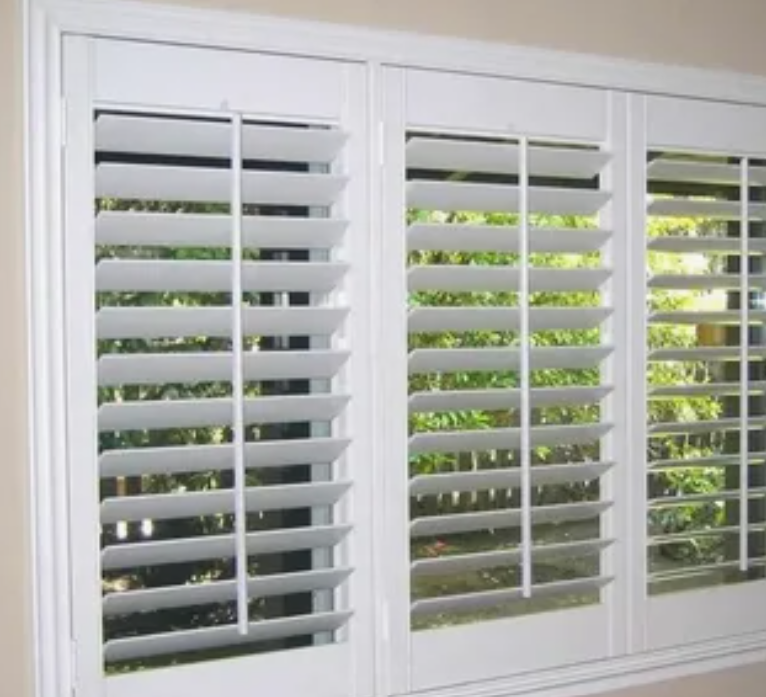
Plantation shutters show up in a lot of discussions about home improvement, and for good reason. They’ve been around long enough to prove they hold up, they work with most interior styles, and they handle the practical demands of Texas living better than a lot of the alternatives. For homeowners in Friendswood specifically, there are a few reasons they come up as often as they do.
The Basics of What Plantation Shutters Are
Plantation shutters are interior shutters made up of hinged panels with horizontal louvers that can be tilted open, closed, or angled anywhere in between. They mount inside or directly over the window opening on a frame and become part of the window rather than just something hanging in front of it.
The louvers, typically 2.5 to 4.5 inches wide, control how much light enters and at what angle. Wider louvers let in more light when open and provide a more open view. Narrower louvers offer a more traditional look and work well in smaller windows. The choice between them comes down to the size of the window and the overall style of the room.
Materials break into two main categories: real wood and composite. Real wood shutters have a more natural grain and feel, but they’re sensitive to humidity and temperature changes. Composite shutters, made from materials like MDF wrapped in a vinyl shell, or engineered wood products, don’t react the same way to moisture, which matters a lot in a place like Friendswood.
Why Friendswood Is a Good Fit for Plantation Shutters
Friendswood’s climate makes material durability a real concern for anything installed near a window. Between summer heat, humidity, and the occasional storm system that pushes moisture into areas it normally wouldn’t reach, materials that expand, warp, or degrade over time become a problem. Composite shutters handle this environment well. They don’t swell with humidity or crack from heat cycles the way real wood can, and they hold their finish without much maintenance.
Beyond durability, the insulation effect of plantation shutters is worth mentioning in a market where cooling costs are significant. The panels create a physical barrier at the window that slows heat transfer into the room. That doesn’t replace window glazing or proper sealing, but it does add a layer of passive insulation that reduces how hard the air conditioning has to work, particularly in rooms with west or south-facing windows that take the most direct sun.
Sun Management in Friendswood Homes
Managing sun exposure is one of the most practical reasons homeowners in this area turn to plantation shutters. The louver system lets you control the angle of incoming light with real precision. You can tilt them to let in morning light while blocking the high-angle afternoon sun, or close them fully during the hottest part of the day and open them again in the evening when the temperature drops.
This kind of control is harder to achieve with roller shades or blinds, which are essentially either open or closed. Shutters give you a range of positions in between, which is useful for managing how a room feels throughout the day without sacrificing natural light entirely.
How Plantation Shutters Affect Home Value
Real estate agents and appraisers in the Houston area generally consider plantation shutters a home improvement that adds perceived value. Because they’re custom-fitted to the window and installed as a fixed feature, they’re treated more like a permanent upgrade than a removable accessory. When a home sells, the shutters stay, which is an appealing detail for buyers who don’t want to immediately start replacing window coverings.
In Friendswood, where the housing market draws buyers looking for move-in-ready homes with quality finishes, having shutters already installed and in good condition is a selling point worth noting. It signals that the home has been maintained with care and that the details were handled correctly.
Long-Term Cost Comparison
The upfront cost of plantation shutters is higher than most other window treatments. That’s a real consideration. What shifts the comparison is longevity. Blinds and shades typically need to be replaced every five to ten years depending on quality and use. Plantation shutters installed correctly can last the life of the home without needing replacement, only occasional cleaning and minor adjustments.
Over a 20-year period, the cost difference between replacing blinds twice and maintaining shutters once tends to close significantly. For homeowners who plan to stay in a home long-term, shutters often end up being the more cost-effective option.
Getting the Installation Right
The quality of a shutter installation has a direct impact on how well they perform and how long they last. Panels that aren’t hung level will sag over time and stop closing flush. Louvers that are set with too much or too little tension will either flop open or be too stiff to adjust easily. Frames that aren’t fit correctly to the window opening leave gaps that defeat the purpose of having shutters at all.
Gulf Coast Blind & Shutter has been installing plantation shutters in Friendswood and throughout the Greater Houston Area for over 27 years. Kim Van Wieren handles every step personally, the measurement, the product selection, and the installation, which means there’s a consistent standard applied from the first consultation to the final walkthrough. For a product that’s meant to last decades, that kind of hands-on approach tends to produce better results than a process split between a sales team and a separate installation crew.
Plantation Shutters Are Worth the Consideration
They’re not the right choice for every window or every budget, but for homeowners in Friendswood who want a window covering that holds up to the climate, improves the room’s insulation, and adds lasting value to the home, plantation shutters are worth serious consideration. The key is getting the material right for the room and making sure the installation is done carefully from the start.