
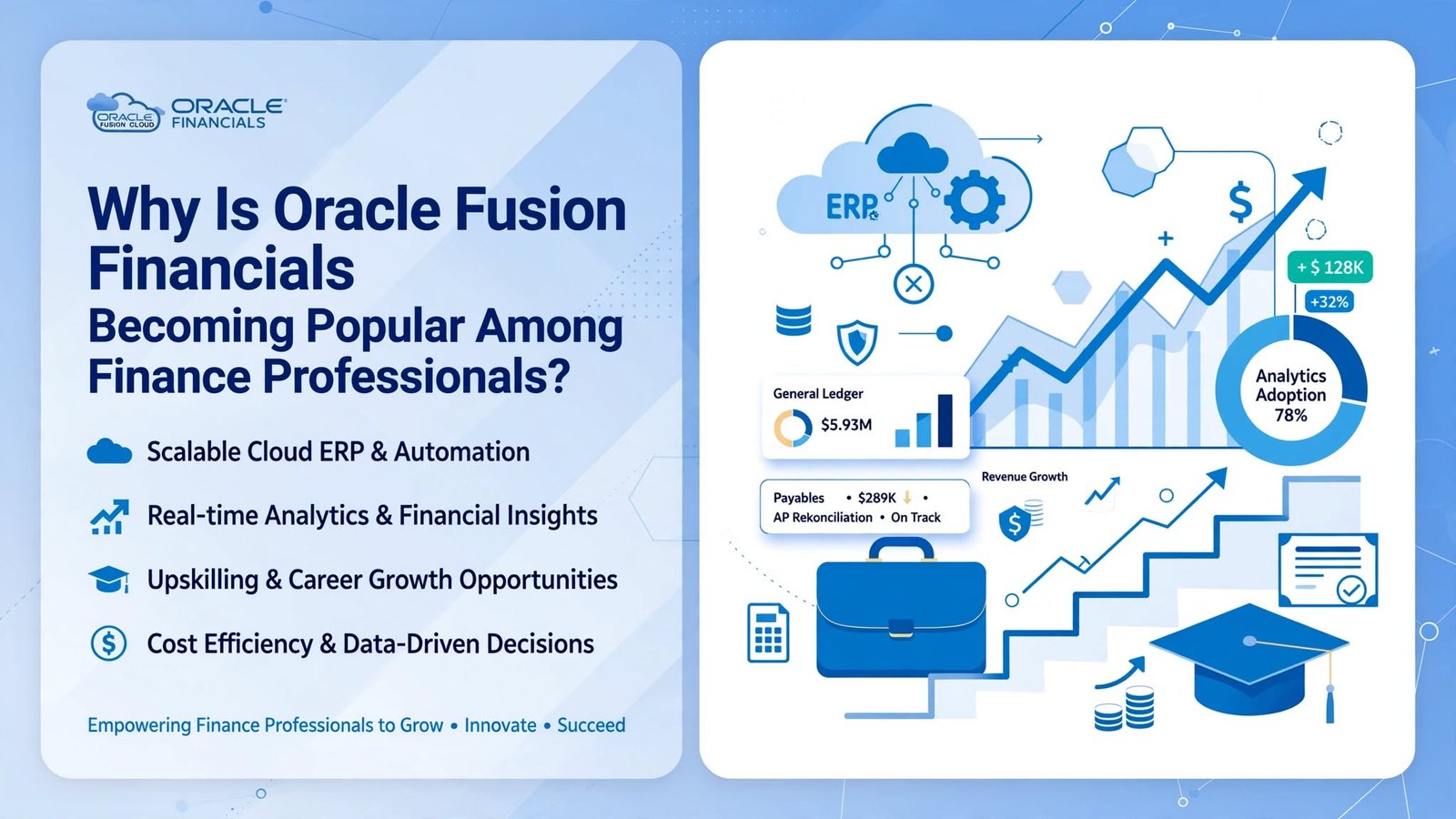
Introduction
Ask a few finance teams what they dread most, and month-end close usually tops the list. Soft Online Training has watched more and more accountants, analysts, and controllers move toward Oracle Fusion Financials to make that routine far less painful. The shift isn’t hype. It comes from real, everyday frustrations that older systems never really fixed. If you’re thinking about Oracle Fusion Financials Training in Hyderabad, it helps to understand what’s driving this popularity first.
It Takes the Pain Out of Month-End Close
Most finance professionals have lived through the spreadsheet scramble at the end of a period. Someone exports a report, someone else matches it against another report, and a mismatch turns up at 9 p.m. on the last working day.
Oracle Fusion Financials tackles this at the root. Payables, Receivables, Fixed Assets, and General Ledger all sit on one platform, so subledger transactions flow into the ledger without constant re-keying. Period close becomes a controlled process instead of a guessing game. You can see which subledgers are still open, which journals are unposted, and where the exceptions are sitting.
For a finance manager, that visibility is a big deal. You spend less time chasing numbers and more time confirming that they’re right.
Real-Time Reporting Changes How Finance Teams Work
Older systems often forced a choice: run the transactions or run the reports. Oracle Fusion Financials has reporting built right into the application, so the numbers you see are the numbers as they stand now, not as they stood last night.
Dashboards, analyses, and drill-down options let you start at a summary balance and trace it back to the individual transaction. That matters when a CFO asks, “Why is this expense line up 18%?” and wants an answer in the meeting, not next week.
It also changes the nature of the finance role. Instead of acting as the team that produces reports after the fact, finance professionals become the people who can explain performance while decisions are still being made.
Why Oracle Fusion Financials Training in Hyderabad Is Attracting Finance Professionals
Hyderabad has become one of India’s biggest hubs for technology companies, global capability centers, and shared service operations. Many of these organizations run their finance back offices on Oracle Cloud, and they need people who can actually work in the system, not just talk about it.
That demand is pushing finance professionals to look for Oracle Fusion Financials Training in Hyderabad. The appeal is practical. Someone who already understands payables, receivables, or general ledger accounting can pick up the Fusion way of doing things and step into roles that were out of reach before.
Hands-on practice matters here. Reading about configuration is one thing. Setting up a ledger, defining accounting rules, and running a payment process yourself is something else, and employers can tell the difference in interviews.
Automation Frees Up Time for Real Analysis
Ask any finance professional how much of their week goes to repetitive work, and the answer is usually uncomfortable. Entering invoices, matching payments, calculating depreciation, and creating recurring journals can eat hours that should go toward analysis.
Oracle Fusion Financials automates much of this. Invoice approvals follow defined workflows. Subledger Accounting rules create journal entries consistently, so two similar transactions don’t end up coded differently because two different people handled them. Depreciation runs on schedule. Intercompany transactions can be balanced by rules rather than by hand.
None of this replaces the finance professional. It removes the dull parts of the job so that judgment, review, and analysis get more of your time. That trade is a big reason people who’ve used the system tend to speak well of it.
Cloud Access, Security, and Regular Updates
Another quiet reason for the growth is the cloud model itself. Finance teams no longer need to depend on heavy infrastructure or long upgrade projects. Oracle delivers updates on a regular cycle, so new features arrive without a major re-implementation every few years.
Security and control are built in as well. Role-based access means a person sees and does only what their job requires. Approval trails and audit history make it easier to answer auditors, because the record of who did what and when already exists.
For finance leaders worried about compliance, this is reassuring. For professionals on the ground, it means fewer awkward audit conversations and cleaner evidence when questions come up.
How Oracle Fusion Financials Training in Hyderabad Supports Career Growth
There’s a straightforward career argument too. As more companies move to Oracle Cloud, the pool of people who truly understand Fusion Financials stays smaller than the number of open roles. That gap usually shows up in better opportunities and stronger pay conversations.
Good training covers more than screens and menus. It should walk you through how a transaction travels from invoice entry to the ledger, how accounting is created, how periods are closed, and how to troubleshoot when something doesn’t behave as expected. That last skill is what separates someone who can follow a demo from someone a team can rely on.
Finance professionals who already hold an accounting background have an edge, since they understand why the system behaves the way it does. Adding Fusion skills to that foundation makes the profile much more attractive, whether you’re aiming for a functional consultant role, a senior accountant position, or a finance systems lead.
Final Thoughts
Oracle Fusion Financials isn’t popular because it’s fashionable. It’s popular because it addresses the daily problems finance teams face: slow closes, scattered data, repetitive manual work, and limited visibility. When those problems ease, the whole department works differently.
If you want to build these skills with practical guidance, Soft Online Training offers a path worth exploring, especially through Oracle Fusion Financials Training in Hyderabad. Start with the core modules, practice real scenarios, and build confidence one process at a time. The finance professionals who do this now are putting themselves in a strong position for the years ahead.