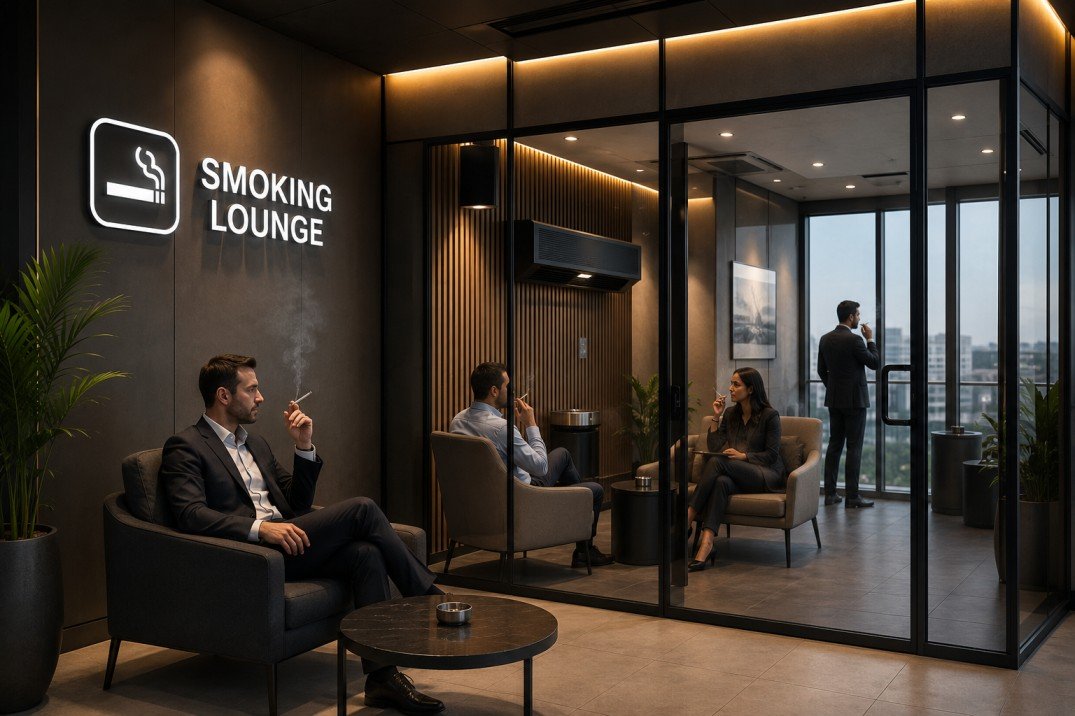
Businesses today are paying greater attention to how smoking is managed within commercial environments. Poorly planned smoking areas can create odour, cleanliness, ventilation and customer-experience concerns, particularly in busy workplaces and public facilities. A properly designed smoking facility provides a controlled location where smoking can take place without unnecessarily affecting surrounding areas. For many organisations, smoking lounges have therefore become a practical way to manage designated smoking spaces while maintaining better control over indoor and outdoor environments.
What Are Smoking Lounges?
Smoking lounges are purpose-built spaces designed to accommodate smokers while controlling smoke, odour and air movement. Depending on the application, they may be installed inside specially ventilated areas or supplied as enclosed standalone units.
Their design can include mechanical ventilation, filtration, controlled airflow, durable surfaces, seating, lighting and other practical features. The objective is not simply to provide a place to smoke, but to separate smoking activity from areas used by non-smokers.
This distinction is particularly relevant for airports, workplaces, hospitality venues, commercial buildings and other locations where large numbers of people share the same environment.
Why Businesses Need Controlled Smoking Areas
Without a defined location, smokers may use entrances, parking areas, corridors, balconies or other convenient spaces. This can create several operational problems.
A dedicated facility gives management greater control over where smoking occurs. It can also make cleaning schedules easier to organise and reduce the likelihood of cigarette waste being left around entrances or common areas.
For businesses, the value is often connected to practical site management rather than simply providing an amenity. A well-planned smoking area can form part of a broader approach to maintaining cleaner and more organised premises.
Improving Air Quality Management
One of the main reasons organisations consider enclosed smoking facilities is air management. Smoke can spread beyond an informal smoking area through doors, pedestrian movement and air currents.
A properly engineered facility can use extraction and filtration systems to manage contaminated air. The exact configuration depends on factors such as occupancy, location, unit size and local requirements.
For example, an airport smoking lounge may require substantially different ventilation capacity from a small workplace facility because passenger volumes can vary considerably throughout the day.
Air management should be considered during the design stage rather than added as an afterthought. Ventilation capacity, extraction points and airflow direction all influence how effectively smoke is contained.
Supporting Workplace Management
Workplaces face a particular challenge because employees may need access to a designated smoking location without exposing other workers to second-hand smoke or persistent odours.
A dedicated smoking room for office India can be considered where the building layout and applicable regulations permit such an installation. The facility needs to be planned around occupancy, ventilation, access, cleaning and the overall workplace environment.
The location also matters. Placing a smoking facility immediately beside a main entrance may undermine its purpose if smoke or odour can still reach people entering the building. Positioning, airflow and separation from high-traffic areas are therefore important parts of the planning process.
A Practical Option for Commercial Properties
Commercial properties often have competing requirements. They need to provide functional facilities while protecting the appearance and usability of the surrounding space.
Modern smoking lounges can be configured for different environments, including offices, hotels, entertainment venues, transport facilities and industrial sites. Materials need to withstand frequent use and should be relatively straightforward to clean.
For organisations operating in India, an air conditioned smoking room India project may involve additional considerations related to local climate, electrical requirements, ventilation and indoor comfort. The technical specification should be based on the intended location and expected usage rather than relying on a standard configuration for every project.
Why Customisation Matters
Every commercial site has different space limitations and operational requirements. A facility designed for a large transport terminal may not be appropriate for a corporate office or hospitality property.
A smoking lounge manufacturer India may therefore need to consider dimensions, ventilation capacity, filtration, electrical infrastructure, access arrangements, materials and installation conditions before finalising a design.
Customisation can also extend to seating capacity, lighting, internal finishes and maintenance access. These details influence how practical the facility is over its operating life.
Outdoor and Standalone Applications
Not every business needs an enclosed room within an existing building. Outdoor facilities can provide an alternative where suitable space is available.
A smoking cabin can be positioned in a designated external area while keeping smoking activity away from building entrances and general pedestrian zones. Depending on its design, it may incorporate ventilation, filtration, lighting and weather-resistant construction.
Businesses may also work with an outdoor smoking zone manufacturer when they require a purpose-built external facility rather than adapting an existing part of the property.
What Businesses Should Consider Before Installation
Before selecting a facility, businesses should evaluate the site and expected usage carefully. Key considerations include:
- Available floor area and installation location
- Expected number of users at peak periods
- Ventilation and filtration requirements
- Electrical and mechanical infrastructure
- Cleaning and maintenance access
- Protection from weather where applicable
- Accessibility and user movement
- Applicable building, workplace and smoking regulations
These factors help determine whether a standalone cabin, enclosed room or another type of facility is appropriate.
The Role of Filtration and Ventilation
Filtration and ventilation are two different but related aspects of smoking facility design. Ventilation removes or redirects contaminated air, while filtration systems can capture particulate matter and other components from extracted air.
The effectiveness of a system depends on its engineering, airflow rate, filter configuration, maintenance and operating conditions. Filters also require scheduled replacement to maintain performance.
For this reason, businesses should consider the ongoing operating requirements when assessing an installation. A system that performs well initially can become less effective if filters, fans or other components are neglected.
SmokinMe and Commercial Smoking Facilities
SmokinMe operates in the smoking facility sector, with products and solutions designed for controlled smoking environments. Its work covers applications where businesses require a dedicated facility rather than an informal smoking point.
Depending on the project, this can involve enclosed smoking cabins, filtration systems and purpose-designed installations. The appropriate configuration ultimately depends on the site, expected occupancy and technical requirements.
The concept of designated smoking area solutions is particularly relevant for organisations trying to separate smoking activity from general public or employee areas while maintaining an organised facility.
Cost Versus Long-Term Operational Value
The cost of a smoking facility depends on its size, construction, ventilation, filtration, installation requirements and additional equipment. Comparing only the initial purchase price can overlook long-term operating considerations.
Businesses should also assess electricity consumption, filter replacement, cleaning requirements, component servicing and expected lifespan. A lower-cost installation may not necessarily provide better value if it requires frequent maintenance or cannot accommodate expected usage.
In some commercial environments, additional equipment such as a vending kiosk may be incorporated into the surrounding smoking area, although this depends on the site’s purpose and local regulations.
Pro Tip
Pro Tip: Before purchasing a smoking facility, measure the available space and estimate peak occupancy rather than average occupancy. This provides a more realistic basis for determining ventilation capacity, internal dimensions and the number of users the facility needs to accommodate.
Conclusion
Businesses invest in smoking lounges because they provide a structured way to manage smoking within commercial environments. They can help organisations establish defined smoking locations, improve control over smoke and odour, simplify site management and separate smoking activity from general-use areas.
The right solution depends on the building, location, occupancy, climate, ventilation requirements and applicable regulations. Whether the requirement involves an internal facility, an external cabin or a larger commercial installation, proper planning is more important than selecting a standard product based solely on appearance or initial cost.
Frequently Asked Questions
1. Why do businesses install smoking lounges?
Businesses install smoking lounges to create a clearly defined smoking location and reduce the spread of smoke and odour into common areas. They can also make cleaning and site management more organised.
2. Are smoking lounges suitable for offices?
They can be suitable for certain workplaces where local regulations and building conditions allow them. The design should consider ventilation, occupancy, location, access and separation from non-smoking areas.
3. What ventilation is required in a smoking lounge?
The required ventilation depends on the size of the facility, number of users, construction and airflow design. A qualified specialist should determine the appropriate extraction and filtration requirements for the installation.
4. Can smoking facilities be installed outdoors?
Yes. Outdoor facilities can be designed as standalone cabins or designated structures. Weather resistance, electrical connections, location, ventilation and user capacity should be considered during planning.
5. How often do smoking lounge filters need replacement?
There is no universal replacement interval. Filter life depends on usage, smoke volume, filter type and operating conditions. Manufacturers typically establish maintenance schedules based on the specific filtration system.
Also Read:- Benefits of Indoor Smoking Cabin in India