
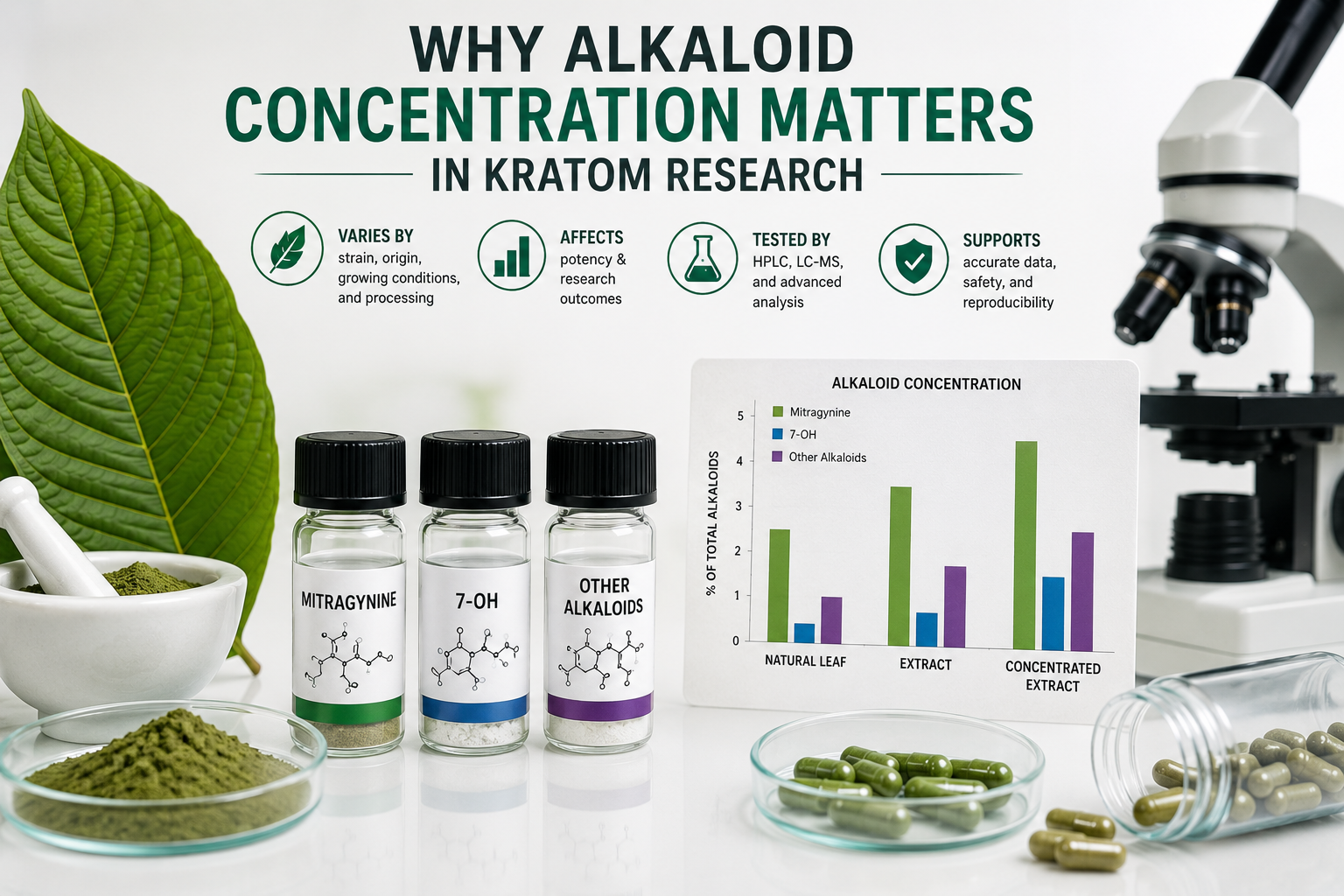
Kratom (Mitragyna speciosa) is a botanical species containing numerous naturally occurring alkaloids. Researchers studying kratom often focus on compounds such as mitragynine and 7-hydroxymitragynine (7-OH), but understanding their concentration is just as important as identifying their presence.
The amount of an individual alkaloid can vary considerably between samples, extracts, and concentrated formulations. For this reason, concentration is an important part of interpreting kratom chemistry and research findings.
What Is an Alkaloid Profile?
An alkaloid profile describes the different alkaloids present in a particular kratom sample and their relative amounts.
Mitragynine is generally the predominant alkaloid in natural kratom, while 7-OH normally occurs at much lower levels. Other compounds, including paynantheine, speciogynine, and speciociliatine, contribute to the broader chemical profile.
Two samples can therefore both be identified as kratom while having different concentrations of individual compounds.
Natural Variation in Kratom
Alkaloid concentration is influenced by numerous factors.
Plant genetics, geographic origin, environmental conditions, maturity, harvesting practices, drying, and storage can all affect the chemical composition of kratom. Processing methods may introduce additional variation.
This natural variability is important when comparing research results. A study conducted using one chemically characterized sample may not necessarily represent every kratom preparation.
Why 7-OH Concentration Gets Attention
7-hydroxymitragynine is particularly important when discussing concentration because it is normally present only in small quantities in natural kratom leaf.
The FDA describes naturally occurring 7-OH as a minor constituent, generally representing less than 2% of the total alkaloid content of natural kratom. Concentrated products can contain substantially higher levels.
This difference means that concentrated 7-OH products can have a chemical profile that differs significantly from traditional botanical kratom.
Concentration and Pharmacological Research
Concentration matters because biological activity can depend on the amount of a compound present.
Laboratory research has demonstrated that 7-OH interacts strongly with the mu-opioid receptor, while mitragynine interacts with several receptor systems. The relative amounts of these compounds can therefore influence the pharmacological characteristics being studied.
However, laboratory receptor activity does not automatically predict effects or safety in humans.
Researchers must consider concentration alongside factors such as route of administration, metabolism, exposure duration, and interactions with other compounds.
Extracts Can Change the Chemical Profile
Extraction can alter the relative proportions of naturally occurring alkaloids.
A traditional leaf preparation contains the plant’s broader chemical mixture. An extract may concentrate certain constituents, while highly refined products can contain predominantly selected compounds.
Recent research has identified commercial products with unusually high 7-OH concentrations compared with typical natural kratom
These findings make concentration an important consideration when comparing traditional kratom with newer concentrated formulations.
Why Testing Matters
A product label can provide useful information, but laboratory analysis provides a more reliable way to characterize chemical composition.
Researchers commonly use analytical techniques such as HPLC, LC-MS, and mass spectrometry to identify and quantify individual alkaloids.
Testing can help establish:
- Mitragynine concentration
- 7-OH concentration
- Other alkaloid levels
- Chemical purity
- Potential impurities
- Batch-to-batch variation
- Presence of unexpected compounds
This information can make research results easier to interpret and compare.
Concentration and Research Reproducibility
Standardized concentrations are particularly important for scientific studies.
If researchers use samples with significantly different alkaloid profiles, two experiments may produce different results even when the experimental design is otherwise similar.
Careful reporting of alkaloid concentrations allows other researchers to understand exactly what material was studied and makes independent replication easier.
This is one reason modern kratom research increasingly emphasizes analytical characterization before biological testing.
Natural Does Not Mean Standardized
It is also important to recognize that natural kratom is not chemically identical from sample to sample.
The term “natural” describes the botanical source, but it does not guarantee a fixed concentration of every alkaloid. Environmental and biological factors can produce measurable differences between plants and harvests.
Consequently, researchers should avoid assuming that a particular alkaloid concentration represents all natural kratom.
Concentration and Safety Research
Concentration is also relevant when interpreting safety data.
Evidence obtained from traditional leaf preparations may not directly apply to highly concentrated extracts or isolated alkaloid products. The FDA has specifically raised concerns about concentrated 7-OH products and distinguishes them from the naturally occurring levels found in ordinary kratom leaf. (fda.gov)
For this reason, researchers should consider the actual chemical composition and concentration of the material being studied rather than relying solely on a general product category.
The Importance of Complete Chemical Profiles
Focusing on one alkaloid provides only part of the picture.
Kratom contains numerous compounds that may interact with biological systems in different ways. The relationship between these compounds, their concentrations, and their metabolism remains an active area of research.
A complete alkaloid profile can therefore provide more useful information than a single measurement.
Final Thoughts
Alkaloid concentration is one of the most important variables in kratom research.
Mitragynine, 7-OH, and other kratom alkaloids can occur at substantially different levels depending on the plant and how the material is processed. Concentrated products can further alter these proportions, producing chemical profiles that may differ considerably from traditional leaf.
For researchers, documenting concentration helps improve reproducibility, chemical characterization, interpretation of pharmacological findings, and comparison between different samples.
As research into kratom continues, accurate analytical testing and standardized reporting will remain essential for understanding how differences in alkaloid concentration relate to the chemistry and biological activity of different kratom preparations.