
A fine mechanical watch is built to last, but even exceptional craftsmanship cannot make every component immune to age. Years of movement, daily wear, accidental knocks, moisture, and ordinary friction can eventually affect individual parts. When that happens, luxury watch part replacements can play an important role in restoring performance while helping preserve the character of a cherished timepiece.
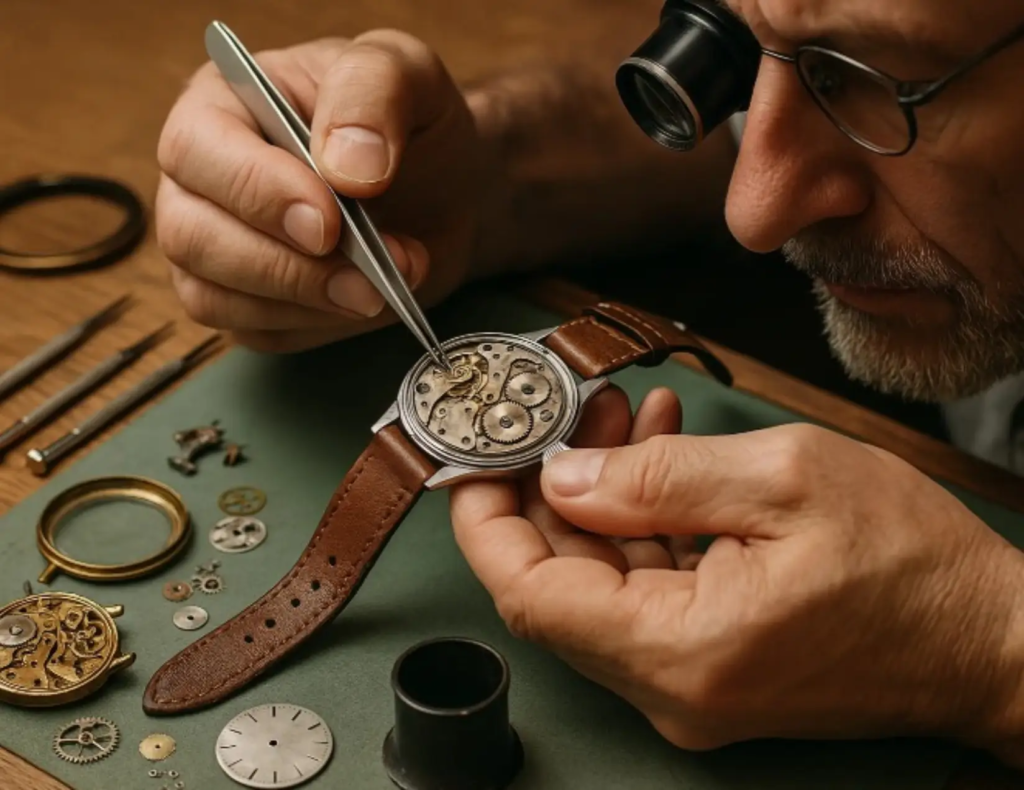
For collectors and owners, replacing a component may sound straightforward. In reality, it requires considerable care. A mechanical watch contains dozens or even hundreds of precisely manufactured pieces, and every component has a specific role. Choosing the wrong replacement or fitting a part incorrectly can affect accuracy, reliability, water resistance, and even the long-term condition of the watch.
Understanding when replacement is appropriate—and why professional expertise matters—can make maintaining a luxury timepiece much easier.
Every Component Has a Purpose
Look at a luxury watch from the outside and its construction may appear relatively simple.
There is a case, a dial, hands, crown, crystal, and bracelet or strap.
Inside, however, lies a remarkably complicated miniature machine.
Gears transfer energy through the movement. Springs store and release power. Jewels reduce friction. Screws secure tiny components. The balance and escapement regulate the movement.
Even seemingly insignificant pieces can have an important function.
A damaged screw, worn wheel, weakened spring, or deteriorated gasket may affect other components if the problem is ignored.
That is why professional assessment should come before replacing anything.
Why Parts Eventually Wear Out
Mechanical watches operate continuously.
Even when sitting quietly on a wrist, numerous components are moving inside the case.
Over time, friction can cause gradual wear. Lubricants can lose their effectiveness. Repeated winding can affect components connected to the crown. Bracelet links can loosen through constant movement.
External parts face environmental exposure as well.
A crystal may develop scratches.
A bezel can suffer an impact.
A crown can become worn.
Seals may gradually lose their ability to protect the case from moisture.
None of this necessarily indicates poor construction.
Wear is simply part of the life cycle of a mechanical object.
Movement Components Require Precision
Movement repairs are among the most technically demanding forms of luxury watch maintenance.
A watchmaker may discover that a particular wheel no longer meets the necessary tolerance. A pivot could be worn, a spring could have lost its ideal characteristics, or another small component could have been damaged by an impact.
Replacing that part requires more than finding something that looks similar.
The replacement must be compatible with the movement.
Its dimensions must be correct.
Its interaction with neighboring components must be appropriate.
Once installed, the movement should be tested to ensure that the repair has restored proper operation.
Precision is essential because mechanical watch components work together as a system.
The Crown and Stem
The winding crown is one of the components that owners interact with most frequently.
It may be used to wind the movement, adjust the time, and operate calendar functions.
Behind the crown is the stem, which connects the external control to the movement.
Because these components are handled repeatedly, they can eventually experience wear.
Signs such as unusual looseness, difficulty winding, resistance during adjustment, or an inconsistent feel can indicate that professional inspection is necessary.
Replacing a worn crown or stem can sometimes restore normal operation while preventing further strain on the movement.
Crystal Replacement Can Transform Appearance
A watch crystal protects the dial and hands from the outside environment while allowing the wearer to read the time.
Scratches, chips, and cracks can compromise both appearance and protection.
Minor scratches may sometimes be addressed depending on the material and condition, but severely damaged crystals may need replacement.
The replacement must match the watch’s specifications carefully.
Thickness, shape, dimensions, and sealing requirements all matter.
A crystal is not simply a transparent piece of material.
It is part of the watch’s protective architecture.
A correctly fitted replacement can restore clarity while helping maintain the integrity of the case.
Gaskets Are Small but Essential
Gaskets rarely attract attention because they are usually hidden.
Yet these small sealing components can be critical to a watch’s protection against moisture and dust.
Over time, rubber and other sealing materials can deteriorate.
Temperature changes, aging, and repeated opening of the case can influence their condition.
When a watch undergoes servicing, technicians may inspect relevant gaskets and recommend replacement where necessary.
This is particularly important when the watch is expected to retain water resistance.
A tiny seal can have a surprisingly important job.
Bracelet Components Can Wear Too
The bracelet is another area where replacement parts may become necessary.
Regular wear can gradually affect links, pins, screws, clasp components, and other elements.
A bracelet that once felt solid may eventually develop noticeable movement between links.
A clasp may become less secure.
Individual screws or pins may require attention.
Replacing only the affected component can sometimes be preferable to replacing an entire bracelet.
This approach preserves the original structure while addressing the specific source of the problem.
Hands and Dials Need Special Care
Cosmetic components require a particularly delicate approach.
Hands are extremely thin and can be bent or damaged during improper handling.
Dials may have delicate finishes, applied markers, textures, or decorative details that are difficult to reproduce.
For vintage watches, original dials and hands can also carry significant historical value.
Replacing them simply because they show signs of age may not always be desirable.
In many cases, preservation is more important than making an older watch look completely new.
A professional can evaluate whether restoration, conservation, or replacement is the most appropriate route.
Vintage Watches Present Different Challenges
Replacing parts on a modern luxury watch can already require expertise.
Vintage timepieces can be even more complicated.
Older components may have aged naturally.
Certain original parts may be difficult to find.
Some replacement components may differ subtly from historical versions.
Collectors may therefore want to preserve originality wherever possible.
A modern-looking replacement could potentially change the character of an older watch.
For this reason, vintage servicing should take the watch’s history into consideration rather than focusing exclusively on cosmetic perfection.
Originality Versus Functionality
One of the most important decisions in luxury watch part replacements involves balancing originality with reliable operation.
Suppose an older component is worn but still functional.
Should it remain?
Or should it be replaced before failure occurs?
There is no universal answer.
Collectors, owners, and watchmakers may have different priorities.
A daily wearer may place greater emphasis on dependable performance.
A vintage collector may prioritize original components.
A valuable heirloom may require a particularly conservative approach.
The right decision depends on the watch, its condition, intended use, and long-term goals.
Why Matching Matters
Luxury watch components are not universally interchangeable.
Even parts that appear nearly identical can differ in important ways.
Dimensions, materials, tolerances, finishes, and mechanical characteristics may all vary.
Using an unsuitable component can create unnecessary pressure or friction within the movement.
That can potentially lead to additional wear.
Professional technicians therefore need to identify the correct part before installation.
The objective is not merely to make the watch function temporarily.
The repair should support dependable performance over the long term.
Replacement Does Not Mean Losing Character
Some owners hesitate when they hear that a component needs to be replaced.
They may worry that the watch will no longer feel original.
That concern is understandable.
However, carefully selected replacement parts can help preserve a watch for many more years.
The key is determining which components are appropriate to replace and which should be preserved.
Replacing a deteriorated gasket is very different from replacing an original vintage dial.
Changing a severely damaged crystal is different from refinishing an entire case.
Every decision should consider the watch’s history and purpose.
The Role of a Skilled Watchmaker
Luxury watch repair requires patience.
A technician needs to work at a scale where tiny mistakes can have significant consequences.
Specialized tools, magnification, timing equipment, cleaning systems, and testing equipment can all contribute to a successful repair.
Experience matters just as much.
A trained watchmaker can recognize signs of wear that may not be obvious to an owner.
They can distinguish between a component that genuinely needs replacement and one that can continue functioning safely.
That judgment can be extremely valuable.
For owners seeking professional assistance with valuable timepieces, AG Watch Repair provides expertise focused on maintaining and restoring luxury watches while giving careful attention to individual repair requirements.
The Importance of Testing After Replacement
Installing a new component is not necessarily the final step.
A properly repaired watch should be evaluated afterward.
Depending on the work performed, testing may involve accuracy, power reserve, winding behavior, calendar operation, water resistance, or other functions.
This verification process helps determine whether the replacement has integrated correctly into the movement or case.
For mechanical watches, testing is especially important because a component can appear correctly installed while still requiring adjustment.
The goal is to ensure that the complete system works harmoniously.
Preventive Replacement Can Be Valuable
Not every replacement happens after a component breaks.
Sometimes, a technician identifies a part that has become significantly worn during routine servicing.
Replacing it before complete failure may prevent damage to surrounding components.
This is particularly useful for parts that are inexpensive compared with the potential consequences of a larger movement problem.
Preventive maintenance can therefore be an investment in the watch’s future.
It is often easier to replace one compromised component than to repair several parts damaged because the original problem was ignored.
Caring for a Watch After Repair
Once a replacement has been completed, owners can help protect their timepiece through sensible daily habits.
Avoid unnecessary impacts.
Keep the crown correctly secured.
Do not expose the watch to water beyond its intended capabilities.
Pay attention to unusual sounds or changes in accuracy.
Have the watch inspected if winding suddenly feels different.
Keep the exterior clean using appropriate methods.
Most importantly, do not force a component that feels stuck.
Mechanical resistance can sometimes indicate a problem that requires professional attention.
Preserving the Story Behind the Watch
Luxury watches often become valuable because of the stories attached to them.
A timepiece may have accompanied its owner through decades of professional achievements, family celebrations, journeys, and everyday experiences.
Replacing a worn component does not erase that history.
Instead, it can help preserve the physical object that carries those memories.
A properly restored watch can continue to accompany its owner rather than becoming something that remains permanently inside a drawer.
That is perhaps one of the most meaningful aspects of careful watch maintenance.
Knowing When Replacement Is the Right Choice
Luxury watch part replacements should never be approached as a routine matter of swapping old pieces for new ones.
Every component contributes to the performance, appearance, and identity of a timepiece.
The best repair decisions come from careful inspection, appropriate parts, skilled installation, and thorough testing.
Whether the issue involves a movement wheel, crown, crystal, gasket, bracelet component, clasp, or another part, professional evaluation can help determine the most sensible solution.
A luxury watch is a remarkably intricate object, but it is also a lasting possession.
With thoughtful maintenance and carefully selected replacements, a timepiece that has experienced years of wear can continue performing beautifully.
After all, the purpose of repairing a cherished watch is not simply to make it work again.
It is to give its craftsmanship more time—and perhaps allow its story to continue for another generation.