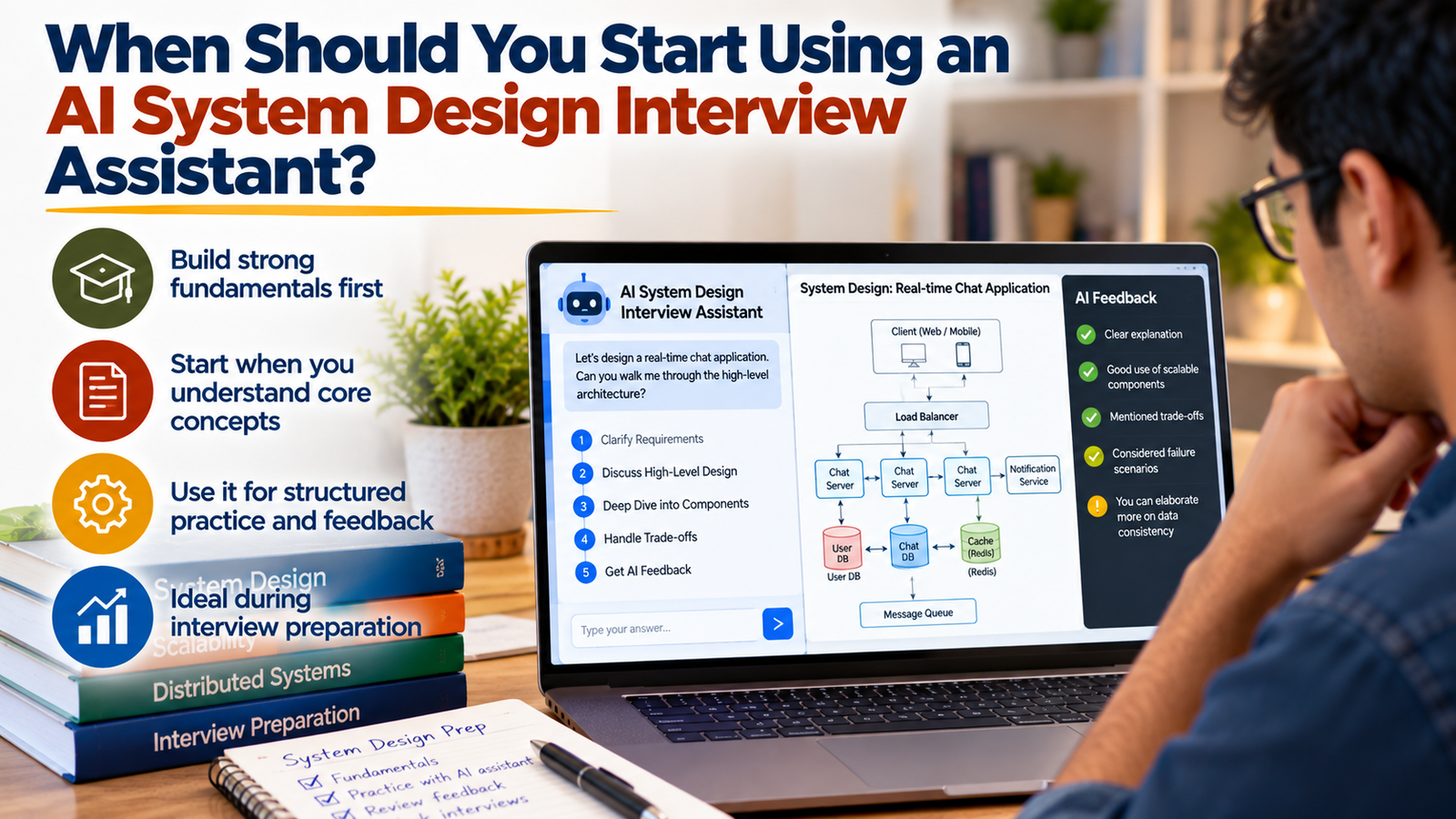
Introducing AI assistance before building basic system design knowledge can encourage candidates to follow generated architectures without knowing why particular choices work. However, waiting until every concept feels mastered can delay useful practice. The right starting point depends less on a fixed number of weeks before an interview and more on readiness. Candidates generally gain greater value once they can attempt a basic design independently, explain several architectural choices, and recognise where their reasoning becomes uncertain. At that stage, structured feedback can expose gaps while still requiring candidates to develop their own technical judgement.
Start After You Can Attempt a Basic Design
Candidates do not need advanced distributed-systems expertise before introducing AI-assisted practice. However, they should recognise enough foundational concepts to make basic architectural decisions without requesting a complete solution immediately.
Useful foundations include:
- client-server communication and APIs;
- relational and non-relational databases;
- caching and load balancing;
- replication and partitioning;
- queues and asynchronous processing;
- storage and data flow;
- availability, consistency, latency, and scalability.
Knowing the terminology alone does not indicate readiness. Instead, candidates should be able to connect these concepts to simple decisions. For example, they should have some reasoning for choosing a database, introducing a cache, or processing work asynchronously.
Look for Practical Readiness Signals
A useful starting point arrives when candidates can independently move from requirements towards a plausible high-level architecture, even when that first design contains weaknesses.
Consider introducing structured AI practice when you can:
- clarify basic functional and non-functional requirements;
- identify major system components;
- discuss likely scale where relevant;
- choose a plausible storage approach;
- describe basic data flow;
- identify obvious bottlenecks;
- justify several architectural decisions;
- discuss at least some technical trade-offs.
Imperfection at this stage is useful. Feedback has greater value when there is already reasoning to challenge. An ai system design interview coach can then question an existing architecture, expose missing considerations, or encourage comparison between alternatives rather than supplying the entire design from the beginning.
Why Starting Too Early Can Weaken Preparation
System design requires reasoning rather than reproducing familiar diagrams. If candidates repeatedly request complete architectures before attempting problems, they may memorise patterns without recognising the assumptions behind them.
For instance, copying a cache into every design does not demonstrate architectural judgement. A candidate should determine what needs caching, where the cache belongs, how stale data affects the system, and whether added complexity solves a relevant problem.
Starting too early can also encourage candidates to accept technology choices, capacity assumptions, or database decisions without evaluating alternatives. Consequently, familiarity with a polished architecture can create an inaccurate impression of independent ability.
Change AI Use as Preparation Progresses
AI assistance should not remain constant throughout preparation. Instead, candidates can reduce support as their independent reasoning improves.
Early Preparation
During the early stage, concentrate on terminology, foundational concepts, requirement clarification, and simple architecture exercises. Attempt each problem first, then request feedback on specific uncertainties.
For example, candidates might ask for criticism of a storage choice after explaining their reasoning rather than requesting an entire architecture immediately.
Middle Preparation
Once basic designs become manageable, move towards complete exercises involving bottlenecks, failure scenarios, database choices, APIs, scaling decisions, and deeper trade-offs.
At this stage, repeated practice can reveal patterns. A candidate may consistently select storage before clarifying read and write behaviour, introduce infrastructure without establishing need, or overlook failure conditions.
Later Preparation
As the interview approaches, practise realistic end-to-end sessions with fewer interruptions. Clarify requirements, design the architecture, analyse bottlenecks, and discuss trade-offs before reviewing automated feedback.
Reducing assistance tests whether previous practice has produced independent reasoning rather than dependence on prompts.
Use Feedback to Expose Application Gaps
Passive study can create familiarity with concepts without proving that candidates can apply them. Structured questioning can reveal that difference quickly.
A candidate may know caching terminology yet struggle to explain what should be cached, how invalidation should work, or what happens as traffic grows. Similarly, someone may recognise replication but struggle to discuss consistency, failure handling, or operational complexity.
Such gaps provide useful preparation targets because system design interviews commonly require candidates to justify decisions in context.
Practise Requirements Before Drawing Architecture
Architecture decisions become easier to defend after candidates establish relevant requirements. Before selecting technologies, practise clarifying major features, expected users, read and write patterns, scale assumptions, latency expectations, availability needs, and consistency requirements.
Not every exercise requires detailed numerical estimates. However, relevant assumptions should shape the architecture.
For example, a read-heavy service may raise different caching and replication considerations from a write-heavy workload. Requirement clarification therefore prevents candidates from treating architecture as a fixed template.
Make Trade-Off Discussion a Core Practice Skill
System design rarely offers one universally correct architecture. Candidates should practise comparing options according to requirements rather than presenting technologies as automatically superior.
Useful comparisons may include relational versus non-relational storage, synchronous versus asynchronous processing, vertical versus horizontal scaling, and precomputation versus computation on demand.
Moreover, candidates should explain the consequences of each choice. Adding infrastructure may improve one property while increasing operational complexity. Stronger consistency may suit one workflow but create different availability or latency considerations elsewhere.
Challenge Designs With Bottlenecks and Failures
After producing a basic architecture, candidates should challenge it systematically. Useful questions include:
- Which component becomes constrained first as traffic increases?
- What happens if a service becomes unavailable?
- Could one database become a bottleneck?
- Where might latency increase?
- What happens when a queue develops a backlog?
- How does the system respond to partial failures?
Later practice can also consider retries, duplicate messages, replication, network problems, and database failures where relevant. The purpose is not to add complexity automatically, but to determine whether the architecture behaves reasonably when assumptions change.
Know When to Reduce Assistance Further
Once candidates can complete a reasonable design exercise, they should increasingly work without prompts. A useful independent session should include requirement clarification, scope definition, architecture creation, storage selection, data-flow explanation, bottleneck analysis, trade-off discussion, and responses to changing requirements.
If frequent hints remain necessary, candidates can identify which underlying concepts require additional study rather than requesting increasingly detailed generated solutions.
After reviewing feedback, closing the assistant and reproducing the reasoning independently provides another useful test. Candidates should be able to explain why each major component exists, which alternatives they considered, what might fail, and which assumptions shaped their decisions.
Add Human Practice at the Right Stage
Human mock interviews become particularly valuable once candidates can sustain a complete design discussion. A skilled reviewer can introduce unpredictable follow-up questions, interpret ambiguous explanations, challenge assumptions, and provide interpersonal feedback.
Automated practice offers repetition and targeted questioning, while human sessions introduce conversational variation. Therefore, candidates can use both methods at different preparation stages without treating either as universally superior.
Automated feedback also has limitations. It may overlook valid alternatives, make questionable assumptions, recommend unnecessary complexity, or suggest technologies without sufficient context. Candidates should evaluate feedback critically rather than treating it as an authoritative answer key.
During actual interviews, candidates should also follow the employer’s stated rules regarding outside assistance. Preparation tools should strengthen independent reasoning, not replace it where external support is prohibited.
Conclusion
Candidates should introduce AI-assisted system design practice once they can attempt basic architectural reasoning independently, even if their designs remain incomplete. That point allows feedback to challenge real decisions rather than substitute for foundational knowledge. As preparation develops, candidates should move from limited feedback towards complete exercises, deeper trade-off analysis, failure reasoning, and increasingly independent sessions. Human mock interviews can add further realism later. The goal is not to produce the most elaborate architecture with assistance, but to build reasoning that remains clear, adaptable, and defensible when no prompts are available.