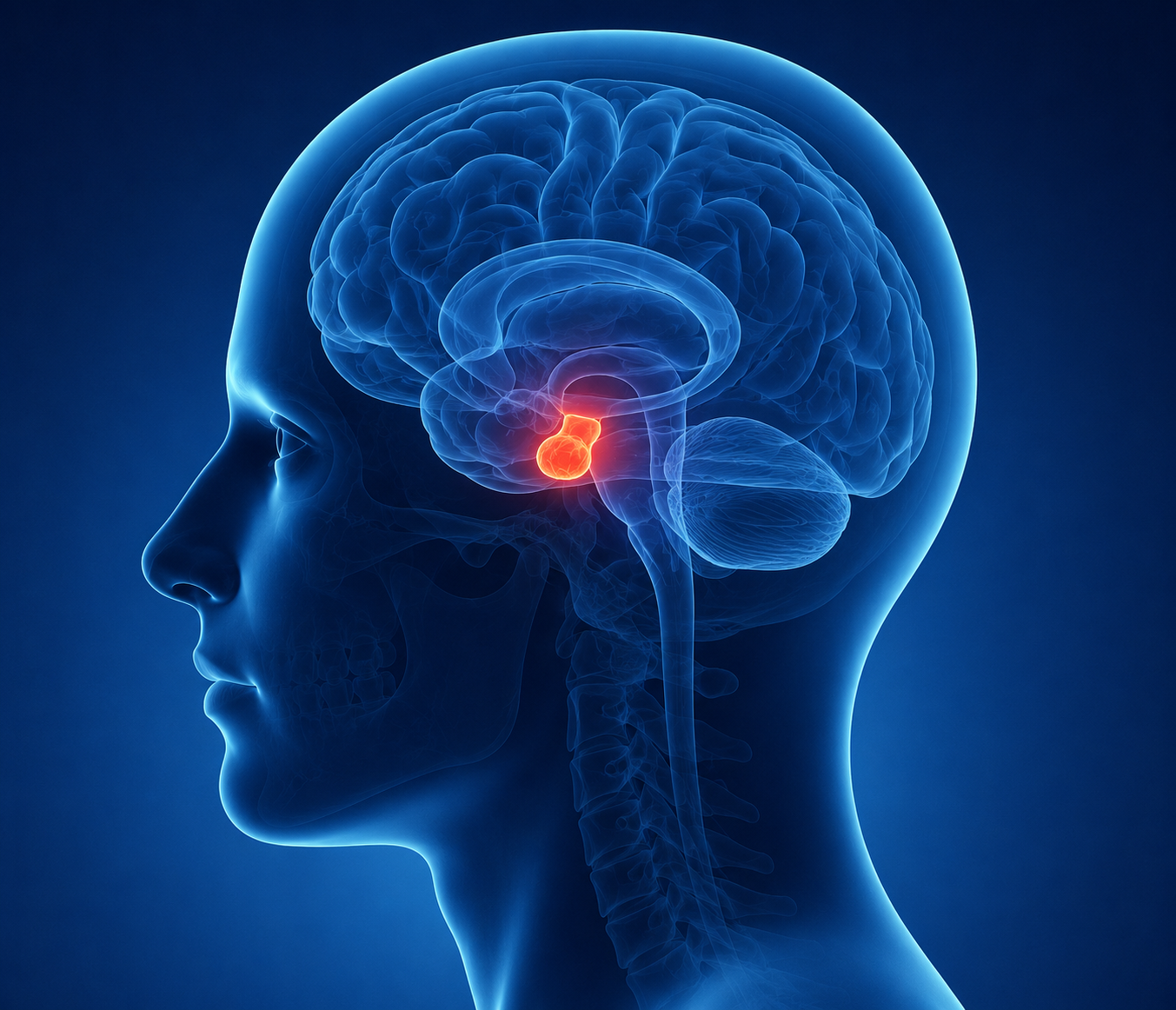
The identification of a pituitary tumor may prove challenging owing to the common nature of its initial symptoms, which could appear in the form of headaches, fatigue, hormonal imbalance, or even vision changes. Despite its small size, equivalent to that of a pea, the pituitary gland is responsible for controlling numerous hormones. The majority of pituitary tumors are harmless, but they might interfere with visual acuity, hormonal balance, and general well-being.
What Is a Pituitary Tumor?
A pituitary tumor is an abnormal growth that develops in or around the pituitary gland at the base of the brain. Many are called pituitary adenomas and are non-cancerous.
Doctors generally classify these tumors as functioning or non-functioning:
- Functioning tumors produce excessive amounts of specific hormones.
- Non-functioning tumors do not produce significant excess hormones but may cause symptoms by growing and pressing on nearby structures.
Because symptoms differ considerably, an accurate diagnosis requires more than simply looking at an MRI scan.
When Should You Consult a Specialist?
You should consider specialist evaluation when symptoms are persistent, unexplained, or occur in combination.
1. Persistent or unusual headaches
Headaches can have many causes, and most are not related to a pituitary tumor. However, persistent headaches accompanied by visual changes, hormonal symptoms, or other neurological problems deserve medical assessment.
2. Changes in vision
A growing pituitary mass can press against the optic nerves or optic chiasm. Some patients develop reduced peripheral vision, double vision, or difficulty seeing clearly.
A practical warning sign is noticing that you are frequently missing objects or people approaching from the side. Vision changes should not be ignored, particularly when an MRI has already identified a pituitary-region lesion.
3. Unexplained hormonal changes
Hormonal symptoms may sometimes be the first clue. These can include:
- Irregular or absent menstrual periods
- Unexplained infertility
- Reduced sexual drive
- Erectile dysfunction
- Unexpected breast milk production
- Unexplained weight changes
- Excessive thirst or urination
- Unusual changes in facial features, hands, or feet
For example, a prolactinoma can cause elevated prolactin, which may affect reproductive function in both men and women. Many prolactinomas respond well to medication, so identifying the tumor type before considering surgery is important.
4. An MRI has detected a pituitary lesion
Sometimes a pituitary lesion is discovered accidentally during an MRI performed for another reason. This does not automatically mean surgery is necessary.
The next step may involve hormone testing, assessment of visual function, review of the MRI characteristics, and regular imaging. Some small, asymptomatic lesions can be monitored rather than treated immediately.
How Is a Pituitary Tumor Evaluated?
A specialist evaluation usually brings together several pieces of information rather than relying on one test.
Step 1: Review symptoms and medical history
The doctor looks for headache patterns, visual symptoms, menstrual or sexual changes, weight changes, medication use, and other endocrine symptoms.
Step 2: Perform hormone testing
Blood tests may assess pituitary and related hormones. The exact tests depend on the symptoms and suspected tumor type.
Step 3: Review pituitary MRI
A dedicated MRI can help determine the lesion’s size, location, growth pattern, and relationship with nearby structures.
Step 4: Assess vision when appropriate
If the lesion is close to or pressing on the optic apparatus, formal visual-field testing may be recommended.
Does Every Pituitary Tumor Need Surgery?
Absolutely not. This is one of the key points that patients should understand.
Treatment is dependent upon the nature of the tumor, its size, hormone secretion activity, symptoms, progression, and the influence of the lesion on neighboring structures. It may involve monitoring, pharmacotherapy, surgical removal, radiotherapy, and combined methods.
To name one of the examples, prolactinoma is usually managed by drugs known as dopamine agonists. When pharmacological treatment is insufficient or impossible, surgery may be an alternative.
When surgery is indicated, many tumors of the pituitary gland can be accessed through the nose by means of transsphenoidal surgical approach without opening of the cranium.
Common Mistakes Patients Should Avoid
Waiting for severe symptoms: Vision loss or significant hormonal problems should not be treated as something to simply watch at home.
Assuming every tumor is cancer: Most pituitary tumors are benign. Their location and hormonal effects can nevertheless make them clinically important.
Focusing only on the MRI report: A scan provides important anatomical information, but hormone evaluation and clinical assessment are also essential.
Assuming surgery is always required: Some tumors can be managed successfully with medicines or careful monitoring.
Pro Tips Before Your Appointment
Bring your MRI images and report, previous hormone-test results, medication list, and a short record of symptoms. Keep track of when your symptoms first appeared and note any changes in their severity, frequency, or pattern over time.
Ask practical questions such as:
- What type of pituitary lesion is this?
- Is it producing excess hormones?
- Is my vision affected?
- Does it require treatment now?
- Would monitoring be appropriate?
- If surgery is recommended, why is it necessary?
A coordinated approach between neurosurgery, endocrinology, radiology, and ophthalmology can be valuable when a tumor affects both hormonal function and nearby visual structures.
When Is Urgent Medical Attention Needed?
A sudden severe headache accompanied by new visual problems, vomiting, confusion, weakness, or altered consciousness requires urgent medical assessment. Rarely, bleeding into a pituitary tumor, known as pituitary apoplexy, can produce an acute neurological or visual emergency.
Conclusion
Consultation with a Pituitary Tumor Specialist in Noida would be advisable if persistent headaches, hormonal changes for no particular reason, vision problems, or detection of a pituitary lesion in an MRI scan are a cause of concern. Not only would it help in diagnosis, but it would also provide details about the tumor itself such as the type, hormonal functioning, size, and impact on the neighboring parts.
In case you have been detected with a pituitary lesion or having any of the above-mentioned symptoms, you should plan for a consultation with a pituitary specialist.