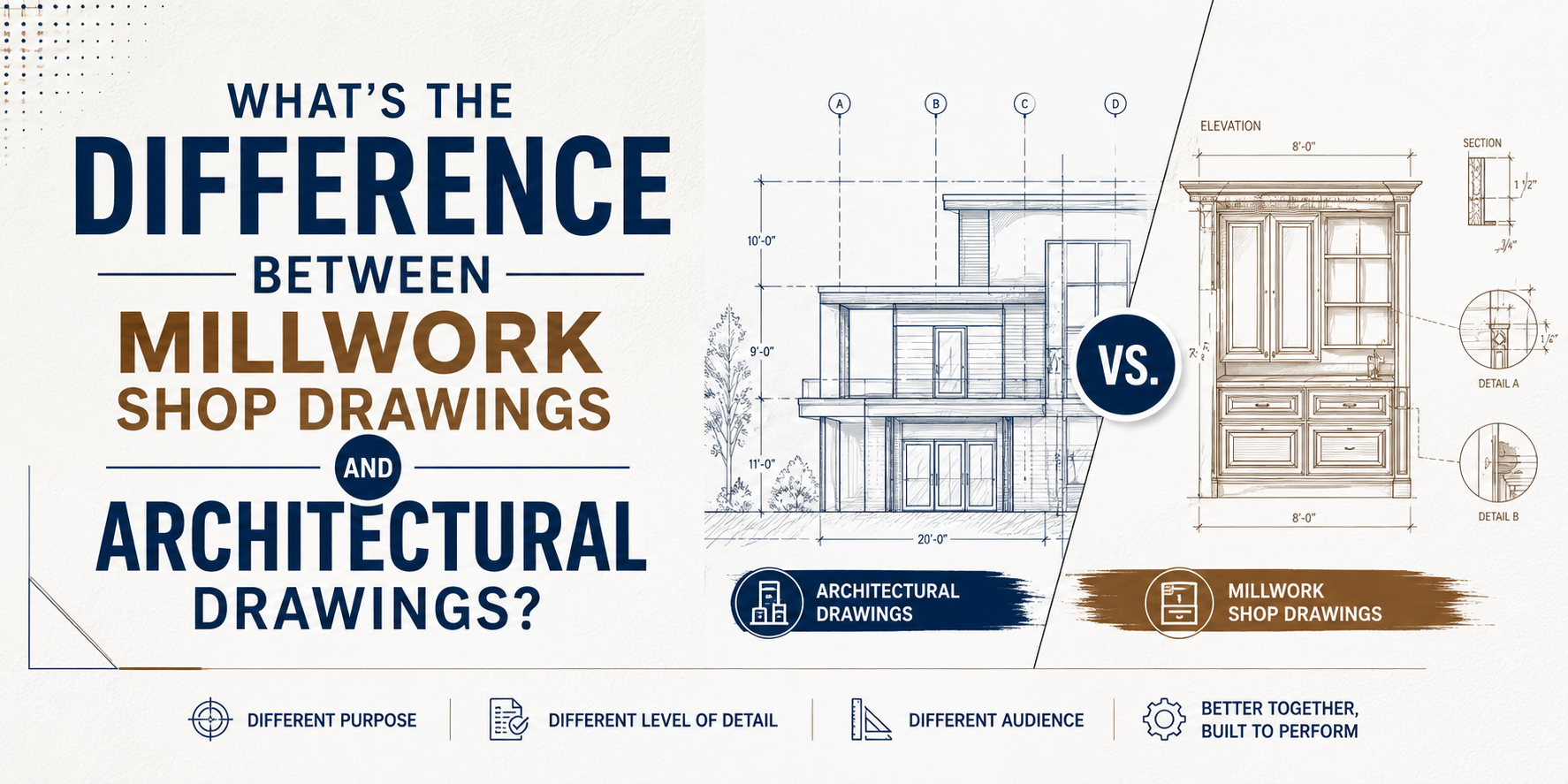
In modern construction and interior fit-out projects, precision is no longer optional. Whether it’s a luxury hotel in London, a healthcare facility in New York, or a commercial office in Manchester, every design detail must transition smoothly from concept to construction. That’s where the distinction between millwork shop drawing services and architectural drawings becomes critically important.
Many business owners, contractors, architects, and even project managers often confuse these two types of drawings. While both are essential to the building process, they serve very different purposes. Misunderstanding the difference can lead to coordination issues, fabrication errors, budget overruns, and project delays.
As the CAD drafting industry evolves rapidly across the USA and UK, demand for detailed architectural millwork shop drawings, BIM-integrated workflows, and advanced cad shop drawings continues to rise. According to a report by Grand View Research, the global CAD market is expected to grow significantly due to increased adoption in architecture, manufacturing, and construction sectors.
So, what exactly separates architectural drawings from millwork shop drawings? And why do modern projects require both?
Let’s break it down clearly.
What Are Architectural Drawings?
Architectural drawings are the foundational design documents created by architects during the planning and conceptual stages of a project. These drawings communicate the overall design intent, layout, dimensions, aesthetics, and structural planning of a building.
They provide a “big-picture” overview of the project and are typically used for:
- Design approvals
- Client presentations
- Permit submissions
- Construction planning
- Coordination between consultants
Architectural drawings often include:
- Floor plans
- Elevations
- Sections
- Site plans
- Reflected ceiling plans
- Door and window schedules
- Material specifications
These drawings help stakeholders understand how the building will look and function once completed.
Why Are Architectural Drawings Important?
Architectural drawings serve as the primary communication bridge between architects, clients, engineers, contractors, and regulatory authorities.
Without them, projects would struggle with:
- Design inconsistencies
- Structural coordination problems
- Compliance failures
- Budget uncertainty
- Construction sequencing issues
In the UK and USA, digital transformation has significantly improved architectural drafting processes. According to Autodesk Construction Cloud Insights, firms adopting digital construction workflows report improved collaboration and reduced rework costs.
However, architectural drawings alone are often not detailed enough for fabrication and installation purposes. That’s where millwork shop drawings come in.
What Are Millwork Shop Drawings?
Millwork shop drawings are highly detailed technical drawings specifically created for the manufacturing and installation of custom woodwork and interior components.
These drawings focus on fabrication-level precision for elements such as:
- Cabinets
- Reception desks
- Wall paneling
- Wardrobes
- Retail fixtures
- Hotel furniture
- Custom shelving
- Interior joinery
Unlike architectural drawings, millwork shop drawing services go deep into construction details, materials, assembly methods, hardware specifications, finishes, and installation instructions.
They are generally prepared by:
- Millwork drafting companies
- CAD specialists
- Fabricators
- Shop drawing experts
- Joinery manufacturers
What Do Millwork Shop Drawings Include?
Detailed architectural millwork shop drawings usually contain:
- Precise dimensions
- Material callouts
- Joinery details
- Hardware specifications
- Sectional views
- Exploded assembly diagrams
- CNC-ready fabrication details
- Edge treatments
- Finish notes
These drawings eliminate ambiguity during manufacturing and installation.
What’s the Main Difference Between Architectural Drawings and Millwork Shop Drawings?
The biggest difference lies in their purpose and level of detail.
| Architectural Drawings | Millwork Shop Drawings |
|---|---|
| Show overall building design | Show fabrication details |
| Prepared by architects | Prepared by millwork drafters/fabricators |
| Conceptual and construction-focused | Manufacturing-focused |
| General dimensions | Exact production dimensions |
| Used for approvals and planning | Used for fabrication and installation |
| Covers entire building systems | Covers custom millwork elements |
| Lower technical fabrication detail | Extremely high technical detail |
In simple terms:
- Architectural drawings explain what should be built
- Millwork shop drawings explain how it should be built
Why Are Millwork Shop Drawing Services Becoming More Important in 2026?
The construction and interior design industry is becoming increasingly complex. Clients today expect:
- Faster project delivery
- Custom interiors
- Sustainable materials
- Precision manufacturing
- Minimal on-site errors
Because of this, businesses are investing heavily in professional millwork shop drawing services.
Key Industry Trends Driving Demand
1. Rise of Custom Interior Design
Modern commercial and residential spaces now prioritize personalized interiors. From luxury retail stores to co-working offices, custom millwork is everywhere.
Detailed cad shop drawings help manufacturers produce accurate custom components without expensive revisions.
2. BIM and Digital Fabrication Integration
Building Information Modeling (BIM) has transformed the drafting industry.
Today’s millwork drafting workflows often integrate with:
- CNC machinery
- Laser cutting systems
- 3D visualization software
- Revit-based BIM coordination
According to McKinsey & Company Construction Technology Insights, digital construction technologies can improve productivity by up to 15%.
This makes precise shop drawings more valuable than ever.
3. Increased Focus on Clash Detection
In complex projects, millwork must coordinate with:
- HVAC systems
- Electrical layouts
- Plumbing systems
- Structural components
Advanced architectural shop drawings integrated with BIM help identify clashes before installation begins.
This reduces:
- Rework
- Material waste
- Project delays
- Budget overruns
4. Offsite Manufacturing Growth
The USA and UK construction sectors are rapidly adopting prefabrication and modular construction methods.
Offsite manufacturing relies heavily on precise fabrication documents. Poor-quality drawings can completely disrupt production workflows.
That’s why professional architectural millwork shop drawings are essential for modern prefabrication environments.
How Detailed Should Millwork Shop Drawings Be?
A high-quality millwork shop drawing should leave no room for interpretation.
Fabricators and installers should be able to manufacture components directly from the drawing without additional clarification.
Essential Elements Include:
- Exact measurements
- Material thickness
- Hardware locations
- Joinery techniques
- Installation sequencing
- Finish specifications
- Tolerance details
- Assembly methods
The more detailed the drawing, the lower the risk of costly site errors.
What Problems Occur When Shop Drawings Are Poorly Prepared?
Many construction delays originate from incomplete or inaccurate drawings.
Poor-quality cad shop drawings can lead to:
Common Issues
- Incorrect fabrication sizes
- Misaligned installations
- Material wastage
- Site rework
- Budget escalation
- Contractor disputes
- Delayed project timelines
According to Construction Industry Institute Research, rework costs can account for 5% to 15% of total construction expenses.
That’s a significant financial risk for businesses and contractors.
How Do Architectural and Millwork Teams Collaborate?
Successful projects require strong coordination between architects and millwork drafting professionals.
Typical Workflow
- Architect creates conceptual and construction drawings
- Millwork drafting team reviews design intent
- Detailed fabrication drawings are developed
- Drawings undergo approval and coordination
- Manufacturing begins
- Installation teams execute based on approved shop drawings
Effective collaboration ensures design intent remains intact while maintaining manufacturability.
Are Millwork Shop Drawings Used Only for Woodwork?
No. While traditionally associated with woodworking and joinery, modern millwork drafting now covers a broad range of materials and interior systems.
Today’s millwork shop drawing services may include:
- Metal fixtures
- Stone countertops
- Acrylic displays
- Glass partitions
- Laminate finishes
- Composite materials
This is especially common in:
- Retail fit-outs
- Hospitality projects
- Airports
- Healthcare interiors
- Corporate offices
What Software Is Commonly Used for Millwork Shop Drawings?
Modern drafting professionals use advanced CAD and BIM tools to create fabrication-ready drawings.
Popular Software Includes:
- AutoCAD
- Revit
- SolidWorks
- Microvellum
- Cabinet Vision
- SketchUp
- Inventor
These technologies improve:
- Accuracy
- Coordination
- Automation
- CNC compatibility
- Visualization
The integration of AI-assisted drafting tools is also becoming a growing trend in 2026.
Why Are CAD Shop Drawings Critical for Large Commercial Projects?
Large-scale projects involve multiple stakeholders and highly complex coordination requirements.
Detailed cad shop drawings help standardize communication between:
- Architects
- Interior designers
- Fabricators
- Engineers
- Contractors
- Installers
This improves project transparency and execution efficiency.
Industries That Depend Heavily on Shop Drawings
- Hospitality
- Retail
- Healthcare
- Airports
- Commercial offices
- Educational institutions
- Luxury residential developments
Without detailed shop drawings, maintaining quality control becomes extremely difficult.
How Are AI and Automation Changing the CAD Drafting Industry?
The CAD drafting industry is undergoing major transformation due to AI and automation technologies.
Emerging Trends in 2026
AI-Assisted Drafting
AI tools now help automate:
- Dimensioning
- Clash detection
- Drawing revisions
- Layout optimization
Cloud-Based Collaboration
Remote collaboration platforms enable real-time coordination between teams across the UK, USA, and global markets.
Digital Twin Technology
Digital twins allow project teams to simulate installations before fabrication begins.
This minimizes:
- Errors
- Material waste
- Installation conflicts
CNC-Integrated Drafting
Modern architectural millwork shop drawings are increasingly connected directly to fabrication machinery.
This streamlines:
- Manufacturing
- Quality control
- Production timelines
According to Deloitte Engineering and Construction Outlook, digital adoption in construction is accelerating due to labor shortages and rising demand for productivity improvements.
What Should Businesses Look for in Millwork Shop Drawing Services?
Choosing the right drafting partner can significantly impact project outcomes.
Key Factors to Evaluate
Industry Experience
Look for teams experienced in:
- Commercial interiors
- Hospitality projects
- Retail environments
- Residential millwork
Technical Accuracy
Drawings should include:
- Clear dimensions
- Material details
- Fabrication instructions
- Installation references
BIM and CAD Expertise
Modern projects require integration with:
- BIM workflows
- Revit coordination
- CNC systems
Revision Management
Efficient drawing revision processes reduce confusion during project execution.
Communication and Coordination
Strong collaboration with architects, contractors, and fabricators is essential.
Why Is the USA and UK Market Investing More in Architectural Millwork Shop Drawings?
Both markets are experiencing increasing demand for:
- High-end interiors
- Sustainable construction
- Modular fabrication
- Faster project delivery
In cities like London, Manchester, New York, Chicago, and Los Angeles, developers are prioritizing efficiency and customization simultaneously.
Detailed architectural shop drawings help bridge the gap between creative design and buildable reality.
Additionally, stricter quality standards and rising labor costs are pushing firms toward digital precision workflows.
Frequently Asked Questions
Are architectural drawings enough for fabrication?
No. Architectural drawings provide design intent but usually lack the detailed fabrication information required for manufacturing custom millwork components.
Can millwork shop drawings reduce project costs?
Yes. Accurate drawings reduce:
- Rework
- Material waste
- Installation errors
- Construction delays
This helps improve overall project profitability.
Who prepares millwork shop drawings?
They are typically prepared by:
- CAD drafting specialists
- Millwork detailers
- Joinery experts
- Fabrication companies
Are shop drawings required for BIM projects?
In most modern BIM workflows, detailed shop drawings are essential for coordination, clash detection, and fabrication accuracy.
Final Thoughts
Understanding the difference between architectural drawings and millwork shop drawings is essential for successful project execution in today’s construction environment.
Architectural drawings establish the overall vision of a project, while millwork shop drawing services transform that vision into precise, manufacturable reality.
As construction projects become more digitally driven, the importance of accurate architectural millwork shop drawings, BIM coordination, and advanced cad shop drawings will only continue to grow across the USA, UK, and global markets.
Businesses that invest in detailed drafting workflows can achieve:
- Better project coordination
- Reduced construction risks
- Faster fabrication timelines
- Improved installation accuracy
- Higher-quality interiors
For companies seeking dependable drafting expertise, working with an experienced UK CAD design company that understands both architectural intent and fabrication precision can make a significant difference in project success.