
Introduction
If you’ve spent any time browsing job portals lately, you’ve probably noticed how often “Oracle Fusion Technical Consultant” shows up in listings. Soft Online Training gets this question almost every week from learners trying to figure out what they’re actually signing up for before they commit their time and money. And honestly, it’s a fair question a lot of course pages throw around fancy module names without explaining what you’ll really be doing day to day. So let’s break it down properly, module by module, and talk about why so many people are choosing Oracle Fusion Technical Training in Bangalore right now.
Why This Skill Set Is Suddenly Everywhere
A few years back, most companies were still comfortable running Oracle EBS. That’s changed. Banks, hospitals, retail chains, manufacturing firms pretty much everyone with a large enough finance or HR department is either mid-migration to Fusion Cloud or already there. And once they get there, they realize functional knowledge alone doesn’t cut it. Someone still has to build the reports, fix the broken data loads, and make the system talk to whatever other software the company is running. That’s where technical consultants come in, and that’s why Bangalore specifically has become such a hub for this training. The city is packed with Oracle implementation partners and IT firms that are hiring for exactly these roles.
What You’ll Actually Learn in an Oracle Fusion Technical Training in Bangalore Program
Most programs don’t just throw you into the deep end. They start slow, build your fundamentals, and then ramp up into the tools you’ll use on real projects. Here’s roughly how it plays out.
Getting Comfortable with the Cloud Setup First
Before touching any tool, you need to understand how Fusion is different from the old on-premise EBS world. This part covers Oracle Cloud Infrastructure basics, how environments and instances work, and how Oracle handles patching and upgrades behind the scenes stuff that sounds boring on paper but saves you from a lot of confusion later.
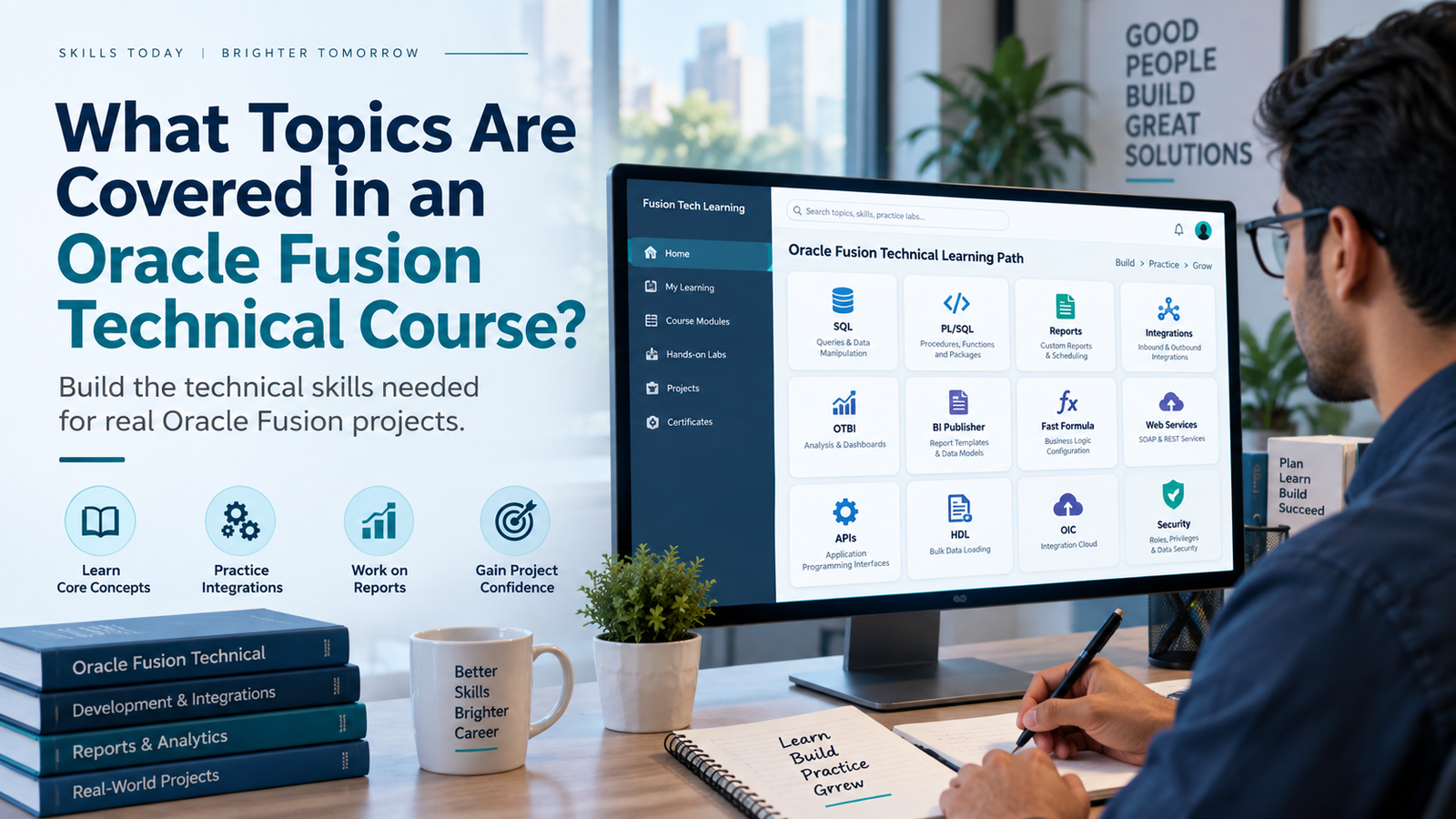
BI Publisher You’ll Spend a Lot of Time Here
This is arguably the tool you’ll touch the most. You’ll build data models, design templates in RTF or Excel, set up bursting so reports get delivered to the right people automatically, and this is the part nobody warns you about spending hours debugging why a perfectly good SQL query suddenly breaks a report layout. It’s tedious sometimes, but it’s also where a lot of the real learning happens.
OTBI, and Knowing When Not to Use BI Publisher
OTBI is Oracle’s built-in real-time reporting tool. The course will show you how to build analyses and dashboards, but more importantly, a decent instructor will actually explain when you should reach for OTBI versus when BI Publisher is the better call. This distinction trips up a lot of beginners.
Application Composer Customizing Without Breaking Anything
Here you’ll learn to add custom fields, set up object workflows, and dabble in some basic Groovy scripting all without touching Oracle’s core code, which is the whole point. Clients almost always want something tweaked to fit their process, and this is how you do it safely.
FBDI and HDL for Moving Data Around
Anyone who’s done a data migration project will tell you this is where the real headaches (and the real learning) happen. File-Based Data Import and HCM Data Loader are the tools you’ll use to move bulk data into Fusion. Expect a lot of practice around preparing templates correctly, catching validation errors before they blow up, and figuring out why a load process failed at 2am because it will, eventually.
Oracle Integration Cloud (OIC)
Fusion rarely runs alone in a company’s tech stack. OIC is how you connect it to everything else third-party apps, REST and SOAP services, custom middleware. This module tends to be one of the more satisfying parts of the course because you actually see systems talking to each other by the end of it.
Fast Formulas for the HCM and Payroll Folks
If you’re leaning toward HR or payroll modules, Fast Formulas become a big deal. You’ll write custom rules for things like eligibility checks and payroll calculations, and yes, the syntax takes some getting used to.
Security Console and Role Setup
Not the most exciting topic, but a necessary one. You’ll learn how role-based access actually works in Fusion creating custom roles, setting data security policies, and configuring what different users are allowed to see or touch.
Approval Workflows
This covers configuring approval hierarchies through the BPM Worklist and Approval Management Extensions basically, how transactions get routed for sign-off before anything actually goes through.
Sandboxes, Because You Don’t Test in Production
Every serious course drills this in: nothing goes live without being tested in a sandbox first. You’ll learn to create sandboxes, publish changes carefully, and manage configurations across different environments.
The Hands-On Part Matters More Than the Slides
Honestly, sitting through slides on any of these topics only gets you so far. What actually builds confidence is working through real scenarios designing a finance report from scratch, migrating a batch of employee records with HDL, or building an OIC integration between Fusion and a payroll vendor’s system. If a program you’re looking at doesn’t include this kind of practical work, that’s worth questioning before you enroll.
Tools You’ll Get Familiar With Along the Way
Expect to spend time in a live Oracle Cloud instance, BI Publisher Desktop, SQL Developer, Postman for testing APIs, and OIC’s visual builder. None of these are optional extras; they’re what you’ll be using on an actual job from day one.
Picking a Training Provider Without Getting Burned
There are a lot of options out there, and not all of them are equal. Ask whether the trainers have actually worked on live Fusion projects or just teach from a manual. Check if you get lifetime access to session recordings, because you will want to rewatch the FBDI and OIC sessions at least once. And find out if there’s real support for resumes and mock interviews afterward that part often gets glossed over. Smaller batch sizes tend to work better too, simply because you get to ask questions instead of sitting quietly hoping someone else asks yours.
What Comes After
Once you’re through the course, roles like Oracle Fusion Technical Consultant, BI Publisher Developer, OIC Developer, and Techno-Functional Analyst all become realistic targets. Bangalore’s IT corridor, full of Oracle partners and global captive centers, gives fresh graduates and career-switchers alike a decent shot at landing these roles locally, and often on projects that stretch across multiple countries.
Wrapping Up
An Oracle Fusion technical course covers a lot more ground than people expect going in reporting, data migration, integrations, security, workflows, and the works. If you’re serious about this path, proper Oracle Fusion Technical Training in Bangalore is worth the investment, but only if it’s genuinely hands-on rather than just a slideshow marathon. Soft Online Training builds its programs around real project work for exactly this reason, so learners walk away having actually done the thing, not just watched someone else do it. Put in the practice, and the job-readiness follows.