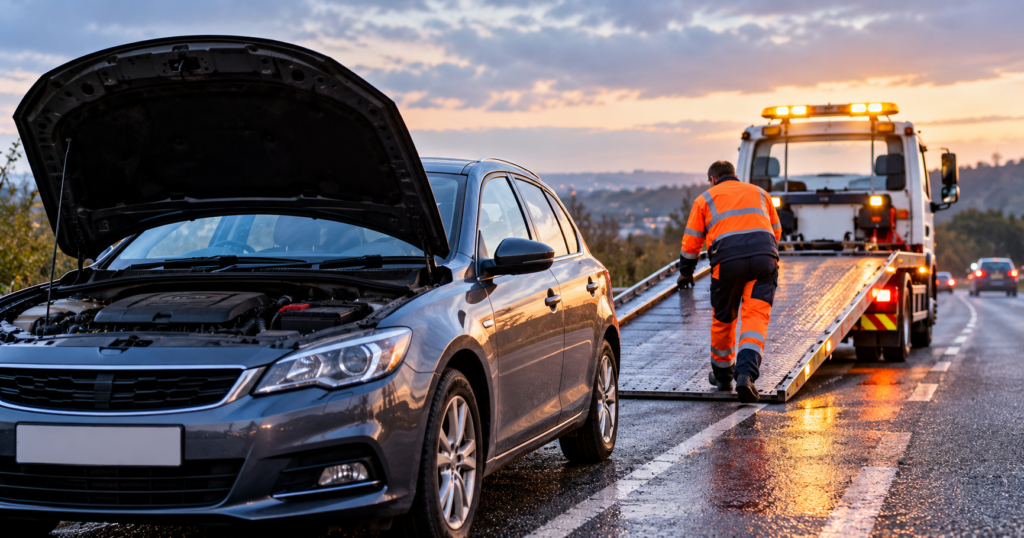
A vehicle breakdown does not always mean that the car needs to be taken away on a recovery truck. Some faults can be dealt with safely at the roadside, while others make continued driving unsafe and require the vehicle to be moved to a garage or another suitable location.
The decision depends on several things, including the type of fault, where the vehicle has stopped, whether essential systems still work, and whether a repair can be carried out safely.
Knowing the difference can help drivers avoid unnecessary towing while also reducing the risk of causing more damage by continuing to drive a vehicle that should remain stationary.
Start With the Location of the Vehicle
The first question is whether the vehicle is in a safe place.
A minor battery problem in a driveway is very different from the same problem on a busy road, narrow junction, or high-speed route.
If the car begins losing power or behaving unusually, reduce speed gradually and move away from traffic where possible.
Once stopped, switch on the hazard lights.
If the vehicle is in a dangerous position, getting it moved may be more important than attempting a repair at the roadside.
Drivers who cannot continue safely may need a breakdown recovery service in Oldham to assess whether the car should be repaired where it is or transported elsewhere.
Battery Problems Can Often Be Fixed at the Roadside
A flat battery is one of the more common faults that may not require towing.
Signs can include slow cranking, clicking when the key is turned, dim dashboard lights, or an engine that will not start.
A jump-start may be enough to get the vehicle running again.
However, drivers should remember that a flat battery can also be caused by another fault.
A failing alternator, loose connection, electrical drain, or ageing battery may cause the problem to return.
Roadside help may get the car moving, but the charging system should still be checked afterward.
Some Tyre Problems Can Be Handled Without Recovery
A tyre problem does not always mean the vehicle needs towing.
If the car has a usable spare wheel, suitable tools, and a safe place to stop, the damaged wheel may sometimes be replaced at the roadside.
Mobile tyre services may also be able to help with certain punctures.
The situation changes if the tyre has severe sidewall damage, the wheel is damaged, more than one tyre is affected, or the vehicle is stopped somewhere unsafe.
Driving on a badly deflated tyre can damage the wheel and may affect steering or suspension.
In that situation, moving the vehicle using recovery equipment is usually safer than trying to continue.
Running Out of Fuel May Be a Roadside Problem
Running out of fuel is inconvenient, but it is often straightforward. If the vehicle has stopped simply because the tank is empty, fuel delivery may allow the journey to continue.
However, if the gauge still showed fuel or the engine does not restart after fuel is added, there may be another problem.
Fuel-pump faults, electrical issues, or engine-management problems can produce similar symptoms. Professional Roadside assistance may help determine whether the fault can be dealt with where the vehicle has stopped.
Overheating Usually Requires More Caution
An overheating engine is different from a flat battery or minor puncture. If the temperature warning appears, the gauge rises unusually high, or steam is visible, the vehicle should be stopped as soon as it is safe.
Do not immediately remove the coolant cap from a hot engine. The cooling system can remain pressurised and may cause serious burns.
Overheating can be caused by low coolant, a leaking hose, thermostat problems, radiator faults, cooling-fan failure, or a damaged water pump.
Even if the engine cools down after stopping, that does not mean the fault has disappeared.
Continuing to drive can cause serious engine damage. If the cause cannot be clearly identified and safely corrected, recovery is generally the better option.
Brake Faults Should Not Be Tested by Driving Further
Brake problems should be treated seriously.
A soft pedal, grinding noise, fluid leak, strong vibration, reduced braking power, or warning light can indicate a fault that affects vehicle control.
Do not continue simply because the car still moves normally. A brake problem can become worse without much warning.
If normal braking performance is uncertain, the vehicle should remain stationary. A vehicle towing service can transport the car without requiring it to be driven in an unsafe condition.
Steering Problems Are Another Reason to Stop
Steering should remain predictable.
Sudden heaviness, strong pulling, excessive play, unusual noises, or difficulty controlling the vehicle may indicate a problem with steering, suspension, tyres, or power assistance.
Some faults may seem manageable at low speed but become much more dangerous once the vehicle reaches normal road speed.
If steering behaviour changes significantly, do not try to “make it home.” Towing is usually safer.
Dashboard Warning Lights Need Context
Not every warning light means that the car must be recovered immediately.
Some warnings are advisory, while others indicate a more serious fault.
Red oil-pressure warnings, severe overheating warnings, brake-system faults, or major charging problems deserve particular attention.
An engine-management light can have many possible causes.
If it appears together with loss of power, rough running, smoke, overheating, or unusual noise, the vehicle may need professional assessment before it is driven again.
The light itself is only part of the information. The symptoms happening at the same time are often just as important.
Transmission Problems Usually Point Toward Recovery
Transmission faults can make a vehicle unpredictable.
Warning signs include slipping, delayed engagement, harsh gear changes, inability to select a gear, strange noises, or fluid leakage.
If the vehicle will not move normally, forcing it to continue can make the fault worse. Transmission issues may also cause the vehicle to lose drive unexpectedly.
Where a car cannot engage or change gear properly, a Vehicle Towing Service Oldham provider can move it to a garage without requiring further driving.
Collision Damage May Not Be Obvious
After a minor accident, a car may still start and move. That does not necessarily mean it is safe to drive.
Damage can affect steering, suspension, tyres, cooling systems, lights, or structural components.
Look for visible leaks, rubbing tyres, damaged wheels, steering changes, warning lights, or panels that interfere with moving parts. If anything appears unusual, arranging recovery can be safer than finding out the problem while driving.
Electrical Problems Can Go Either Way
Electrical faults vary widely. A loose battery terminal or weak battery may be resolved at the roadside.
A burning smell, smoke, repeated fuse failure, damaged wiring, or major electrical warning is more serious. Electrical problems can also affect several systems at the same time.
If the car will not start reliably or essential systems such as lights, steering assistance, or charging are affected, roadside diagnosis may be needed before deciding whether towing is necessary.
Explain the Vehicle’s Condition Clearly
Recovery operators need accurate information. Tell them the make and model, fuel type, registration, and whether the vehicle is a car, van, motorcycle, electric vehicle, or hybrid.
Mention whether the wheels turn, steering works, the vehicle is damaged, or it is unusually low or heavily loaded.
Electric and hybrid vehicles should always be identified because they can have specific towing or transportation requirements. The more accurate the information, the easier it is to send suitable equipment.
Check Where the Vehicle Will Be Taken
Before recovery begins, confirm the destination. If the vehicle is going to a garage, check whether the garage is open and able to accept it.
If the business is closed, ask whether there is a secure procedure for leaving the vehicle or keys.
Access can also matter. Some garages, residential properties, and car parks have narrow entrances, height restrictions, locked gates, or limited turning space. Explaining these details in advance can prevent delays when the recovery vehicle arrives.
Ask What Type of Assistance Is Being Provided
Roadside assistance, towing, and vehicle transportation are not exactly the same service.
Roadside assistance aims to solve suitable faults where the vehicle has stopped. Towing moves a vehicle that cannot continue under its own power.
Vehicle transportation may be more appropriate for accident-damaged cars, certain electric vehicles, low-clearance vehicles, or faults where conventional towing is not suitable.
Before agreeing to a service, ask what method will be used and where the car will be taken.
Do Not Let Convenience Override Safety
Drivers sometimes continue because the garage or home is only a short distance away. That is not a good way to decide whether a vehicle is safe.
A brake fault can worsen quickly. An overheating engine can suffer major damage within a short distance. A damaged tyre can fail completely.
The decision should be based on the condition of the vehicle, not the inconvenience of arranging recovery.
Understand the Difference Between a Repair and a Temporary Fix
Some roadside solutions are temporary. A jump-start may get the engine running, but it does not confirm that the battery or alternator is healthy.
Adding coolant may allow the engine to run briefly, but it does not repair a leak. Inflating a tyre may help if pressure was low, but it will not solve a puncture.
If a roadside fix gets the vehicle moving, the underlying issue may still need professional inspection.
When Towing Is Usually the Safer Choice
Towing is generally the safer option when the problem affects braking, steering, transmission, cooling, major mechanical components, or vehicle control.
It is also appropriate when the vehicle has suffered significant accident damage or is stopped somewhere where roadside work cannot be carried out safely.
The important point is that a running engine does not automatically mean the car is safe to drive.
Final Thoughts
Deciding between roadside repair and towing becomes easier when safety comes first. Minor faults such as a flat battery, simple tyre problem, or running out of fuel may sometimes be resolved where the vehicle has stopped.
Problems involving overheating, braking, steering, transmission, collision damage, or major warning signs usually need more caution.
Start by making the vehicle and occupants as safe as possible. Then describe the symptoms and location clearly to the recovery operator.
If there is any doubt about whether the vehicle can continue safely, recovering it is usually a better decision than risking further damage or losing control on the road.