
Introduction
Journal reversals are one of the most common sources of confusion during month-end and year-end close. Soft Online Training helps accountants see that while a reversal looks simple on paper, it often gets tangled with recurring journals, multiple ledgers, currency conversions, and manual adjustments making it hard to explain why a period’s numbers look off.
This is exactly the scenario professionals face in Oracle Fusion Financials Training in Hyderabad, where real-world General Ledger troubleshooting is treated as seriously as theory. Mastering reversals means reconstructing the decision trail behind them, so results are explained with confidence, not guesswork.
Start With the Original Batch, Not the Reversal
The first instinct when a number looks wrong is often to stare at the reversal entry itself. That’s usually the wrong starting point. A reversal only makes sense in the context of the original journal batch it was created to offset, so the accountant’s first move should be to locate that original entry and examine it alongside its source.
Every journal batch carries a journal source the upstream process or subledger that generated it, whether that’s payables, receivables, a subledger accounting rule, or a manual entry. Connecting the batch to its source early on tells you whether you’re dealing with a routine system-generated reversal or something that was manually triggered, which changes the entire investigation from there.
Compare Accounting Dates Against the Close Calendar
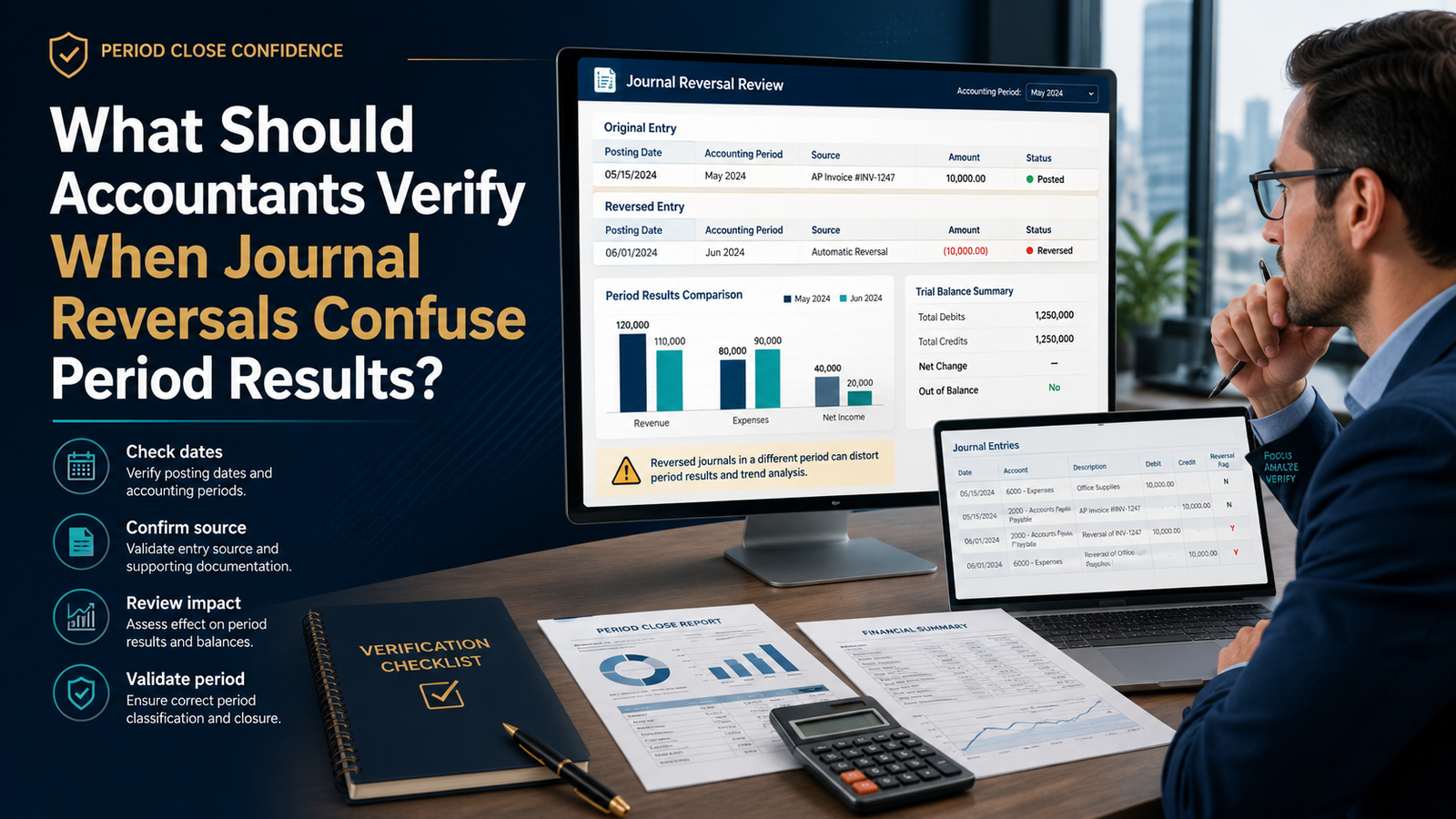
One of the most frequent causes of “confusing” period results isn’t the reversal logic itself; it’s a mismatch between when someone believes an entry was posted and when it was actually recognized in the ledger. Relying on a user’s recollection of an entry date is unreliable; the close calendar is the source of truth.
Accounting dates need to be checked against the close calendar for the relevant period, and cross-referenced with the ledger currency in use. A journal that looks like it landed in the wrong period may simply reflect a currency-driven timing difference, or it may indicate that a period was left open or closed at the wrong time. Either way, this comparison should happen before anyone assumes the reversal itself is faulty.
Determine How the Reversal Was Created
Not all reversals are created equal. Some are automatic, generated by the system based on a reversal method set at the time of original entry. Others are manual, entered deliberately by an accountant to correct something. And some are part of a recurring journal template that regenerates on a schedule.
Identifying which of these applies is critical, because it determines what “normal” looks like. An automatic reversal tied to an accrual should behave predictably every period. A manual reversal, by contrast, is more likely to reflect a one-off correction and if one shows up where it isn’t expected, that’s a stronger signal that something needs escalation. Connecting the reversal period to posting status, and checking whether the close calendar was open or locked at the time, helps confirm whether the reversal followed the expected process or deviated from it.
Check Posting Status Before Making Any New Adjustments
There’s a natural temptation, when a period doesn’t reconcile, to jump straight to fixing it, editing a description, adding a note, or creating yet another adjusting entry. This is where problems compound rather than resolve. Before touching anything, the posting status of both the original and the reversal needs to be confirmed.
An entry that is still unposted behaves very differently from one that has already hit the ledger and fed into reporting. Modifying descriptions or layering a new adjustment on top of an entry whose status hasn’t been verified risks creating a second discrepancy rather than explaining the first one. This is also the point at which the journal source should be traced back to sequence numbers, since a sequence mismatch is often the real reason a reversal appears to be paired with the wrong original journal.
Validate Balancing by Segment and Currency
A period result should never be labeled “unexplained” until balancing has been validated by both segment and currency. Balancing segments enforce the structural integrity of the ledger ensuring that debits and credits net to zero within a defined business unit, entity, or cost center and currency validation ensures that translated or converted amounts haven’t introduced rounding or timing distortions.
Skipping this step is one of the most common reasons accountants misdiagnose a reversal issue as a system error when it’s actually a segment or currency configuration matter. Connecting balancing segment behavior back to the original journal batch closes the loop and confirms whether the entry’s structure, not just its amount, is consistent with the rest of the ledger.
Trace the Audit Trail Before Concluding Anything
Sequence numbers and references exist specifically so that a reversal can be matched to the correct original journal with certainty, rather than by inference. Reviewing these references, and tracing the audit trail associated with them, protects against the scenario where a reversal is incorrectly assumed to offset one entry when it actually corresponds to a different one entirely.
This audit trail should be reviewed end-to-end: from the original journal batch, through the journal source, to the posting status, and finally to the accounting date and close calendar status at each step. Only once this trail is intact should an accountant consider the investigation complete.
Document the Correction Path and Reconcile
Once the root cause has been identified whether it’s a timing issue, a currency mismatch, a sequence error, or simply a normal automatic reversal behaving as designed the chosen correction path needs to be documented clearly. This documentation matters as much for the next reviewer as it does for the current one; without it, a second adjustment risks duplicating the effect of the first, creating a new discrepancy in the process of fixing the old one.
The investigation should conclude with an auditable reconciliation that ties together the original journal, the reversal, and the final posted balance, so that anyone reviewing the period later can see exactly what happened and why.
Why This Discipline Matters
A disciplined review of journal reversals connects journal batch, journal source, and balancing segment data to a specific owner and a clearly defined next step rather than treating a confusing period result as a mystery to be waited out. This is precisely the kind of structured, evidence-based troubleshooting emphasized in Oracle Fusion Financials Training in Hyderabad, where learners are encouraged to explain not just what they observed in the ledger, but why it matters and what should be verified next.
Oracle’s own documentation is a useful reference for terminology and standard behavior, but local configuration, role-based access, and organization-specific close calendars will always shape what an individual accountant actually sees on screen. Building the habit of tracing decisions from batch to source, from accounting date to close calendar, from posting status to audit trail is what turns a confusing period result into a well-documented, defensible explanation. That habit is what makes support conversations calmer, audits smoother, and every future reversal easier to reason through.