
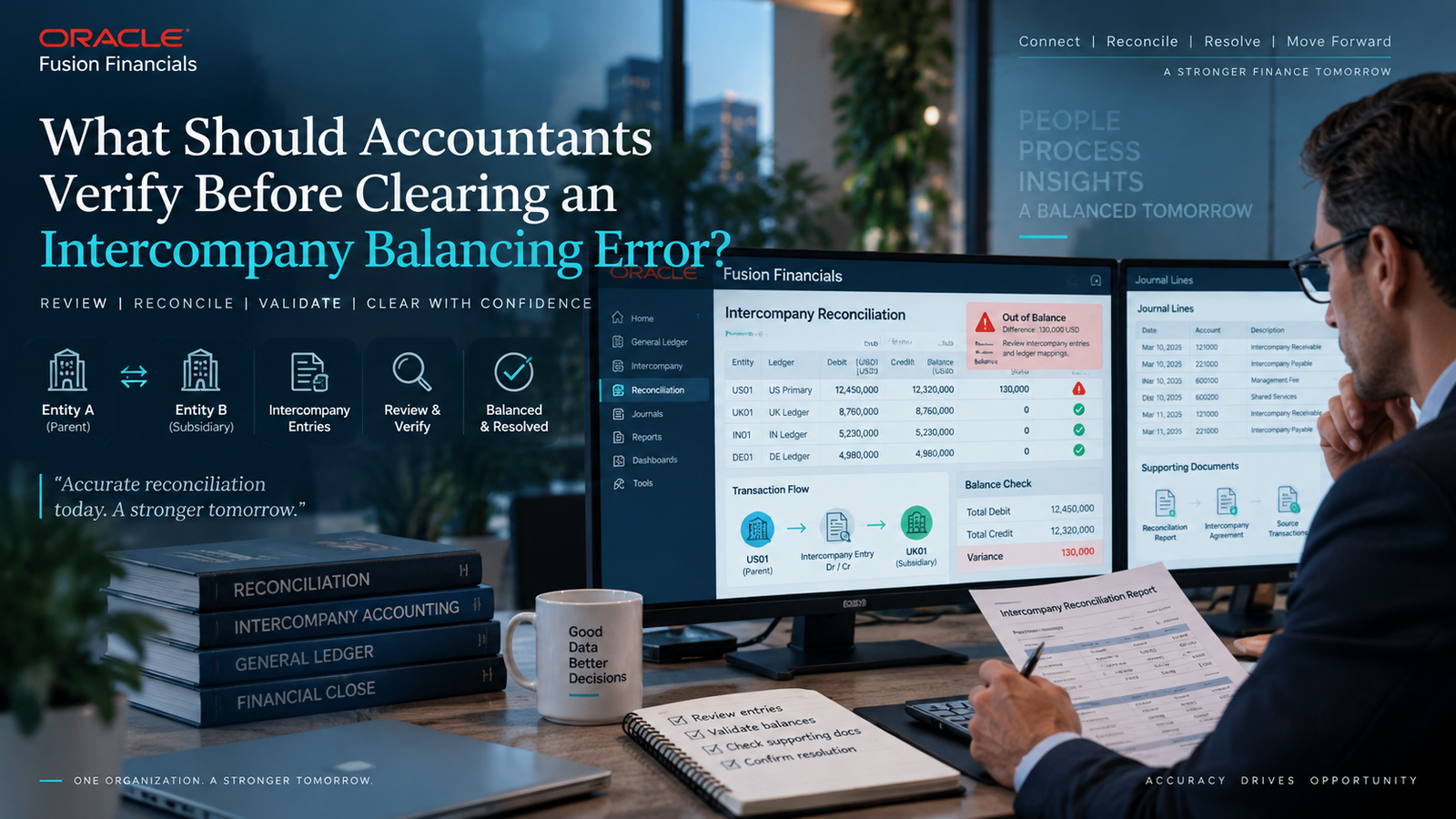
Introduction
Intercompany balancing errors show up the moment a consolidated trial balance refuses to net to zero. When that happens, most finance teams, per Tech Leads IT, instinctively rush to close the gap before the reporting deadline. But speed without investigation turns small discrepancies into compounding problems. Anyone who has completed Oracle Fusion Financials Training understands elimination mechanics reasonably well, yet true judgment knowing whether a residual is a harmless timing lag or a structural misstatement comes only from repeated exposure to real scenarios, something a solid Oracle Fusion Financials Online Training or Oracle Fusion Financials Course builds over time. Clearing an unverified error doesn’t remove it; it simply defers and often magnifies the problem into future periods.
Step One: Distinguish a Transaction Problem from an Elimination Configuration Problem
The very first thing to determine is whether the imbalance is coming from the underlying transactions themselves or from the elimination logic that is supposed to net them out. Intercompany eliminations depend entirely on finding matched pairs a payable recorded in one entity has to line up with a receivable recorded in the counterparty entity, with the same amount, same currency, and same counterparty identifier. If the ERP’s intercompany balancing segment doesn’t produce a matching line because a balancing segment value is missing, an account combination has been deactivated, or a cross-validation rule silently blocks the posting the elimination journal will post with a residual that has nothing to do with the actual business transaction. It’s a setup gap, not a data error.
This distinction matters enormously because it changes where you look next. If you start pulling invoice and shipment documents trying to explain a residual that’s actually caused by a broken balancing segment configuration, you’ll spend hours chasing a transaction-level explanation for what is fundamentally a system configuration issue. Practitioners who have gone through an Oracle Fusion Financials Course are typically trained to check the balancing segment setup across every legal entity in scope before diving into transaction detail and that sequencing saves real time during close.
Step Two: Rule Out Currency Revaluation as the Source
The second major category of “apparent” imbalance isn’t an error at all; it’s currency mechanics working exactly as designed, but easy to misread as a mistake. Consider a simple case: Entity A books an intercompany payable in USD using the month-end rate. Entity B, whose functional currency is EUR, books the corresponding receivable using its own revaluation schedule, which might run on a different calendar day than Entity A’s. By the time the elimination runs in the consolidation currency, the two legs no longer agree numerically, even though both entities recorded the transaction correctly under their own local rules.
This is expected behavior, provided two things are true: the revaluation gain or loss has been posted to the correct equity or profit-and-loss account, and the cumulative translation adjustment (CTA) has absorbed the difference correctly. So the verification task here isn’t “find the error” it’s “confirm the revaluation methodology is consistent.” That means checking whether both sides of the intercompany pair are using the same rate type, whether revaluation runs daily or only at period end, and whether it’s applied at the balance level or the transaction level. Any inconsistency in these settings between the two entities will generate a residual that looks like a data problem but is actually a methodology mismatch. Reconciling the CTA movement against the revaluation logs is the concrete step that confirms or rules out this cause.
Step Three: Check Whether the Close Calendar Accounts for Timing Lag
A third, very common source of apparent imbalance is nothing more than ordinary business timing. Entity A ships goods on the 28th of the month and immediately records revenue along with an intercompany receivable. Entity B doesn’t physically receive those goods until the 2nd of the following month, and only then records the corresponding payable. For those few days spanning the period boundary, the elimination is genuinely unbalanced not because anything is wrong, but because the two entities are recording the same economic event on different calendar days.
The fix here isn’t a correcting entry against the transaction; it’s a structural accommodation in the close calendar. Does the organization have a soft-close window that tolerates this kind of lag? Is there a standard manual accrual that bridges the gap? Is there a defined tolerance threshold below which small residuals are accepted without investigation? If none of these mechanisms exist, then every month-end will generate the same “error,” and accountants will keep re-investigating and re-explaining a pattern that is actually just supply chain timing. The verification step is really a design question: does the elimination schedule reflect the physical and system realities of how goods and services actually move between entities?
Step Four: Inventory Transaction Types for Coverage Gaps
Most elimination configurations are built around the obvious case trade payables and trade receivables. But intercompany activity is rarely limited to trade flows. Intercompany loans, interest accruals, royalty charges, management fee allocations, and tax settlements are all common, and they frequently route through entirely different modules Treasury, Projects, Tax that may not carry the same balancing segment logic as the core trade elimination set.
When one of these non-trade transaction types doesn’t have a defined elimination rule, it produces a persistent, low-volume residual that keeps appearing month after month. Because the amounts are often small relative to trade flows, this kind of gap can go unnoticed for a long time right up until it accumulates into something material. Before clearing any balancing error, it’s worth taking the time to inventory every intercompany transaction type present in the chart of accounts and confirming that each one has an assigned, functioning elimination rule. A missing rule is easy to mistake for a data entry mistake, when it’s actually a configuration omission that needs to be added to the elimination set, not chased through subledger detail.
Reconciling Elimination Configuration and Subledger Integrity
Once the broad categories above have been considered, a more granular, document-level reconciliation is warranted before any clearing journal is finalized. This means pairing invoices, credit memos, cash receipts, shipment records, and settlement documents by counterparty and originating transaction identifier, and then comparing entered currency, accounted currency, exchange-rate date, and posting period across both sides of the pair.
It’s also worth confirming that the elimination rule actually assigned to the specific ledger and legal-entity combination matches what’s documented in the setup guidance; a rule that exists in the system but isn’t assigned to the right combination will never fire, no matter how correctly it was built. Anyone working through an Oracle Fusion Financials Online Training program will typically spend time specifically on this assignment logic, because it’s one of the more common reasons a seemingly well-configured elimination set fails silently for a subset of entities.
Running an elimination preview and comparing it line-by-line against subledger and general-ledger detail helps pinpoint exactly where the two sides first diverge, rather than treating the residual as one opaque number. That comparison should also distinguish between an item that will reverse naturally in the following period like the shipping timing example above and one that genuinely requires a correcting entry. And if a manual entry does turn out to be necessary, someone needs to verify it isn’t duplicating an interface retry, an automatic accrual, or a scheduled reversal that’s already in the pipeline. Ownership of that temporary balance who is responsible for clearing it and by when should be made explicit rather than left implicit.
Verifying Subledger Data Integrity Before Any Clearing Entry
Beyond the elimination logic itself, the underlying subledgers deserve independent scrutiny. An intercompany invoice can post cleanly to accounts receivable in Entity A but never make it across to accounts payable in Entity B because of a failed interface batch, a validation error on the receiving side, or a user who deleted a draft document before it was posted. When that happens, the elimination engine only ever sees one side of the pair, and it generates a residual that has nothing to do with currency, timing, or configuration; it’s simply a missing document.
This check is frequently skipped in practice, mainly because it requires cross-module visibility that not every accountant has by default. But it’s one of the most important checks to perform, because no amount of tuning the elimination rules will fix a one-sided entry that never made it into the destination ledger in the first place. Reviewing interface logs, error queues, and the status of every intercompany document across both the source and destination subledgers is the only reliable way to catch this category of error.
Building the Clearing Entry for Auditability
Once the root cause has actually been identified rather than assumed the clearing entry itself needs to be constructed with future auditability in mind. A generic journal that simply debits and credits an intercompany clearing account, with no reference to the specific transactions, entities, or periods involved, creates a black box. Six months later, neither an external auditor nor the same accountant who posted it will be able to reconstruct why it was made.
A properly documented clearing entry should reference the balancing segment values involved, the specific transaction identifiers, the original posting dates, and a clear statement of the reason for the residual whether that’s timing, currency, a missing rule, or an interface failure. Supporting evidence, including subledger reports, the elimination preview output, and the currency revaluation logs, should be attached or linked directly to the entry. This turns what could be a one-off fix into an actual control artifact that supports the integrity of the close process.
Looking for the Root Cause, Not Just the Fix
The final step in the verification checklist is stepping back and asking whether this particular error is a one-time occurrence or a signal of something systemic. A currency revaluation mismatch that keeps recurring points to a revaluation schedule that needs to be realigned across entities. A repeated interface failure points to a monitoring gap somewhere in the middleware layer. A missing elimination rule for management fees points to a governance gap in how the chart of accounts is maintained as the business adds new transaction types.
Clearing the current period’s number without addressing whatever created it simply guarantees the same issue will appear again next period and the period after that. A properly built verification checklist doesn’t end at the clearing entry. It ends with a root-cause action item, assigned to whoever owns the relevant configuration or process, with a deadline for resolution.
Conclusion
An intercompany balancing error is a symptom, not a disease in itself. The real discipline lies in checking configuration, currency logic, timing design, transaction-type coverage, subledger integrity, and audit trail completeness before a single clearing entry is posted. Teams that build this checklist into their standard close process reduce not just the number of clearing entries they have to make, but the far more dangerous risk that an embedded, unverified error survives quietly and distorts consolidated results down the line. For finance professionals looking to build this kind of structured judgment rather than just rote elimination mechanics, a well-rounded Oracle Fusion Financials Training program, an Oracle Fusion Financials Online Training track with hands-on case studies, or a focused Oracle Fusion Financials Course covering consolidation and elimination scenarios in depth can make the difference between a close that is merely closed and one that is genuinely clean.