
Introduction
Ask anyone who has worked on a Fusion project and they’ll tell you the same thing: the ERP never works alone. At Soft Online Training, we hear this from learners all the time, usually a few weeks after their first project starts, when they realise most of their day goes into connecting systems. Payroll sits in one tool, the bank sends files from another, and some old CRM still has to stay in sync. That gap is exactly what Oracle Integration Cloud fills, and it’s a big reason people look for Oracle Fusion Technical Training in Pune before moving into technical roles.
So, What Is Oracle Integration Cloud?
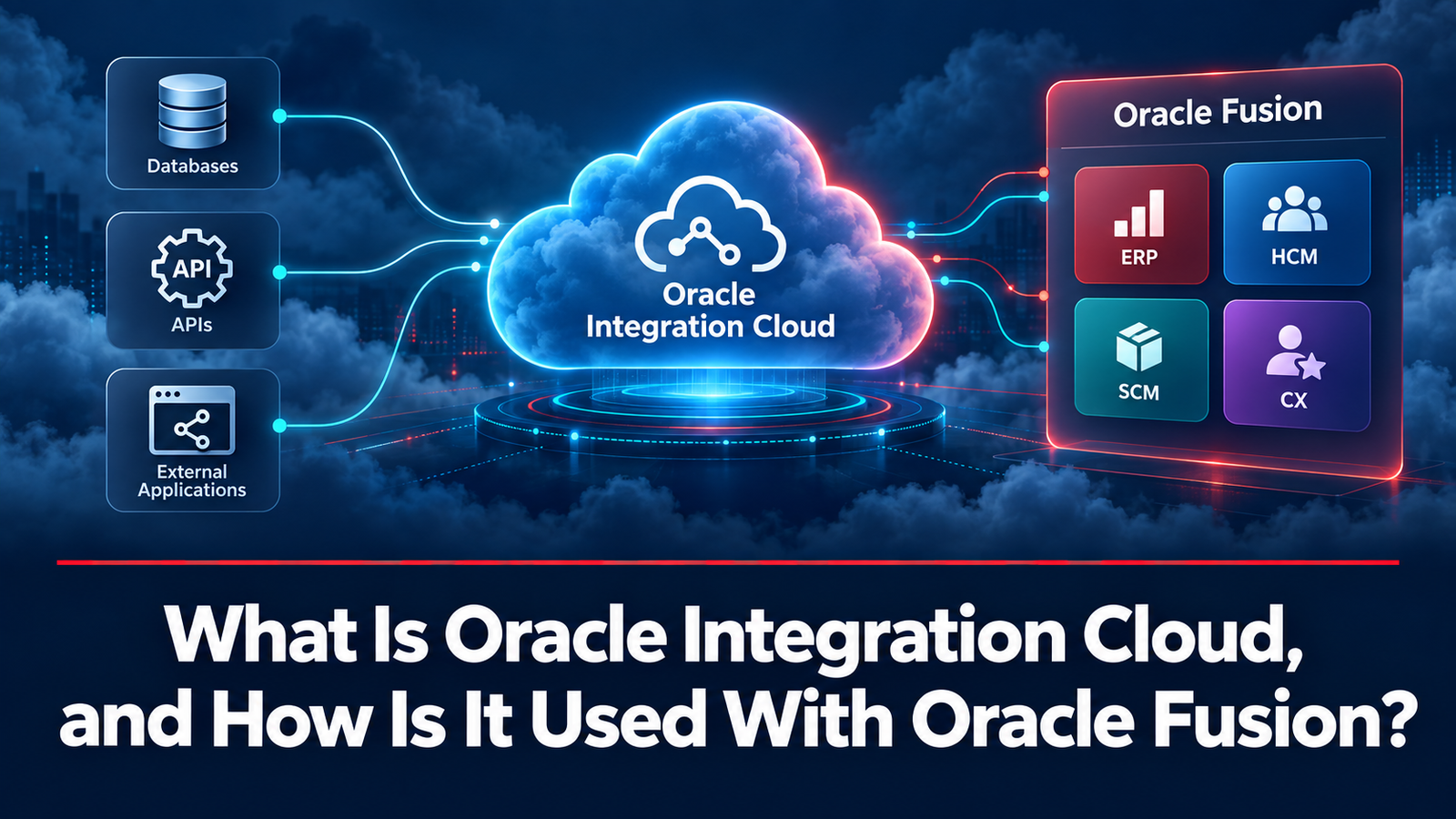
The short version is that OIC is Oracle’s cloud tool for connecting applications and moving data between them. Picture a translator sitting between two people who speak different languages. One system says something, OIC understands it, reshapes it into what the other system expects, and passes it along.
Before tools like this, teams wrote custom scripts for every single connection. They worked fine until somebody changed a field or upgraded an application, and then someone lost a weekend fixing things. OIC gives you one place to build these flows visually, watch them run, and sort them out when they fail.
It also handles process automation (approvals, forms, business rules) and has a Visual Builder for small apps. But if you’re heading for a Fusion technical job, integrations are the part you’ll use most, so that’s where I’d put your energy first.
Why Fusion Projects Can’t Skip Integration
Fusion is a SaaS product, and that changes how you work. In the old E-Business Suite days, a developer could often go straight to the database and write a query. With Fusion, that door is closed. Everything goes through REST APIs, SOAP services, file imports, or business events.
OIC is built around exactly those channels, which is why Oracle points people towards it. And the need is everywhere. A retailer wants daily sales from its point-of-sale system landing in Financials. An HR team wants new hires from a recruitment portal to show up in HCM without anyone retyping them. A manufacturer wants warehouse stock to match what Fusion SCM thinks it has. None of that happens by itself.
How OIC Talks to Oracle Fusion
The link between OIC and Fusion is something called an adapter. It’s a ready-made connector that handles the messy technical details of talking to a particular application. OIC has an Oracle ERP Cloud adapter, an Oracle HCM adapter, and plenty of generic ones for REST, SOAP, FTP and databases.
Most integrations follow the same rhythm. Something kicks it off, maybe a schedule, an incoming API call, a file landing on an SFTP server, or an event raised inside Fusion. Then you map the data, because field names almost never match between systems, and a date in one format has to become a date in another. After that, OIC calls the Fusion API or uploads a file and reads the response. Finally, you decide what happens when things go wrong: retry, alert someone, or park the record for review.
Once this pattern clicks, a surprising number of integrations turn out to be small variations of it. That’s good news if you’re a beginner.
What You’ll Actually Build After Oracle Fusion Technical Training in Pune
Some scenarios come up again and again in real projects. Supplier invoices arrive from outside systems and get loaded into Fusion Payables, often through FBDI (File-Based Data Import). Employee changes like joiners, transfers and exits travel between HCM and other tools so payroll and access stay correct. Bank statement files get picked up from SFTP, converted, and passed to Cash Management. Order and inventory updates move between SCM and outside platforms. And scheduled BI Publisher reports pull data out of Fusion for data warehouses or partners.
If you can build two or three of these end to end, you’re already doing what a junior Fusion technical consultant does every day.
Skills That Help Alongside OIC
OIC doesn’t live in a bubble. People who pick it up quickly usually know a bit about REST and SOAP: what an endpoint is, how JSON and XML look, how authentication works. XSLT helps too, because the mapper is friendly until you hit a tricky transformation. FBDI and ADFdi matter for bulk loads, and BI Publisher and OTBI matter for reports. SQL is still handy for checking data when something looks off.
One more thing people forget is basic functional knowledge. If you don’t know what an invoice or a worker record means inside Fusion, it’s hard to build a good integration around it. You don’t need to master all of this first. Most learners pick these up alongside small practice projects.
Picking Oracle Fusion Technical Training in Pune That Isn’t Just Slides
Pune has a busy IT scene with Oracle partners, global capability centres and product companies, so there’s no shortage of Fusion openings. That also means plenty of courses, and they’re not all equal.
Look for one where you build things yourself. Watching a trainer click through a demo feels productive, but it doesn’t stick. You want labs where you build an invoice load or an HCM sync, hit an error, and work out why. Check that error handling, monitoring and deployment are covered, because interviewers love asking about them. And ask about mock interviews, since explaining your own integration out loud is a skill of its own.
A Few Tips for Learning Faster
Start small. Build a simple REST integration that reads one record from Fusion and writes it to a file. Add a schedule. Add error handling. Try an FBDI load. Each step teaches you something real, and in a few weeks you’ll have a handful of working examples to talk about.
Read Oracle’s documentation, but don’t stop there. Break your own integrations on purpose and look at the error messages. Troubleshooting takes up a big chunk of project life, and being comfortable with failure is a real advantage. Also, talk to people already doing the job. One honest conversation with a working consultant can save you weeks of guessing.
Conclusion
Oracle Integration Cloud is the bridge that lets Oracle Fusion work smoothly with everything else a business runs. It takes care of the mapping, routing, automation and monitoring that used to need custom code and constant babysitting. If you want a technical career in Fusion, understanding OIC is close to a must.
If you’d like to learn it with proper hands-on practice, Soft Online Training offers Oracle Fusion Technical Training in Pune built around real integration scenarios, practical labs and interview preparation. Start with the basics, build small things, and keep at it. It starts making sense sooner than you’d expect.