Introduction
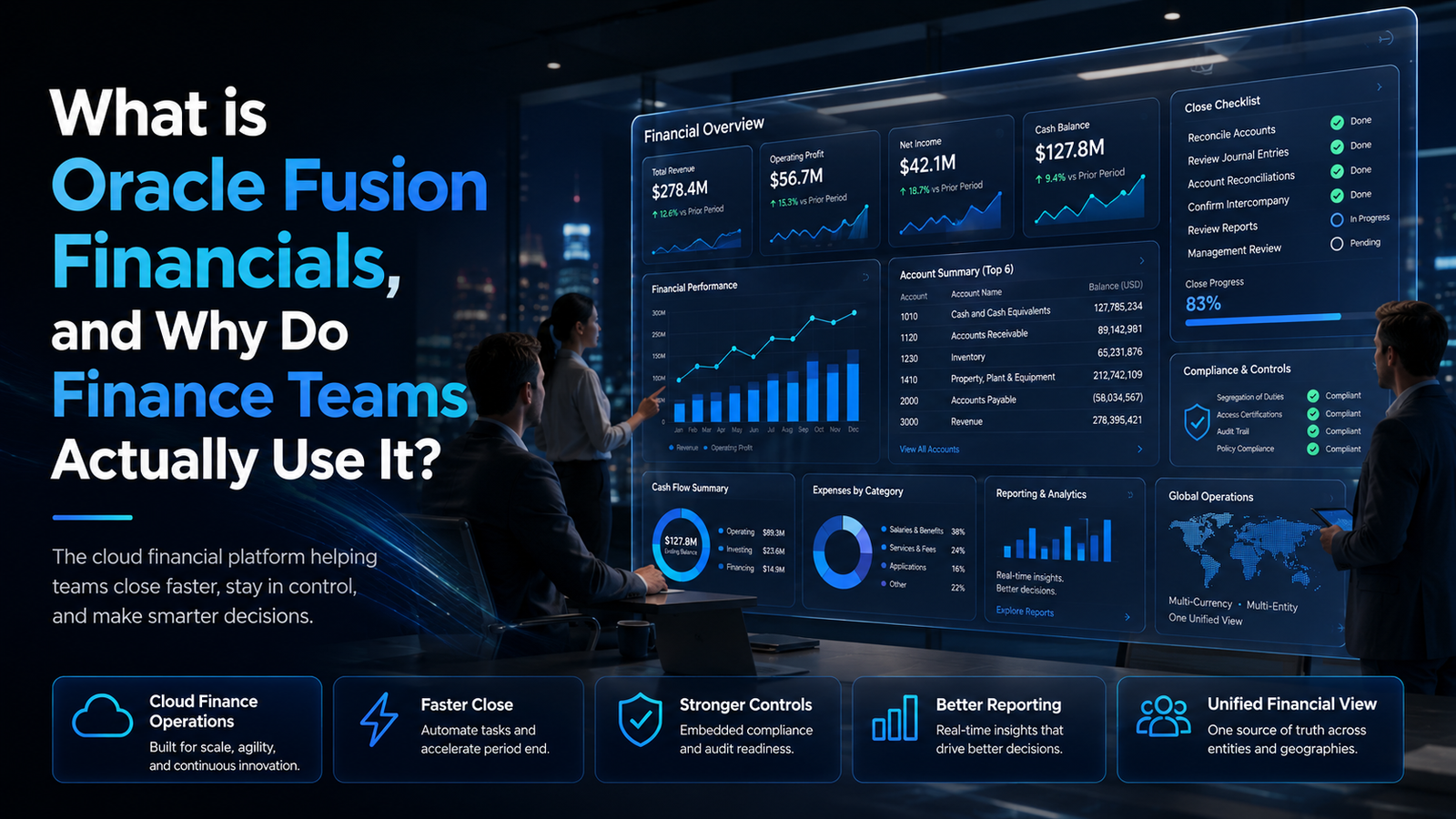
Ask anyone working in corporate finance right now what tool they’re learning, and there’s a decent chance Oracle Fusion Financials comes up. It’s quietly become the default cloud platform for a lot of accounting departments, and that’s exactly why Soft Online Training has seen a steady rise in people signing up for Oracle Fusion Financials Training in Hyderabad. Whether you’re switching careers or just trying to stay relevant in finance, Oracle Fusion Financials Training in Hyderabad is turning into one of the more practical ways to get there. But if you’re new to it, the name alone doesn’t tell you much. So let’s slow down and actually walk through what this system does, what problems pushed companies toward it in the first place, and how it shows up in the day-to-day life of an accountant or controller.
Okay, But What Is It, Really?
Here’s a mistake a lot of beginners make: they hear “Oracle Fusion Financials” and picture a glorified spreadsheet, or maybe just a general ledger with a new coat of paint. It’s more than that. Think of it as a full cloud suite built around the core work finance departments do all day recording transactions, generating accounting entries, running payables and receivables, tracking fixed assets, keeping tabs on cash, closing periods, and pulling reports.
Under the surface, several pieces work together: General Ledger, Payables, Receivables, Assets, Cash Management, Expenses, Subledger Accounting, Intercompany, Tax plus the reporting, approval, and security layers that hold it all together. There’s also the setup side most people forget about: ledgers, legal entities, business units, currencies, calendars, and the chart of accounts. None of it works in isolation, which is really the whole point.
And honestly, the goal was never just to move paper processes onto a screen. Companies adopt this stuff to standardize how finance work gets done, take some of the manual reconciliation burden off people’s plates, and give leadership more reason to trust the numbers they’re looking at. That matters more now than it used to; finance teams are expected to close faster, stay ready for audits, and still carve out time for actual analysis, not just data entry. For teams spread across offices or even countries, it also gives everyone a shared way of handling approvals, balances, and who owns what at period-end.
This is a big reason people don’t just try to self-teach the platform by clicking around; they sign up for structured Oracle Fusion Financials Training in Hyderabad, because the whole thing clicks a lot faster once you see it as connected processes instead of a pile of unrelated screens.
The Problems That Actually Drove Companies to Switch
Nobody rips out an old finance system for fun. Usually a handful of problems just get too painful to keep living with.
Fragmented data is probably the most common one. When payables, receivables, assets, and expenses each sit in their own separate tool, accountants end up spending way too much time cross-checking files instead of doing actual analysis. Putting everything on one platform gets rid of a lot of that busywork.
Then there’s the close that never seems to end on time. Late invoices, journals stuck in limbo, missing approvals, balances nobody’s reconciled yet any of these can drag a close out by days. Period controls, structured accounting steps, and better visibility into what’s still open help teams actually see where the bottleneck is instead of guessing.
Traceability is another one people underestimate until it bites them. Try explaining, in a spreadsheet-heavy world, exactly how a number on a report came to be. In Oracle Fusion Financials, you can usually trace a balance back to its journal, that journal back to the subledger entry, and from there to the original transaction assuming your access allows it. That trail matters both for audits and for someone new trying to learn how the numbers actually flow.
And then, controls. Different teams have a way of developing their own habits. One department’s idea of a proper approval might look nothing like another’s. Standardized approvals, role-based access, and validation rules push everyone toward the same playbook instead of leaving it up to individual judgment.
Following the Money: How the Accounting Actually Works
It all starts with something happening in the business. A supplier sends an invoice. A customer gets billed. A payment goes out. A receipt comes in. An asset gets put into service and starts depreciating. Each of these needs to turn into an accounting entry somewhere down the line.
The subledgers handle the operational side first. Payables logs the supplier invoices and payments. Receivables track what customers owe and what they’ve paid. Assets records additions, depreciation runs, transfers, retirements. Expenses handle employee reimbursement claims. From there, Subledger Accounting takes all of this raw activity and, using configured rules, turns it into actual accounting entries.
Those entries then move over to the General Ledger, where journals get imported and posted, and balances get organized by ledger, period, currency, and account combination. Reports pull from those balances to build income statements, balance sheets, cash views sliced however the business needs, by department, region, product, whatever.
What’s nice about this setup is that it works for everyone at once. An executive can glance at a summary. A controller can dig into variances. An accountant, if they need to, can drill all the way down to one specific journal line or invoice. Same data, just different depths.
Why So Much of the Appeal Comes Down to Reporting
If you ask finance people what actually sold them on a connected system like this, reporting comes up constantly. A report is only as good as what’s behind it, and the chart of accounts along with its hierarchies is what lets Oracle Fusion Financials organize balances in a way that’s actually useful. Company, department, cost center, product if your chart has those segments, they become real reporting dimensions you can slice by.
Reporting these days isn’t just about printing a trial balance once the books are closed. Teams want to watch progress during the close, compare actuals to budget, dig into activity, and answer questions from management without waiting for someone to compile an offline extract.
Drilldown is where this really pays off. Travel expense spikes: who’s driving it, which department, which invoices? Receivables balance climbs which customers, which receipts came in late? Depreciation shifts were new asset additions, or did someone change a useful-life assumption? Because ledger balances and subledger detail are linked, that kind of digging doesn’t require a scavenger hunt across five different systems.
Worth remembering, too: this isn’t only about external financial statements. Management reporting, operational reviews, project analysis, audit support it’s all drawing from the same controlled pool of data.
Controls: The Part Nobody Loves Talking About, But Everyone Needs
Controls are basically the rules, approvals, and paper trail that keep financial information trustworthy. They matter because there’s real risk baked into everyday accounting work: an invoice entered wrong, a payment approved by someone who shouldn’t have the authority, a journal landing in the wrong account, a period staying open longer than it should.
Role-based security is the first line of defense. Maybe someone can enter invoices but can’t create new suppliers. Maybe someone else can approve journals but has zero ability to touch accounting rules. Someone in reporting might only be able to view balances, full stop. That separation of duties isn’t bureaucracy for its own sake, it’s what keeps one person from having too much unchecked control.
Workflow approvals add another layer, making sure transactions get reviewed before they’re finalized. Invoices, expense reports, journals they can all follow approval paths based on rules the organization sets, and that approval history sticks around as part of the record.
Account-level controls stop bad accounting before it even happens cross-validation rules, account hierarchies, segment security. Period controls keep transactions from sneaking into a period that’s already closed. And audit tools let someone go back and see exactly who did what, and when.
At the end of the day, it’s all about being able to explain your process to an auditor, to a manager, to whoever’s asking without hand-waving.
What Changes When It’s Cloud-Based
Being cloud-native changes a lot about how companies handle upgrades and configuration. In the old on-premise days, a major upgrade was its own multi-month project that IT and finance had to survive together. With cloud, updates come on a regular cycle, and organizations plan their testing and change management around that instead of around a one-off overhaul.
That doesn’t mean configuration disappears, finance teams still design ledgers, legal entities, business units, charts of accounts, approval rules, tax settings, security roles. It just tends to happen within the application’s own framework rather than through custom code bolted on the side.
Conclusion
At its core, Oracle Fusion Financials exists to solve problems finance teams have been dealing with for years with scattered data, slow closes, weak traceability, and controls that vary by department. Bringing payables, receivables, assets, cash, and the general ledger onto one platform makes the whole process easier to explain, audit, and trust. If you’re thinking about building a career around this kind of work, going through proper Oracle Fusion Financials Training in Hyderabad is probably the most direct route; it gets you working with the actual process flows instead of just memorizing where buttons are.