Introduction
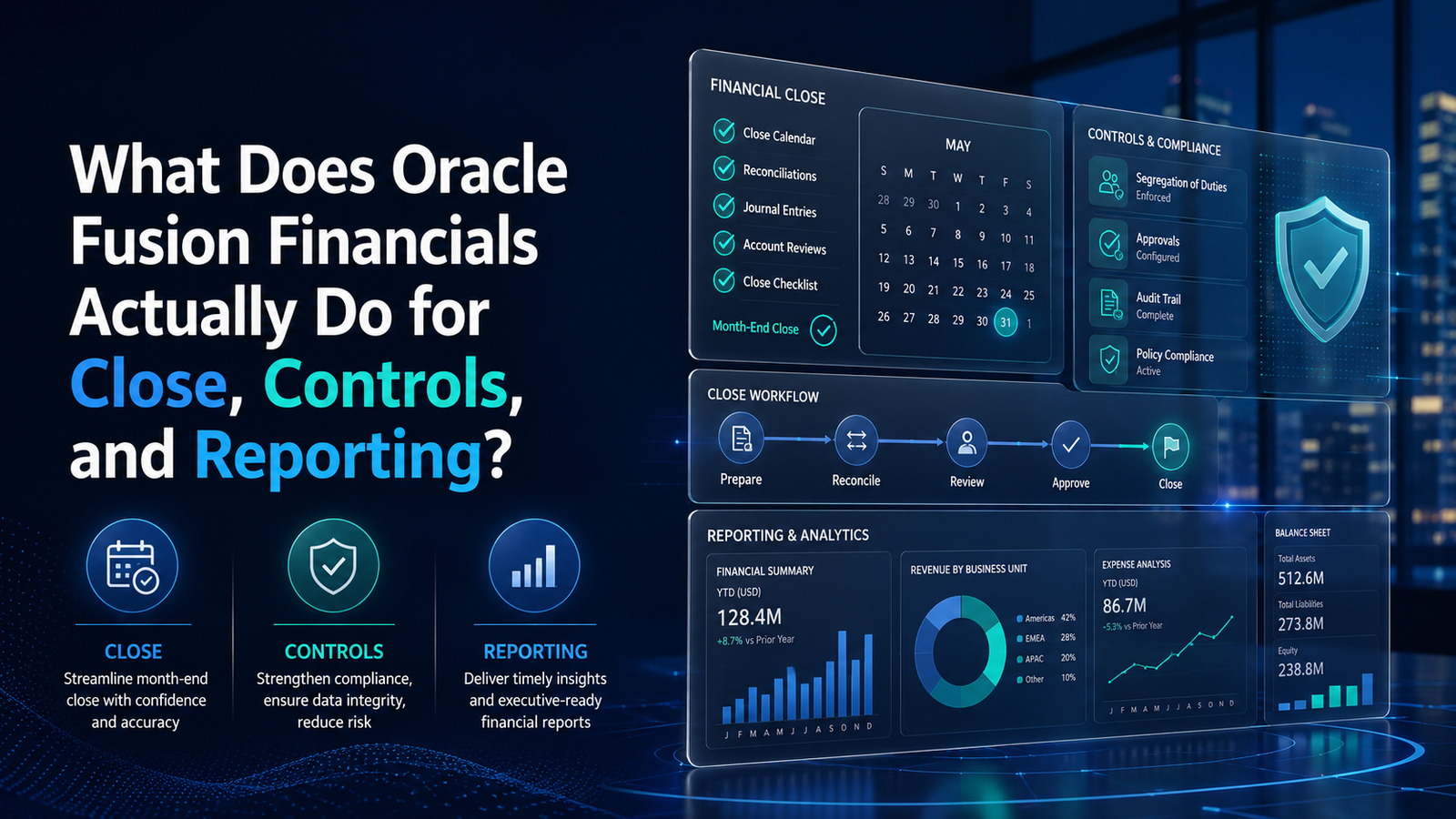
Ask ten finance professionals what actually happens during month-end close, and you’ll get ten slightly different, mildly stressed answers. Tech Leads IT sees this pattern often, and it’s usually a sign the process is being held together by habit rather than a real system. Oracle Fusion Financials is built to change that bringing the close, internal controls, and reporting into one connected environment instead of a patchwork of spreadsheets and side tools. This article walks through what the platform actually does in those three areas, in plain terms, without getting lost in every screen and setting. It’s also why so many professionals start with Oracle Fusion Financials Training, move into a full Oracle Fusion Financials Online Training program, or enroll in a structured Oracle Fusion Financials Course to see how these ideas play out in real work.
Why Finance Teams Keep Coming Back to Oracle Fusion Financials
Anyone who has sat through a month-end close knows it isn’t just a date on the calendar. It’s a chain of work that has to happen in the right order: invoices get entered, receipts get matched, assets get depreciated, accruals get booked, journals get reviewed, and by the end of it, someone in leadership expects a number they can trust. Oracle Fusion Financials exists to hold that whole chain together in one place, instead of every team running its own version of the close through spreadsheets, email chains, and “did you approve this yet?” messages.
If you’re new to it, think of Oracle Fusion Financials as the operating system underneath core accounting. General ledger, payables, receivables, assets, cash management, expenses, subledger accounting, intercompany, collections, tax, and reporting all live under one roof and share the same data. That’s really the whole pitch: because everything is connected, the close doesn’t have to be a scavenger hunt across disconnected tools.
This piece isn’t a screen-by-screen walkthrough. It’s meant to give you a working sense of what the platform does in three areas that every finance team cares about: closing the books, keeping controls in place, and getting reporting that people can actually rely on. A lot of professionals get their first real exposure to these ideas through Oracle Fusion Financials Training, where the concepts stop being theory and start showing up on actual screens and in actual workflows.
How It Supports the Accounting Close
The close is the moment where day-to-day operational activity turns into financial statements. Oracle Fusion Financials organizes that process around ledgers, legal entities, business units, accounting periods, calendars, currencies, and the chart of accounts. None of that sounds exciting on paper, but these are the structures that decide how your organization actually records and views its results.
During close, everyone needs to know what’s done and what isn’t. Payables might still be chasing down supplier invoices. Receivables might still be applying cash. Fixed asset accountants are checking additions, retirements, and depreciation runs. GL is posting manual entries, reversing accruals, or consolidating numbers across entities. Instead of each of these teams working in isolation, the system gives them a shared framework to close against.
One of the more important ideas here is period control. Payables, Receivables, and Assets each have their own period status open, closed, or locked from new activity and the general ledger has its own status too. Managing these statuses is what keeps a stray transaction from sneaking into a period that’s supposed to be finished. The system will also flag exceptions, unposted journals, and reconciliation gaps that still need attention before anyone signs off.
There’s also traceability, which sounds like a small thing until you’re the one trying to explain a journal line to an auditor. Because accounting entries stay linked to the transaction that created them a supplier invoice, a customer receipt, a depreciation run, an expense report an accountant can drill from a ledger balance all the way back down to the source, rather than digging through old files.
What Close Automation Actually Looks Like
Automating the close doesn’t mean accountants become unnecessary, it means the repetitive parts get defined once and then applied the same way every time. Oracle Fusion Financials can handle accounting generation, journal imports, recurring journals, allocations, reversals, revaluations, translations, and intercompany balancing. The real win isn’t just speed; it’s consistency.
Say your company has the same expenses hitting every month recurring journal logic saves you from re-entering them by hand. Need to split a cost across departments? Allocation rules apply the agreed percentages automatically. Carrying foreign currency balances? Revaluation recalculates unrealized gains and losses based on the rates you’ve set up. Reporting across multiple currencies? Translation converts everything into the reporting currency the way it’s configured to.
There are still checkpoints built in. A journal can move through save, complete, approve, and post stages depending on how it’s set up, and approval workflows route entries to the right reviewer based on amount, source, or account combination. That matters because closing fast without any review discipline is how control problems creep in. Good configuration lets teams move quickly without giving up accountability.
None of this works, though, if the upstream data is messy. If invoices go in with missing distributions, receipts sit unapplied, or asset additions get miscategorized, the close will still drag no matter how well the automation is set up. The platform gives you the structure; your team still has to own the data, respect cut-off dates, and chase down exceptions.
How Controls Show Up in Everyday Work
People tend to think of internal controls as something auditors care about once a year, but day-to-day, they’re really just guardrails that stop the wrong person from posting the wrong thing, or catch an approval that got skipped. Oracle Fusion Financials builds this in through role-based security, approval workflows, accounting rules, setup governance, audit trails, segregation of duties, and period controls.
Role-based access is probably the most obvious one. A payables clerk can enter invoices but has no business touching ledger setup. Someone who prepares journals shouldn’t be the one approving their own high-value entries. A reporting analyst can look at balances without being able to post anything. These boundaries cut down on both honest mistakes and anything more deliberate.
Approval workflows do a similar job for invoices, expense reports, journals, and payments — routing them based on rules the business has already agreed on. In a manual process, proof of approval usually lives in someone’s inbox. Here, it’s baked into the transaction history itself.
Validation adds another layer. Account combinations can be turned on, turned off, secured, or governed by cross-validation rules, which cuts down on postings to the wrong department, cost center, or account. Accounting rules inside subledger accounting also make sure similar transactions get treated the same way every time, instead of depending on who happened to process it.
Why Reporting Feels More Connected
Reporting is where all that closing and control work finally pays off for the people making decisions. Oracle Fusion Financials pulls reporting from ledger balances, account hierarchies, reporting cubes, dashboards, and financial reporting tools. Every organization sets this up a little differently, but the underlying idea stays the same: reporting should trace back to accounting data that’s actually been governed, not a side spreadsheet someone built on their own.
The chart of accounts sits at the center of all of it. Segments like company, department, account, cost center, product, project, and region become the dimensions you report on. Design it well, and finance can slice results by entity, function, geography, or natural account without building shadow structures on the side. Design it poorly, and even great software won’t save your reporting.
Because it’s cloud-based, reporting users can usually pull current balances and transaction details without waiting on someone to rebuild an extract. That doesn’t remove the need for data governance, it just means controllers and analysts can dig into results while the close is still happening, instead of waiting until everything’s finished.
It’s a bit like the difference between reading a printed report and actually having a conversation with the numbers. A static report gives you the final balance and stops there. A connected environment lets someone move from a variance, to the account, to the journal behind it, to the subledger accounting, and down to the source document, wherever access allows. That’s a big reason integrated systems matter so much to finance teams.
How Close, Controls, and Reporting Depend on Each Other
It’s tempting to treat close, controls, and reporting as three separate jobs, but they lean on one another more than people expect. Close activity produces the balances. Controls protect the quality of those balances. Reporting is how you actually communicate them to the people who need to see them. Weaken one, and the other two feel it.
Picture a company that closes fast but lets unsupported manual journals slide through reporting shows up on time, but nobody fully trusts it. Or a company with airtight approvals and a poorly designed chart of accounts plenty of control evidence, but leadership still can’t get the view they actually need. Or a company with a beautiful dashboard sitting on top of unresolved subledger exceptions. It looks great, but the numbers underneath aren’t finished.
Oracle Fusion Financials tries to solve this by putting all of it under one architecture: subledgers create the accounting, the ledger holds the posted balances, security and approvals decide who can act, period controls manage timing, and reporting tools present the results with audit and inquiry features to back them up. This is especially useful once an organization outgrows manual close trackers and a patchwork of local systems. It’s also part of why many finance professionals eventually work through an Oracle Fusion Financials Online Training program. The pieces make a lot more sense once you can follow a transaction from entry, through journal posting, all the way to reconciliation and reporting.
Habits That Make the Close Easier
The software only gets you so far teams still need habits that fit around it. First is clear ownership: every subledger should have someone responsible for period-end work, open exceptions, and reconciliations. When everyone assumes someone else is handling it, the close stalls out.
Second is cut-off discipline. Transactions need to land in the right period, and while late invoices and backdated entries will always happen occasionally, they need rules and visibility around them. Period controls help enforce this, but ultimately it’s a policy decision the business has to make.
Third is solid master data. Supplier records, customer accounts, asset categories, tax setup, account values, and approval hierarchies all shape accounting quality. Messy master data means messy accounting downstream a lot of “general ledger problems” actually start further upstream in setup.
Fourth is exception-based review. Rather than checking everything with the same level of scrutiny, teams can zero in on unposted journals, failed accounting, odd account combinations, large variances, and anything stuck pending approval. That’s where an accountant’s judgment is actually needed.
Fifth is treating the close calendar as something to keep improving, not a fixed ritual. If the same issue keeps popping up month after month, it’s worth asking whether it’s a rule, an approval path, a training gap, an integration, or a master data issue that needs fixing.
Questions People Usually Ask First
Is Oracle Fusion Financials basically just a general ledger tool?
A. Not really. General Ledger sits at the center, but the real value comes from how the subledgers, accounting rules, controls, and reporting all connect back into it. The ledger is the book of record; everything else explains how the numbers got there.
Does it replace accountants?
A. No, it changes what accountants spend their time on. Less time chasing down scattered evidence, more time reviewing exceptions, making judgment calls, designing controls, and explaining results. The system handles the repeatable logic; people still handle interpretation.
Is this only for huge enterprises?
A. It’s common in complex organizations because it handles multiple entities, currencies, ledgers, and tax requirements well. But the core ideas clean data, real controls, connected reporting matter to any finance team trying to get a better handle on its accounting.
Oracle Fusion Financials is also just one piece of the broader Oracle Fusion Applications portfolio. Zooming out, enterprise resource planning as a category grew out of the need to tie business processes together. There’s a good overview of that history on Wikipedia’s page on enterprise resource planning. For finance teams specifically, the takeaway is simpler: accounting gets more reliable once transactions, controls, and reporting are all built on the same governed foundation. Anyone looking to build real, hands-on skill in this area usually finds it worth working through a structured Oracle Fusion Financials Course rather than trying to piece it together from documentation alone.
Conclusion
At its core, Oracle Fusion Financials brings close, controls, and reporting into one connected system instead of leaving finance teams to stitch it together manually. A faster close means little without strong controls behind it, and controls mean little if reporting can’t turn them into insight leadership can act on. The real strength of the platform is how these pieces reinforce each other. For professionals who want to move beyond theory and actually work through these processes hands-on, an Oracle Fusion Financials Training, Oracle Fusion Financials Online Training, or a focused Oracle Fusion Financials Course is often the most practical starting point.