
Japan has given the world sushi, samurai, and some of the most beautifully compact wisdom you’ll ever come across. Japanese proverbs known as kotowaza (ことわざ) pack centuries of philosophy, humour, and hard-earned life lessons into just a handful of words. If you’re a language learner, a lover of quotes, or simply someone hunting for a little daily inspiration, exploring beginner Japanese proverbs is one of the most rewarding ways to connect with Japanese culture while picking up new vocabulary along the way.
In this article, we’ll walk through some of the most beloved Beginner Japanese Proverbs and quotes, explain what they mean, and explore why learning through proverbs is such an effective (and enjoyable) strategy especially if you’re weighing Japanese among the best languages to learn this year.
Why Japanese Proverbs Are Perfect for Beginners
Before diving into the list, it’s worth understanding why proverbs make such great learning material. Unlike long grammar drills or vocabulary lists, proverbs are short, rhythmic, and culturally rich. They teach you sentence structure, common kanji, and cultural values all at once. Many teachers recommend starting with proverbs precisely because they’re memorable a single four-word phrase can stick with you far longer than a page of textbook exercises.
This is also one of the reasons Japanese consistently ranks among the best languages to learn for people interested in culture, business, or personal growth. It opens doors to anime and literature in their original form, to a fascinating history, and to a mindset of discipline and patience that proverbs capture perfectly.
My Favourite Japanese Proverbs and What They Mean
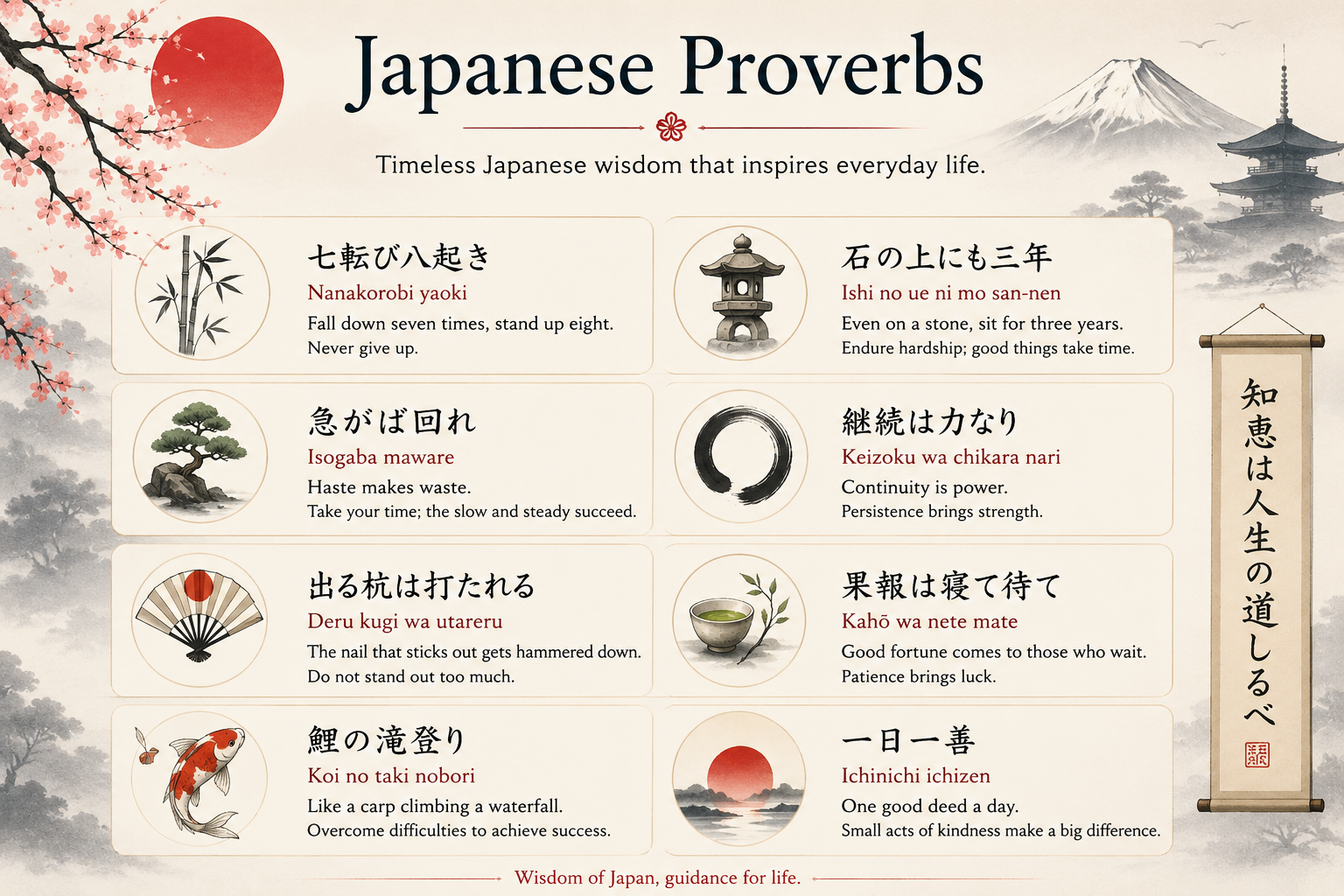
1. 七転び八起き (Nana korobi ya oki) “Fall seven times, stand up eight”
This is arguably the most famous Japanese proverb in the world, and for good reason. It’s a simple, powerful reminder that resilience matters more than perfection. No matter how many times life knocks you down, the goal is always to get up one more time than you fall. It’s a favourite among athletes, entrepreneurs, and language learners alike because let’s be honest, learning any language involves plenty of stumbles before fluency.
2. 猿も木から落ちる (Saru mo ki kara ochiru) “Even monkeys fall from trees”
Even the most skilled among us make mistakes. This proverb is the Japanese equivalent of “everyone has an off day,” and it’s a gentle, humorous reminder not to be too hard on yourself. Monkeys are experts at climbing trees, yet even they slip sometimes. If a master can stumble, so can you and that’s perfectly okay.
3. 石の上にも三年 (Ishi no ue ni mo san nen) “Three years on a stone”
Literally referring to sitting on a cold stone for three years until it becomes warm, this proverb champions patience and persistence. Good things take time. Whether you’re building a career, a relationship, or your Japanese vocabulary, this proverb is a beautiful nudge to keep showing up, even when progress feels slow.
4. 出る杭は打たれる (Deru kui wa utareru) “The nail that sticks out gets hammered down”
This proverb offers insight into a core aspect of Japanese social culture: the value placed on harmony and group cohesion. It warns against standing out too much or drawing unwanted attention. While interpretations vary some see it as a caution against arrogance, others as commentary on conformity it’s a fascinating window into how collectivist values shape everyday thinking in Japan.
5. 光陰矢の如し (Kōin ya no gotoshi) “Time flies like an arrow”
A poetic reminder that time is precious and fleeting, much like the English “time flies.” This proverb encourages mindfulness and urgency don’t waste the present moment, because it won’t come back around.
6. 花より団子 (Hana yori dango) “Dumplings over flowers”
This one is a personal favourite for its wit. It means choosing practicality over aesthetics substance over style. Traditionally used to describe someone at a cherry blossom festival who cares more about the snacks than the scenery, it’s now used more broadly to describe anyone who prefers function over form.
7. 猫に小判 (Neko ni koban) “Gold coins to a cat”
The Japanese version of “casting pearls before swine.” It describes giving something valuable to someone who can’t appreciate it. A cat has no use for gold coins so why bother? It’s a humorous way of pointing out when effort or resources are wasted on someone unable to value them.
8. 案ずるより産むが易し (Anzuru yori umu ga yasushi) “Giving birth is easier than worrying about it”
This proverb reassures us that things are often less difficult than we fear. Anxiety about a task tends to be worse than actually doing it. It’s a comforting mantra for anyone facing a daunting challenge including tackling a new language.
How to Start Learning Beginner Japanese Proverbs
If these quotes have sparked your curiosity, here are a few simple ways to start incorporating beginner Japanese proverbs into your language journey:
- Learn one proverb a week. Write it down, understand its literal and figurative meaning, and try using it in a sentence.
- Pair proverbs with kanji study. Many proverbs use common kanji, so you’ll reinforce vocabulary while learning cultural context.
- Say them out loud. Proverbs are rhythmic and often follow patterns that help with pronunciation practice.
- Connect them to your own life. Reflecting on how a proverb applies to your personal experiences makes it far easier to remember.
Why Japanese Deserves a Spot on Your Language-Learning List
When people debate the best languages to learn, Japanese often comes up for its unique writing systems, its deep literary tradition, and its usefulness in business, technology, and travel. But beyond the practical benefits, learning Japanese starting with something as simple as a handful of proverbs offers a window into a worldview built on patience, humility, resilience, and quiet wit.
Proverbs like nana korobi ya oki aren’t just quotes to memorise; they’re mindsets to live by. And that’s ultimately what makes Japanese such a rewarding language to learn: it doesn’t just teach you new words, it teaches you new ways of thinking.
So, what’s your favourite Japanese proverb? Whether you’re drawn to the resilience of “fall seven times, stand up eight” or the wit of “dumplings over flowers,” there’s a proverb out there that will resonate with exactly where you are in life and in your language-learning journey.