Introduction
So you’ve decided to learn about Oracle Fusion Financial’s good move. At Tech Leads IT, we meet plenty of beginners who feel a little lost in week one. Modules, terminology, workflows connecting in ways that aren’t obvious yet it’s a lot. That confusion is normal; everyone who’s good at this platform today started exactly where you are.
This isn’t a textbook rundown of every feature. It’s a walk through what actually matters early on the modules you’ll use most, the concepts that unlock everything else, and where beginners usually trip up. Still deciding between figuring it out solo or joining Oracle Cloud Financials Online Training? Keep reading. And if you’re comparing options, Oracle Cloud Financials Training Online programs can shortcut a lot of that early confusion for you.
Why Bother Learning Oracle Fusion Financials in the First Place?
Let’s get this out of the way first, because it’s a fair question. Companies used to run their finance operations on clunky, on-premise systems that needed IT teams to babysit servers and push manual updates. Oracle Fusion Financials threw that model out. It’s cloud-native, updates happen in the background, and it plugs into other Oracle applications Procurement, HR, Supply Chain without the messy custom integrations older systems needed.
What that means for you as a learner: fewer weird workarounds to memorize, and more time spent understanding how the business logic actually flows. It’s still a big system, don’t get me wrong. But it’s built to make sense once the pieces click, and that’s a lot more than you can say for some of the ERP tools it replaced.
General Ledger: Where Everything Eventually Lands
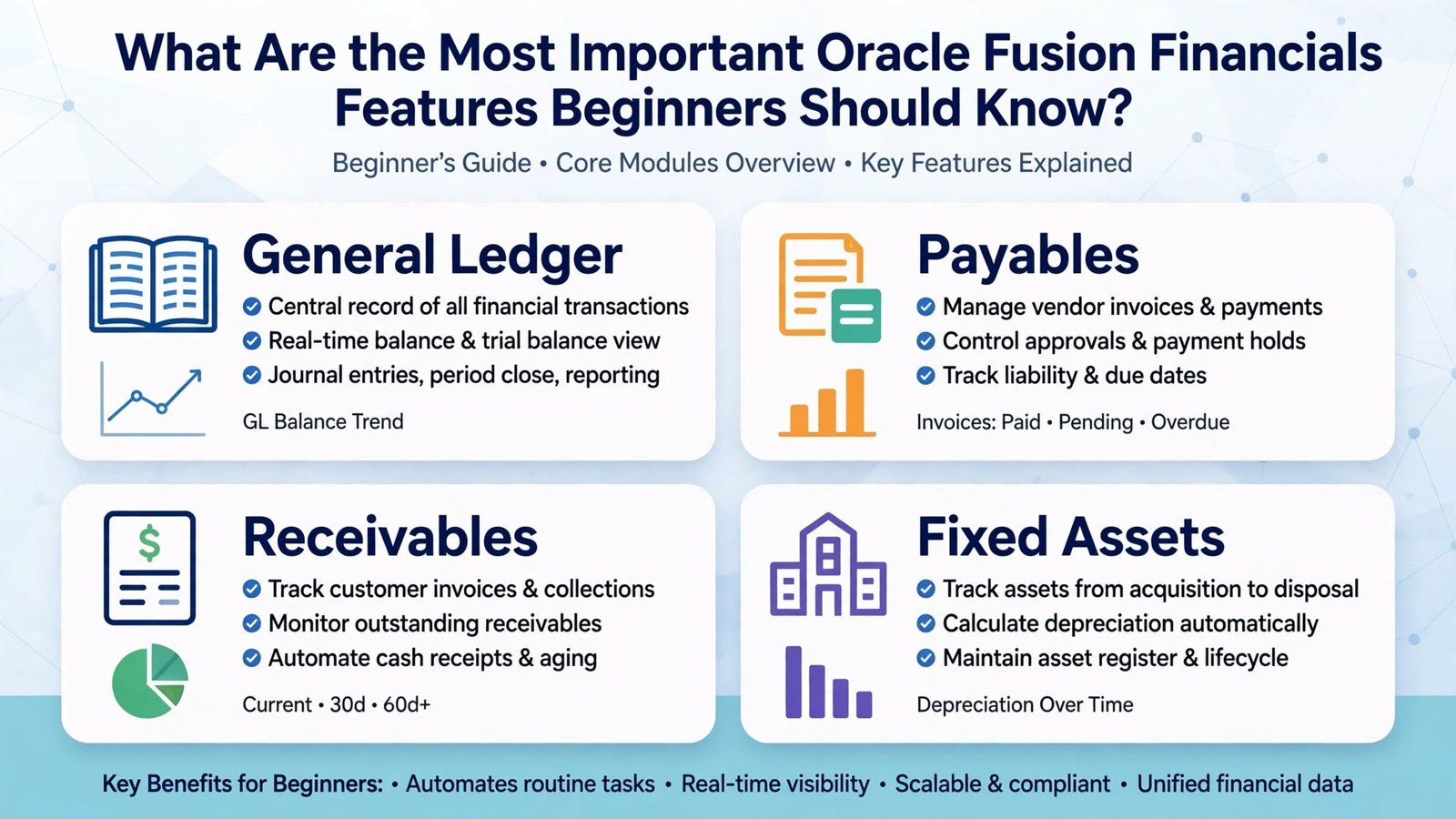
If there’s one module you can’t skip, it’s General Ledger. Every transaction no matter which module it started in eventually finds its way here. GL is the record-keeper, the summarizer, the thing that turns thousands of scattered entries into a balance sheet someone can actually read.
Early on, focus on getting comfortable with charts of accounts structures, how journal entries move through the system, and what happens during period close. Oracle also builds in these reporting cubes (they’re Essbase-powered, if you want the technical term) that let you pull real-time views of your data instead of waiting around for an overnight batch job to finish. Once you understand how account hierarchies and multi-ledger consolidation work, a lot of the rest of the platform starts making more sense too.
Accounts Payable and Accounts Receivable The Modules You’ll Live In
AP and AR are where the day-to-day happens. Accounts Payable deals with vendor invoices, payments, supplier records basically money going out. Accounts Receivable is the mirror image: customer invoicing, collections, cash coming in.
As a beginner, the invoice-to-pay cycle and the order-to-cash cycle are worth learning cold, because they’re the backbone of how cash actually moves through a business. Oracle automates a good chunk of this invoice imaging, automatic matching, configurable approval routing which cuts down on the manual grunt work that used to eat up finance teams’ time. You’ll still need to understand what’s happening under the hood, though, because automation only helps if you know what it’s automating.
Fixed Assets: Not Glamorous, But You Need It
Nobody gets excited about Fixed Assets, but it’s a module you’ll run into constantly. It tracks everything from acquisition to depreciation to eventual retirement of a company’s assets, buildings, equipment, software licenses, you name it.
Pay attention to how depreciation methods get configured and, more importantly, how assets flow into the General Ledger automatically once a transaction posts. That tight coupling is actually one of the smarter parts of Oracle’s design; it means asset values on the books stay accurate without someone manually reconciling two separate systems.
Cash Management: Keeping an Eye on Liquidity
Every CFO cares about one thing above almost everything else: how much cash is actually available right now. Cash Management is the module that answers that question. It handles bank statement reconciliation, gives a real-time cash position, and helps with forecasting.
The part beginners usually find satisfying here is watching automated matching work bank statements get imported and matched against transactions without someone manually eyeballing spreadsheets line by line. If you want to actually practice this rather than just read about it, Oracle Cloud Financials Training Online programs typically build in hands-on labs where you reconcile mock statements yourself. That kind of repetition is honestly what makes it stick.
Expenses: A Decent Place to Start If You’re Overwhelmed
If GL and AP feel like too much too soon, the Expenses module is a gentler entry point. It’s what employees use to submit travel and business expense reports, and it applies company policy checks and approval routing automatically behind the scenes.
The logic here is more intuitive than in the heavier modules, which makes it a good warm-up. And because the approval workflow engine you learn here gets reused across other parts of Oracle Fusion, you’re not wasting time, you’re building a skill that transfers.
How Procurement Ties Back Into Financials
Procurement technically lives in its own product family, but you can’t really separate it from Financials once purchase orders start flowing. Purchase orders, receipts, supplier invoices all move between Procurement and Accounts Payable as part of one connected procure-to-pay process.
Understanding this connection early saves you from a common beginner mistake: thinking of each module as an island. They’re not. Oracle’s whole pitch is that these systems talk to each other, and that’s a real advantage over the older, disconnected legacy tools a lot of companies are trying to move away from.
Reporting and Analytics Where You Actually Prove Your Worth
Here’s something not enough beginners hear early enough: your reporting skills will matter more than almost anything else you learn. Oracle Transactional Business Intelligence (OTBI) and Financial Reporting Studio let you build dashboards and real-time reports without needing to be a developer.
Spend real time here. This is genuinely what separates someone who can just navigate the system from someone who can hand a CFO a report that actually answers their question. If you go through Oracle Cloud Financials Online Training, this is usually where a good trainer earns their keep walking you through realistic reporting scenarios instead of leaving you to poke around dashboards with no context.
Security and Roles The Stuff Nobody Talks About Enough
Access in Oracle Fusion Financials is role-based. What you can see and do depends entirely on the job roles assigned to your user account. As a beginner you probably won’t configure this yourself, but you should understand how it works function security versus data security, and why segregation of duties matters so much in finance specifically.
Even if security setup isn’t your job, knowing why you can’t see certain screens (or why a colleague can’t) will save you a lot of confused support tickets down the line.
Period Close: Where the Pressure Shows Up
Ask anyone who’s worked in finance and they’ll tell you period close is stressful. Accounts get reconciled, journal entries get reviewed, statements get finalized all against a deadline that doesn’t move. Oracle gives teams visibility into task status across departments so nothing quietly falls through the cracks.
It’s also worth getting familiar with how the system handles compliance audit trails, approval documentation, segregation of duties because these aren’t optional extras. In regulated industries, they’re the whole reason certain workflows exist the way they do.
Why Most Beginners Do Better With Structured Training
Here’s the honest truth: you can learn Oracle Fusion Financials from documentation and YouTube videos alone. People have done it. But it takes a lot longer, and it’s easy to build gaps in your understanding without realizing it until something breaks.
Structured Oracle Cloud Financials Training Online programs exist for a reason: they give you a sequence to follow, real project scenarios to work through, and someone to ask when you get stuck at 11pm wondering why your journal entry won’t post. That’s not a knock on self-learners. It’s just a faster, less frustrating path for most people.
Mistakes Beginners Make (So You Don’t Have To)
A few patterns show up again and again. People memorize click-paths without understanding the business logic behind them, and then panic the moment something looks slightly different than the tutorial they watched. Others skip General Ledger entirely because it sounds boring, then get stuck later trying to understand why AP transactions post where they do.
The fix is boring but true: go in order. Core concepts first, then integrations, then reporting. It’s not the exciting path, but it’s the one that actually works.
Where This Knowledge Can Take You
People who get genuinely good at Oracle Fusion Financials end up in roles like Financial Functional Consultant, ERP Business Analyst, Oracle Cloud Implementation Specialist, or Financial Systems Administrator. Banks, manufacturers, retailers, IT services firms they’re all hunting for people who understand both the functional side and the technical side of this platform.
And Oracle isn’t slowing down its cloud investment anytime soon, so the demand for people who actually know this system isn’t going away either.
Wrapping Up
Oracle Fusion Financials looks intimidating from the outside, but it breaks down into manageable pieces once you take it module by module General Ledger, AP, AR, Fixed Assets, Cash Management, Expenses, and the reporting layer that ties it all together. At Tech Leads IT, we’ve seen enough beginners go through this to know that the ones who succeed aren’t necessarily the most naturally gifted; they’re the ones who build a solid foundation first instead of rushing ahead.
If you’re serious about this as a career move, put some real time into either Oracle Cloud Financials Online Training or Oracle Cloud Financials Training Online guided practice beats trial and error almost every time. Learn the fundamentals well, get your hands dirty with actual configuration exercises, and you’ll be surprised how quickly “beginner” stops being an accurate description.