
Introduction
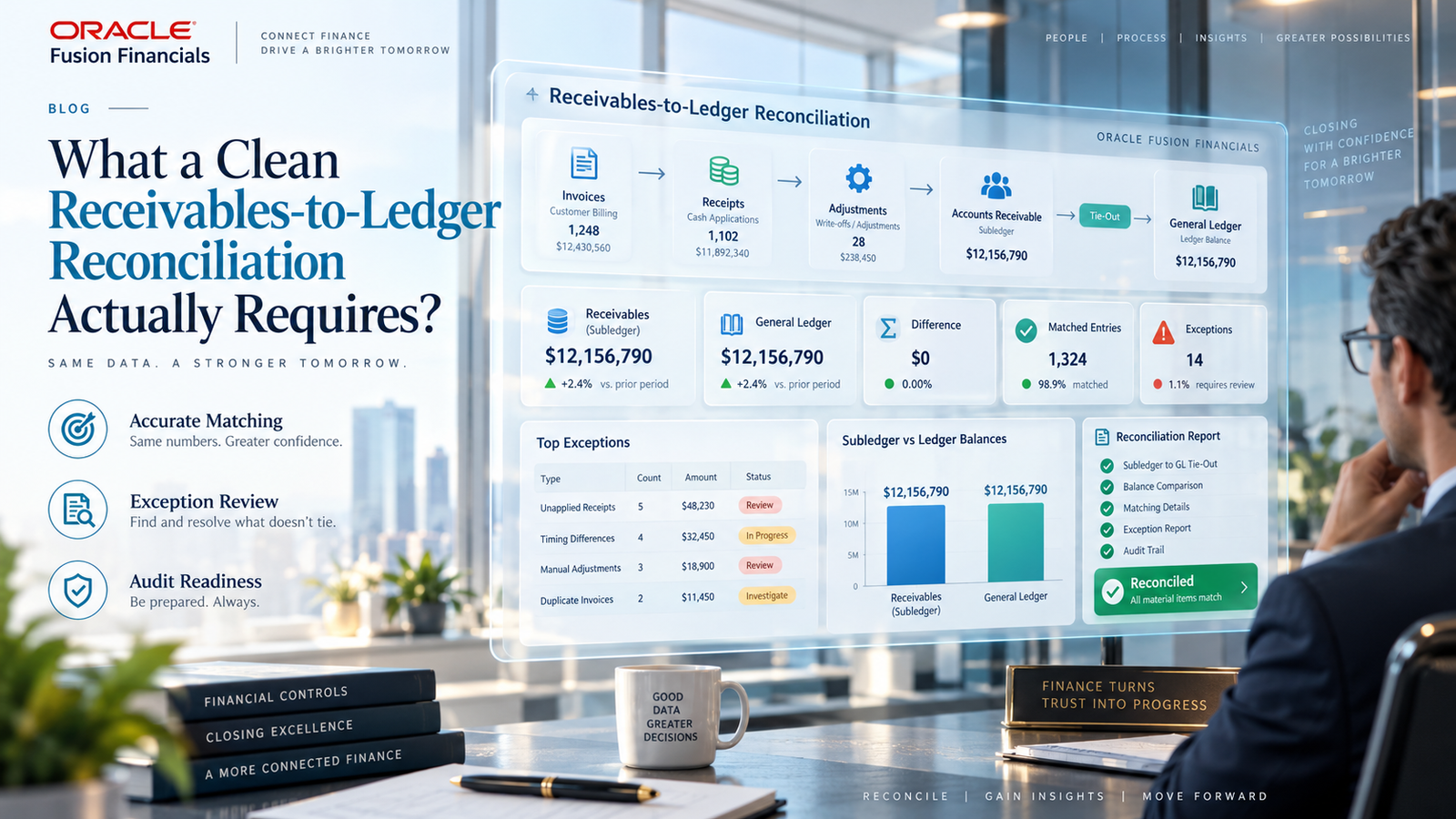
A clean reconciliation is never just a report that lands on zero. According to Tech Leads IT, it is a controlled comparison between receivables activity, subledger accounting, and posted general ledger balances, all measured for the same period and scope. Someone new to Oracle Cloud Financials Online Training might treat this as a simple reporting task, but the real work starts earlier, transactions must be complete and journals must reach the ledger before differences can be explained.
That sequence matters because a difference can be valid without being acceptable. Learners in Oracle Cloud Financials Training Online quickly discover that two unrelated errors can cancel out, producing a tidy total and a thin audit trail.
Why Oracle Cloud Financials Training Starts With the Accounting Flow
The expected path runs from the receivables transaction, into subledger accounting, then into a general ledger journal, and finally into posted ledger balances. Each stage changes what can actually be compared. A transaction with no completed accounting belongs in an operational exception queue, not a reconciliation spreadsheet. A journal that hasn’t been posted belongs inside the period-close process. Neither situation should be waved away as a generic “timing issue” when the system already shows exactly where the flow broke down.
Oracle’s own documentation on account reconciliation and subledgers makes the ordering explicit: receivables and payables transactions must be imported and accounted for in the general ledger, and the related journals must be posted, before reconciliation reports are pulled. This gives reviewers a practical control step to confirm accounting and posting status first, before spending time chasing report differences. Skipping that check means investigating balances that were incomplete from the start, rather than isolating genuine exceptions. This is one of the first habits any solid Oracle Cloud Financials Online Training program tries to instill, because it saves hours of misdirected effort later in the close cycle.
Freezing a Comparable Period Is Central to Oracle Cloud Financials Training Online
A reconciliation only means something when both sides represent the same cutoff. The subledger period should be closed to further activity before the extraction that generates summarized reconciliation data. If transactions keep posting after that extraction, the detail can reflect later activity while the summary stays frozen at the earlier point. The mismatch that results can look like a genuine accounting failure, when really it’s just two different snapshots being compared. Closing the period and logging the exact extraction time removes that ambiguity entirely.
Scope deserves the same level of precision. A whole-ledger comparison can work fine when responsibility and business-unit mapping are straightforward. A primary balancing segment comparison gives tighter ownership when separate teams manage distinct entities or operating units. Whichever level is chosen, the ledger, accounting period, currency context, and balancing segment should all be locked in before the review starts. Changing any one of those dimensions midway through an investigation invalidates earlier conclusions and makes the supporting documentation nearly impossible to follow later. Anyone working through Oracle Cloud Financials Training Online will notice this is one of the recurring themes: scope discipline is treated as seriously as the numbers themselves, because a reconciliation built on a shifting scope isn’t really a reconciliation at all.
Reading Differences as Transaction Trails
The most useful reconciliation output does more than show a variance figure. It connects the balance back to the journals, and the journals back to the transactions that generated them. That drill path lets a reviewer ask a sharper question: which specific records caused the out-of-balance position? Common answers include incomplete accounting, an amount that doesn’t agree with its own accounting entry, a journal posted directly to the account outside the normal flow, or a journal created entirely outside the receivables process. Each of these answers points to a different owner and a different fix.
Beginning and ending balances also need the period activity that sits between them. An account analysis can show the journal lines that make up that movement, along with source, category, and reference information. Those details help separate an unusual-but-valid entry from something genuinely unexplained. The reviewer’s job is to preserve that full chain from summary balance, to journal, to transaction instead of copying isolated numbers into a workbook where their origin and status quickly get lost.
Protecting Receivables Control Accounts
A receivables control account stays easier to reconcile when its postings come exclusively through the intended subledger route. Letting unrelated sources or casual manual journals hit that account expands the population well beyond customer transactions and weakens its direct tie to receivables. Designating the account as a control account and restricting other sources doesn’t eliminate every exception, but it does turn an unexpected source into a visible, flagged event rather than something that quietly blends into the balance.
Where a manual journal is genuinely necessary, its supporting documentation should explain why the subledger couldn’t produce the entry on its own, who approved that treatment, and how the related receivables balance will stay traceable going forward. Reconciliation isn’t improved by forcing every single difference back into the subledger at all costs. It’s improved by making the route, the approving authority, and the ongoing effect of each entry clear enough that another reviewer could reconstruct the decision without needing to rely on the preparer’s memory.
Turning Exceptions Into Real Close Controls
A useful exception log classifies each break by stage, not just by dollar amount. Incomplete accounting, unposted journals, source mismatches, amount mismatches, and direct ledger postings all call for different responses. The log itself should retain the transaction or journal reference, the period, the responsible owner, the current status, and resolution evidence whether that’s written out in prose or linked to supporting workpapers. This creates continuity when an item stays open across multiple closes, and it prevents the same issue from being “rediscovered” under a slightly different description every month.
Ownership needs a review date attached to it as well. An item can be legitimately open at one close and still turn into a control problem if nobody revisits the underlying assumption. Simply tracking how long an item has been open doesn’t explain the risk behind it, so reviewers should weigh value, root cause, the expected clearing event, and whether a particular account keeps generating similar breaks month after month.
Warnings that come out of the general ledger close process deserve just as much attention as the reconciliation reports themselves. An unposted journal might be intentionally excluded from a given close, but that assumption should be verified rather than taken on faith. The close review should also draw a clear line between a true unresolved difference and activity that simply occurred after the extraction was already taken. With these controls in place, the final sign-off can state something more meaningful than “the balances agree” ; it can confirm that known exclusions and reconciling items were identified, assigned an owner, and properly supported.
Why This Discipline Matters Beyond the Reconciliation Report
None of this is really about producing a cleaner-looking spreadsheet. It’s about building a process that another reviewer, months later, could pick up and follow without guesswork. That’s the standard that separates a reconciliation people trust from one that just happens to net to zero this month. It’s also the standard that makes structured Oracle Cloud Financials Training Online genuinely useful rather than theoretical. The sequencing, the cutoff discipline, the control-account boundaries, and the exception ownership are the parts of the job that don’t show up in a quick tutorial but make the difference in an actual audit.
Conclusion
A sound receivables-to-ledger reconciliation rests on four things: sequence, a stable cutoff, protected accounts, and traceable exceptions. The strongest result isn’t a polished total, it’s a clear path from balance, to journal, to customer transaction, with every interruption assigned to the correct process and owner. That’s the practical standard worth carrying forward from any serious Oracle Cloud Financials Online Training program: verify that the accounting flow is complete, compare like populations against like populations, and document every difference until another reviewer could reach the same conclusion independently, without ever needing to ask you how you got there.