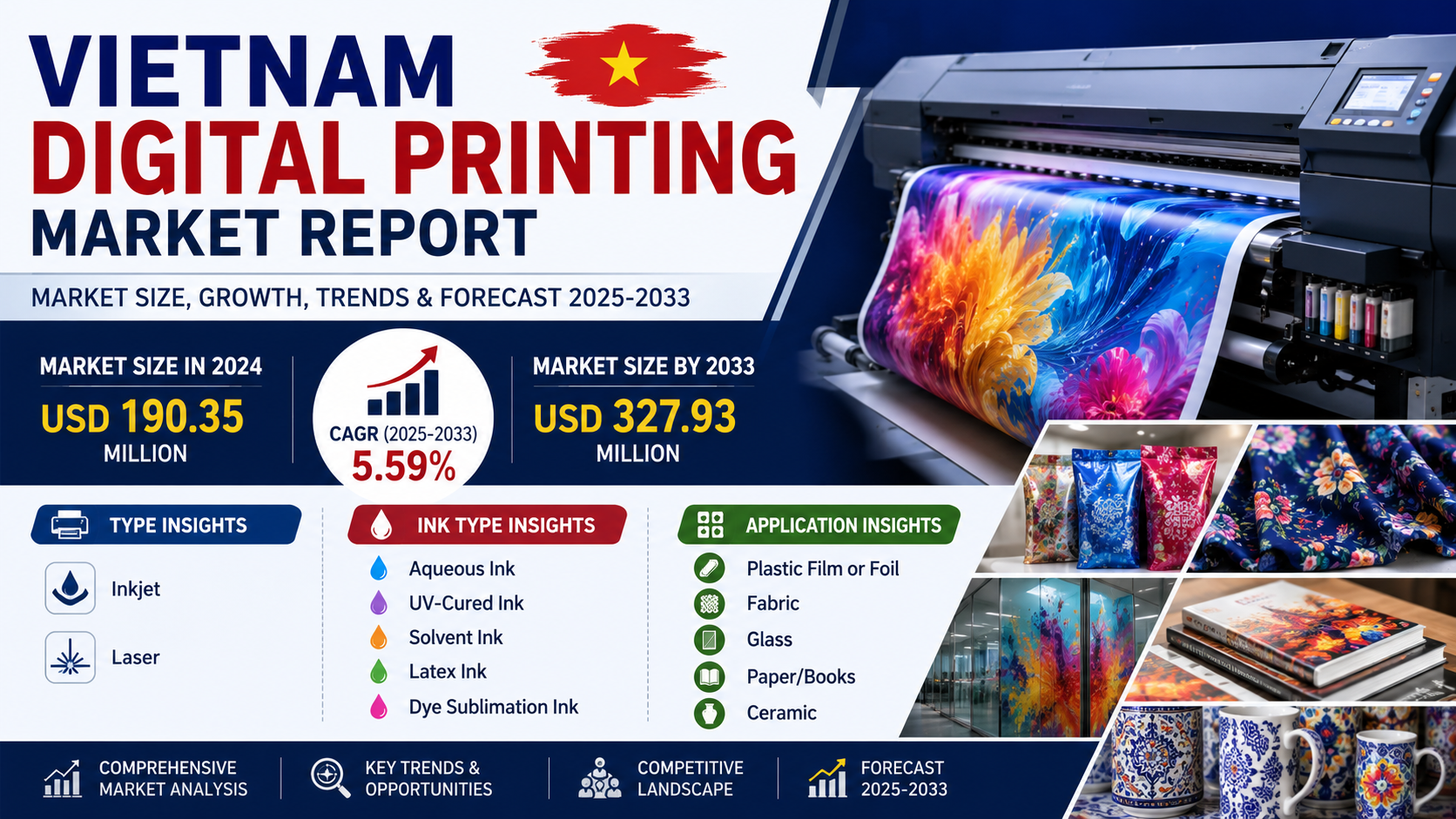
The Vietnam digital printing market refers to the collective industry involved in the reproduction of digital-based images directly onto a variety of media substrates – such as paper, fabric, plastic, and glass – without the need for traditional printing plates. Unlike offset or flexographic printing, this process utilizes advanced inkjet or laser technologies to transfer ink or toner, allowing for high-precision, on-demand production. As of 2024, the market reached a valuation of USD 190.35 Million and is rapidly becoming the cornerstone of Vietnam’s modern manufacturing and packaging sectors.
Why is the Vietnam Digital Printing Market Growing for E-Commerce Business Owners?
For entrepreneurs and e-commerce stakeholders, the primary catalyst for market expansion is the explosion of online shopping. Vietnam currently ranks as one of the top three e-commerce markets in Southeast Asia. The Vietnam digital printing market is projected to reach USD 327.93 Million by 2033, growing at a CAGR of 5.59%.
E-commerce leaders are driving this growth because digital printing offers:
- Customized Packaging: As online shoppers rise by 4 million annually, brands need unique carton boxes for clothing, cosmetics, and household products.
- On-Demand Flexibility: Digital technology allows for smaller batch sizes and variable data printing, which is perfect for personalized labels.
- Rapid Turnaround: The ability to print directly from electronic files eliminates long setup times, allowing businesses to respond instantly to market trends.
How are Technological Advancements Benefiting Industrial Printing Operators?
For technical operators and printing facility managers, the shift toward automation is a game-changer. Digital printing is expected to account for 30-35% of total printing volume in Vietnam within the next five years.
Industry professionals are focusing on:
- Elimination of Plates: By removing the need for traditional printing plates, setup costs for short and medium runs are significantly reduced.
- IoT Integration: Modern inkjet and laser systems now feature Internet of Things (IoT) capabilities for remote monitoring and predictive maintenance.
- Precision and Versatility: State-of-the-art equipment allows for direct printing on diverse surfaces including glass, ceramic, and textiles with unmatched accuracy.
Which Ink Types are Most Critical for Sustainable Manufacturing Specialists?
For sustainability officers and eco-conscious manufacturers, the choice of ink is vital for meeting environmental, social, and governance (ESG) standards. The market is seeing a massive shift toward “green” solutions, highlighted by:
- UV-Cured and Water-Based Inks: These options offer lower volatile organic compound (VOC) emissions compared to traditional solvent inks.
- Dye Sublimation and Latex Inks: Popular for textiles and soft signage, these inks align with circular economy principles by reducing chemical waste.
- Precise Application: Digital systems minimize ink waste through targeted application, supporting net-zero carbon emission goals by 2050.
How Does Digital Printing Solve Challenges for the Textile and Fashion Industry?
For fashion brands and textile manufacturers, digital printing is the solution to the demand for fast fashion and sustainable fabrics. The recent launch of the Econogy Hub in Vietnam spotlights these advancements:
- Fabric Diversity: Digital printers can easily handle organic cotton, recycled polyester, and Tencel.
- Vibrant Customization: Designers can produce complex patterns and high-fidelity colors without the limitations of screens.
- Waste Reduction: On-demand printing prevents overproduction, ensuring that only what is sold is actually printed.
What are the Key Regional Opportunities for Printing Service Providers?
For regional investors and business developers, the opportunities are strategically spread across three main areas:
- Northern Vietnam: A hub for industrial manufacturing and electronics packaging.
- Southern Vietnam: Centered around Ho Chi Minh City, this region remains the heart of e-commerce and commercial advertising, as evidenced by major events like VietnamPrintPack.
- Central Vietnam: An emerging market for tourism-related signage and local craft packaging.
Understanding these regional dynamics allows providers to tailor their services – whether it be paper/books, plastic film, or ceramic printing – to the specific industrial needs of each province.
Sample Request For Your Business
Why is Automation the Top Priority for Vietnamese Printing Enterprises?
For business strategists, automation is the key to remaining competitive in the global marketplace. The adoption of automation technology is focused on:
- Operational Efficiency: Reducing human error and production downtime through automated workflows.
- Cost Reduction: Lowering labor costs while increasing output quality.
- Data Analytics: Using real-time monitoring to improve quality control and optimize the use of substrates like paper, foil, and glass.
Conclusion:
The Vietnam digital printing market is undergoing a profound transformation, evolving from a niche service to a multi-million dollar industrial powerhouse. With a projected value of USD 327.93 Million by 2033, the market is perfectly positioned to serve e-commerce giants, sustainable fashion brands, and industrial manufacturers. By embracing inkjet and laser technologies, eco-friendly inks, and automated systems, Vietnam is solidifying its status as a leading hub for advanced and responsible printing solutions in Southeast Asia.