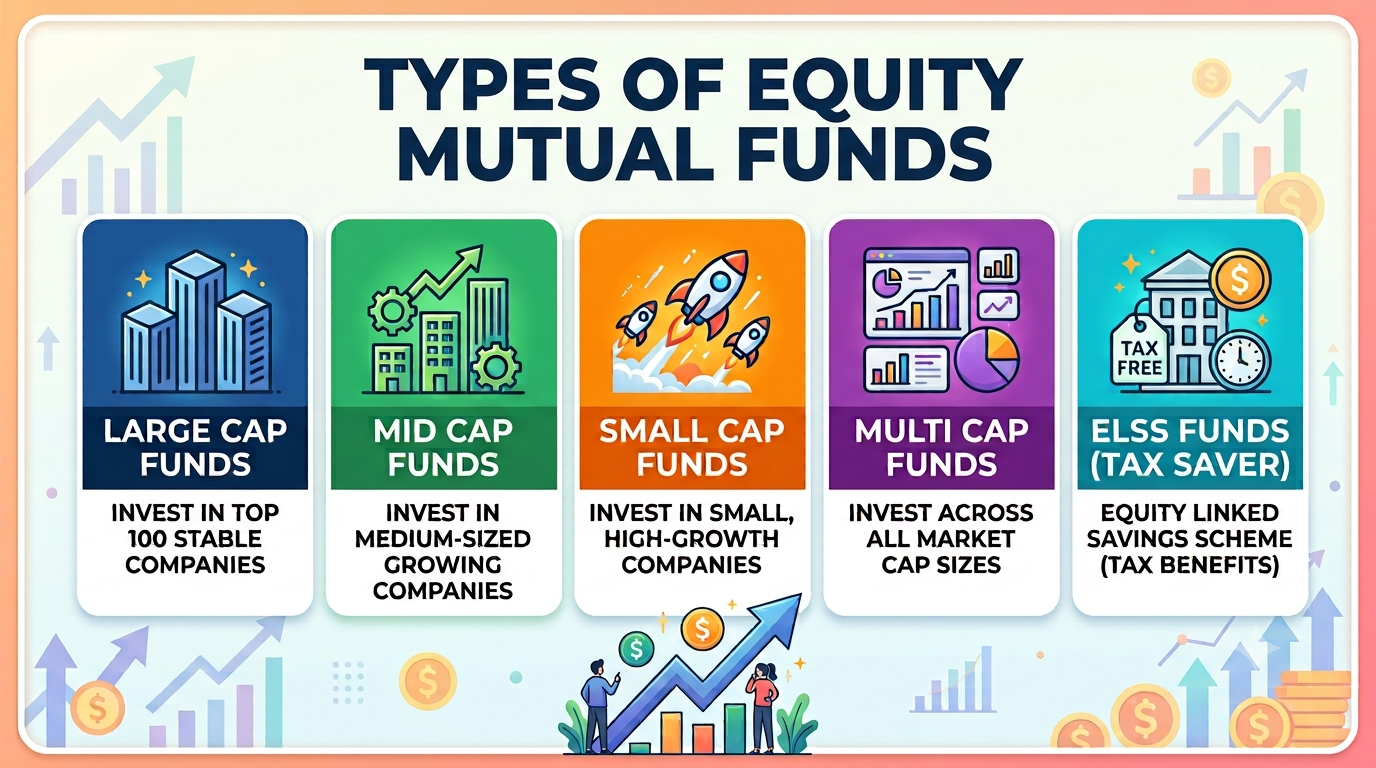
Investing in equity mutual funds can be an effective way for goal-based investors to grow their wealth over time. These funds primarily invest in stocks, aiming for long-term capital appreciation. However, with various types of equity mutual funds available in the market, it’s vital for investors to understand each type’s characteristics and how they align with their investment goals. In this article, we will delve into the various types of equity mutual funds, emphasizing how they can be tailored to meet specific investment objectives.
Understanding Equity Mutual Funds
Before we explore the different types, let’s clarify what equity mutual funds are. Equity mutual funds pool money from multiple investors to invest primarily in stocks (equity) of different companies. The objective of these funds is to generate growth over the long term, but it’s essential to remember that they come with higher risk compared to fixed-income investments.
Equity funds are managed by professional fund managers, who make investment decisions based on rigorous market analysis and research. The performance of these funds is linked to the performance of the equities they invest in, making it essential for investors to understand the fund types and their corresponding investment strategies. Understanding the types of equity mutual funds can help investors evaluate different investment strategies based on their financial goals and risk tolerance.
Types of Equity Mutual Funds
1. Large-Cap Equity Funds
Definition: Large-cap equity funds primarily invest in large, well-established companies with a market capitalization typically over ₹10,000 crores.
Ideal For: Investors seeking stability and moderate risk.
Characteristics:
- These funds tend to be less volatile than smaller-cap funds due to their investment in larger companies that are generally more resilient during market downturns.
- Suitable for long-term investors looking for wealth accumulation with reduced risk.
2. Mid-Cap Equity Funds
Definition: Mid-cap equity funds invest in medium-sized companies, with market capitalizations ranging from ₹5,000 to ₹10,000 crores.
Ideal For: Investors aiming for growth and who can tolerate a higher risk.
Characteristics:
- Mid-cap funds offer the potential for higher returns than large-cap funds, but with increased volatility.
- Suitable for investors with a time horizon of at least five years who are looking for capital appreciation.
3. Small-Cap Equity Funds
Definition: Small-cap equity funds focus on investing in small companies with market capitalizations below ₹5,000 crores.
Ideal For: Aggressive investors looking for high-risk, high-reward opportunities.
Characteristics:
- These funds are the most volatile and can provide substantial returns during bullish market conditions but can also suffer significant losses during downturns.
- Investors should have a high-risk tolerance and a long investment horizon to smooth out the volatility.
4. Multi-Cap Equity Funds
Definition: Multi-cap equity funds invest across various capitalization segments—large, mid, and small-cap companies.
Ideal For: Investors seeking diversification within a single fund.
Characteristics:
- These funds adjust their investments based on market conditions, providing flexibility and diversification.
- Suitable for investors looking for a balanced approach to equity investing.
5. Sectoral/Thematic Funds
Definition: Sectoral funds focus on specific sectors of the economy—such as technology, healthcare, or real estate—and invest predominantly in companies operating within that sector.
Ideal For: Investors with a deep understanding of market trends or those wanting targeted exposure to specific sectors.
Characteristics:
- These funds can be highly volatile, as the performance is tied to the health of a particular sector.
- Best suited for investors who believe in the long-term potential of a specific industry.
6. Index Funds
Definition: Index funds aim to replicate the performance of a specific market index, such as the Nifty 50 or Sensex.
Ideal For: Passive investors seeking to match market returns.
Characteristics:
- Typically have lower management fees due to their passive nature.
- Suitable for investors looking for long-term growth with minimal management costs.
7. Equity Linked Savings Scheme (ELSS)
Definition: ELSS funds are a type of mutual fund that offers tax benefits under Section 80C of the Income Tax Act and invests a substantial portion in equities.
Ideal For: Investors looking for tax-saving investments with the potential for capital growth.
Characteristics:
- ELSS funds have a mandatory lock-in period of three years, making them suitable for long-term tax planning.
- They combine the benefits of tax savings and potential wealth growth.
Choosing the Right Type of Equity Mutual Funds
When selecting the appropriate type of equity mutual fund, investors should assess their financial goals, risk tolerance, and investment horizon. Here are a few key considerations:
- Risk Tolerance: If you are a conservative investor, large-cap or multi-cap funds may suit you best. Conversely, if you can tolerate higher risks, consider mid-cap or small-cap funds.
- Investment Duration: If you aim to grow wealth over a long period, consider funds that offer higher volatility, such as small-cap funds. If your time horizon is shorter, opt for more stable large-cap or diversified funds.
- Financial Goals:Identify your investment objectives—whether saving for retirement, a child’s education, or wealth accumulation—and align your fund choices accordingly. Considering the objectives and strategies of different equity funds can help investors select an option that fits their financial goals.
Conclusion
Understanding the types of equity mutual funds is essential for goal-based investors seeking to build wealth and achieve their financial objectives. The option to choose funds based on market capitalization, risk tolerance, and investment goals allows for tailored financial strategies. By selecting the right kind of equity mutual fund, investors can navigate the complexities of the market while aiming for substantial returns.
For more detailed information on the various types of equity mutual funds, you can visit Bajaj Finance and explore your investment options further, ensuring your portfolio aligns with your financial aspirations.