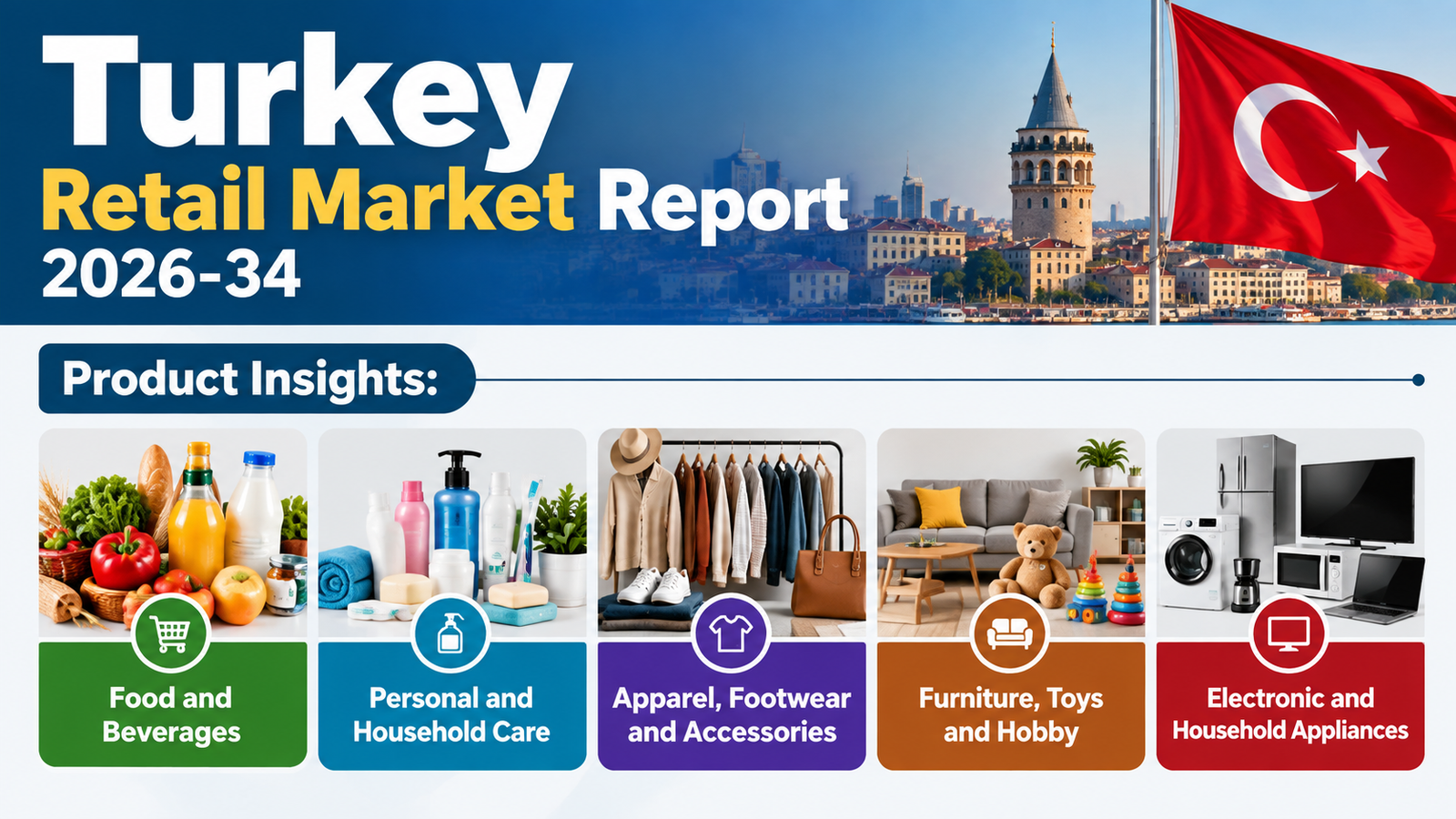
Turkey Retail market is driven by the modernization of retail infrastructure, the rapid growth of discount grocery chains, and the strong rise of online shopping. Turkey retail market size reached USD 220.0 Billion in 2025. Looking forward, IMARC Group expects the market to reach USD 455.9 Billion by 2034, exhibiting a growth rate (CAGR) of 8.18% during 2026-2034. Organized retailers are widening their store networks, while digital marketplaces are drawing in younger and mobile-first shoppers. Government oversight of digital commerce and rising consumer confidence are also supporting broader product assortments across categories.
How AI is Reshaping the Future of Turkey Retail Market?
- AI-powered demand forecasting helps large grocery chains plan stock across thousands of outlets. BIM operates over 14,000 stores, A101 around 13,600, and Migros 3,830, so even small gains in forecast accuracy reduce waste, stockouts, and logistics cost.
- Marketplaces use AI personalization engines to recommend products, adjust promotions, and increase average basket size. This matters because smartphone penetration is above 88% and online shopping is largely mobile-first.
- Quick commerce and delivery platforms apply AI to route planning and order batching. Migros combines its supermarket network with Sanal Market, Hemen, and Yemek services, and Uber’s acquisition of Trendyol Go has added more technology investment to urban grocery and meal delivery.
- Retailers are adopting computer vision, self-checkout, and electronic shelf labels to cut labor-intensive tasks and shrinkage. Migros has invested in self-checkouts and electronic price tags across its network.
- AI-driven analytics let discounters tune private label ranges and pricing. Discounters have expanded private label offerings to support household spending, which matters in a market where food inflation shapes purchase decisions.
Grab a sample PDF of this report: https://www.imarcgroup.com/turkey-retail-market/requestsample
Market Growth Factors
The Turkey retail market is driven by the shift from traditional trade to organized formats. Discount chains continue to open compact neighborhood stores in cities and towns. Among organized food retailers, BIM holds about 18.4% share, followed by Migros at 9.2%, A101 at 7.8%, and ŞOK at 6.0%. Migros alone plans 180 to 200 new store openings in its current guidance and reported net sales of TL 412.8 billion. This store-led expansion improves access to packaged food, household goods, and fresh products, and gives suppliers national reach.
Online retail is the second major growth engine. Turkey’s Ministry of Trade reports total e-commerce volume of TRY 4.57 trillion (about USD 115.43 Billion) across 5.94 billion transactions, with retail e-commerce at TRY 2.46 trillion. E-commerce represents 6.9% of GDP and about 19.3% of total trade. The Ministry runs the ETBİS e-commerce registration system and publishes an annual outlook report to monitor the sector and support fair competition among digital marketplaces. Per capita e-commerce spending is close to USD 277, near the worldwide average of USD 301, which shows room for further growth as the share of online shoppers (29.3% of the population) rises.
Consumer lifestyles and policy support are also shaping demand. A young, urban, and digitally active population is increasing demand for fashion, electronics, and home categories, and international brands are entering through malls and flagship stores. Government priorities on e-exports, which are around 2.9% of total exports or roughly USD 8 Billion, aim to lift that share toward 10% and encourage retailers and marketplaces to build cross-border logistics. At the same time, inflation and currency volatility push shoppers toward value formats, private labels, and promotions, which keeps competition intense across both physical and online channels.
Market Segmentation
Product Insights:
- Food and Grocery
- Clothing and Apparel
- Electronics and Appliances
- Others
Distribution Channel Insights:
- Supermarkets and Hypermarkets
- Convenience and Discount Stores
- Specialty Stores
- Online Stores
- Others
Regional Insights:
- Marmara
- Aegean
- Central Anatolia
- Mediterranean
- Black Sea
- Southeastern Anatolia
- Eastern Anatolia
Recent Development & News
- May 2026: Turkey’s Ministry of Trade published its annual e-commerce outlook, reporting total e-commerce volume of TRY 4.57 trillion, a 6.9% share of GDP, and a 19.3% share of total trade.
- September 2026: The Istanbul Global E-Export Summit, coordinated by the Ministry of Trade with the Turkish Exporters Assembly and the Electronic Commerce Operators Association, highlighted plans to scale e-exports toward USD 6 Billion.
- November 2025: The Trade Ministry reported per capita e-commerce spending of USD 276.7 and an online shopper ratio of 29.3% of the population, with e-commerce at about 7% of total retail sales.
- May 2025: Uber announced plans to acquire an 85% stake in Istanbul-based Trendyol Go for USD 700 million, strengthening its position in Turkey’s meal and grocery delivery market.
- April 2025: Spanish fashion brand Women’secret re-entered Turkey after 13 years, opening its first store at Emaar Square Mall in Istanbul.
If you require any specific information that is not covered currently within the scope of the report, we will provide the same as a part of the customization.
About Us
IMARC Group is a global management consulting firm that helps the world’s most ambitious changemakers to create a lasting impact. The company provides a comprehensive suite of market entry and expansion services. IMARC offerings include thorough market assessment, feasibility studies, company incorporation assistance, factory setup support, regulatory approvals and licensing navigation, branding, marketing and sales strategies, competitive landscape and benchmarking analyses, pricing and cost research, and procurement research.
Contact Us
IMARC Group,
134 N 4th St. Brooklyn, NY 11249, USA,
Email: sales@imarcgroup.com,
Tel No: (D) +91 120 433 0800,
United States: +1-201971-6302