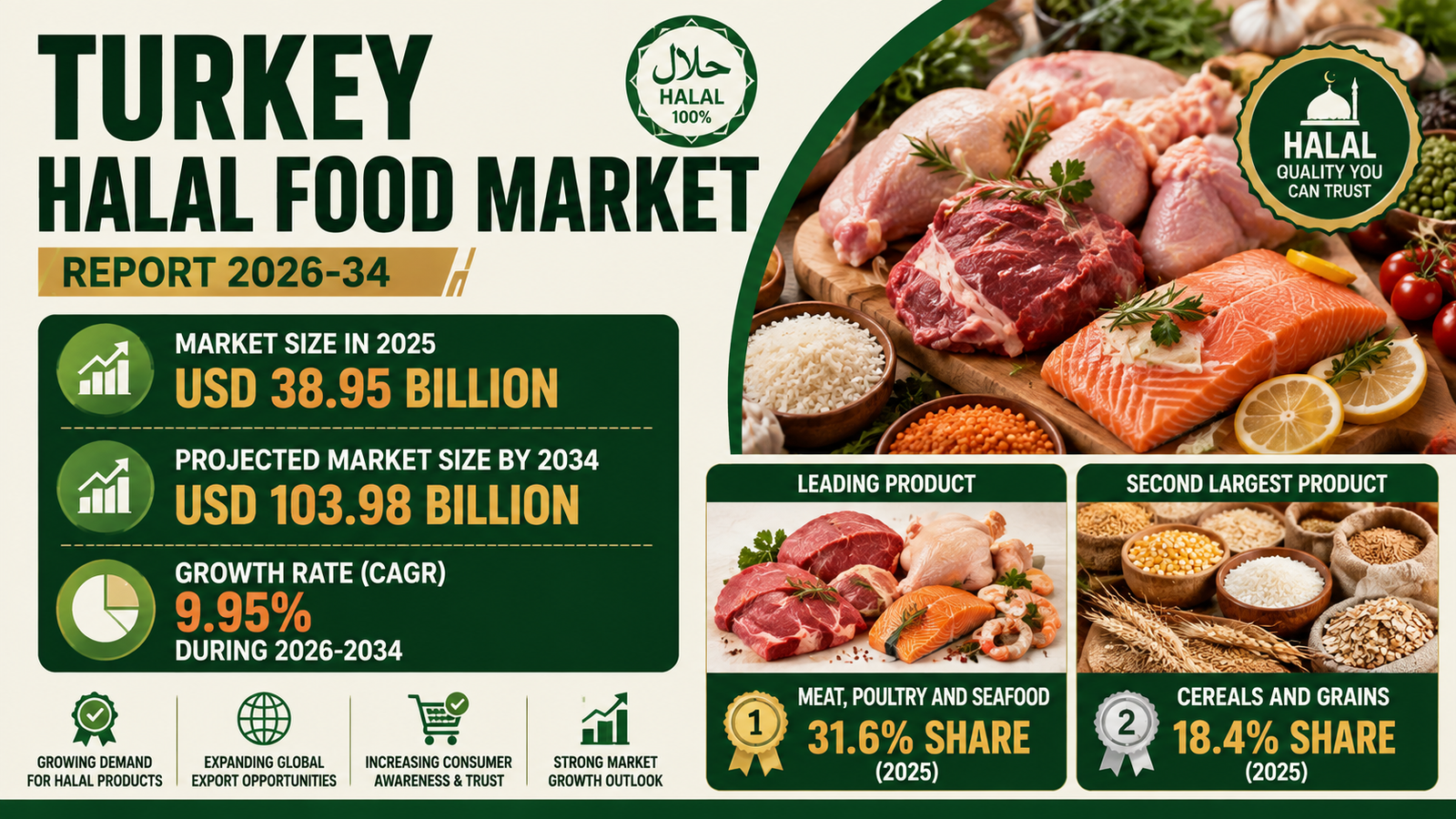
The Turkey Halal Food Market is supported by a predominantly Muslim consumer base, strong domestic demand for halal-certified products, expanding food exports, and rising awareness of food quality, safety, and traceability. Meat, poultry and seafood represent the leading product category with a 31.6% share, while traditional retailers account for 38.9% of distribution and the Marmara region holds 30.2% of the market. Turkey halal food market size was valued at USD 38.95 Billion in 2025 and is projected to reach USD 103.98 Billion by 2034, exhibiting a CAGR of 9.95% during 2026-2034.
Turkey’s halal food ecosystem spans meat and poultry processing, dairy, cereals and grains, edible oils, confectionery, packaged foods, logistics, retail, and export markets. Government-backed accreditation and export initiatives are also strengthening certification credibility and international market access.
How AI is Reshaping the Future of Turkey Halal Food Market?
- AI-powered food traceability systems are helping producers monitor ingredients, processing conditions, logistics, and certification requirements across complex halal supply chains, improving transparency and compliance.
- AI-enabled e-commerce platforms are supporting personalized product recommendations, digital promotions, subscription models, and faster delivery, helping halal food brands connect with urban consumers seeking convenience.
- Advanced analytical technologies, including DNA-based species identification and polymerase chain reaction testing, are being used to authenticate ingredients and detect adulteration, supporting halal compliance and export certification.
- AI-driven demand forecasting can help food manufacturers optimize production, inventory, cold-chain capacity, and distribution across high-demand areas such as Marmara and Central Anatolia.
- Digital audit trails, IoT-enabled monitoring, and automated compliance systems are increasingly supporting end-to-end visibility from agricultural sourcing through processing and retail.
Grab a sample PDF of this report: https://www.imarcgroup.com/turkey-halal-food-market/requestsample
Market Growth Factors
The Turkey halal food market is driven by strong domestic demand for halal-certified products and Turkey’s expanding role in international halal food trade. Meat, poultry and seafood account for 31.6% of the market, reflecting the importance of certified animal protein, integrated processing infrastructure, and export demand from Gulf and other halal-importing markets.
Government investment in halal accreditation is improving confidence among producers, retailers, consumers, and international buyers. In February, Turkey’s Halal Accreditation Agency reported that its accreditation decisions had secured the halal certificates of more than 2,500 businesses, while 128 accreditation applications had received positive decisions.
Retail structure is another important growth factor. Traditional retailers account for 38.9% of distribution, while supermarkets and hypermarkets represent 34.6%, reflecting continued consumer reliance on neighborhood food outlets alongside the expansion of organized retail.
E-commerce and digital food delivery are creating additional opportunities for halal brands. Online distribution is identified as the fastest-expanding channel, supported by grocery e-commerce, cold-chain investment, mobile commerce, and changing preferences among younger urban consumers.
Turkey’s export infrastructure also supports market development. In October, the government’s GATE project helped remove restrictions affecting Turkish poultry meat and aquatic-product exports to the Philippines, strengthening access to an important Asian food market.
Market Segmentation
Product Insights:
- Meat, Poultry and Seafood
- Fruits and Vegetables
- Dairy Products
- Cereals and Grains
- Oil, Fats and Waxes
- Confectionery
- Others
Distribution Channel Insights:
- Traditional Retailers
- Supermarkets and Hypermarkets
- Online
- Others
Regional Insights:
- Marmara
- Central Anatolia
- Mediterranean
- Aegean
- Southeastern Anatolia
- Eastern Anatolia
- Black Sea
Meat, poultry and seafood lead the product category with a 31.6% share, while cereals and grains account for 18.4%. Traditional retailers hold the largest distribution share at 38.9%, followed by supermarkets and hypermarkets at 34.6%. Marmara leads regional demand with a 30.2% share, followed by Central Anatolia at 18.1%.
Recent Developement & News
- February: Turkey’s Halal Accreditation Agency reported that more than 2,500 businesses had their halal certificates secured through HAK accreditation decisions. The agency also stated that accreditation had expanded beyond food into areas such as food packaging, tourism, logistics, accommodation, and cosmetics.
- October: Turkey’s GATE project advanced efforts to remove technical barriers for agricultural and food exports to the Philippines. Restrictions affecting Turkish poultry meat and aquatic-product exports were removed, creating additional opportunities for halal food exporters.
- November: The 11th World Halal Summit and Halal Expo opened in Istanbul under the Turkish Presidency, bringing together companies and institutions across the global halal ecosystem. The event included B2B meetings designed to help Turkish SMEs access international markets and expand export networks.
- November: Turkey’s Halal Accreditation Agency and the Saudi Food and Drug Authority signed an MoU covering cooperation, information sharing, training, workshops, and halal-sector knowledge exchange, strengthening institutional links between Turkey and Saudi Arabia.
- June: Turkey’s Ministry of Trade announced that inspections of imported products carrying halal claims would be integrated into the TAREKS digital risk-based control system. The new framework requires relevant halal conformity documents to come from bodies accredited by HAK.
Competitive Landscape
The Turkey halal food market includes multinational food companies, Turkish food groups, halal specialists, ingredient suppliers, processors, retailers, and exporters. Key players identified in the market include Nestlé, Yaşar Holding, and Cargill, Incorporated.
Nestlé
Nestlé operates across multiple food categories and maintains halal-certified product offerings for Muslim-majority and Muslim-minority markets.
- Product Portfolio: Dairy products, breakfast cereals, culinary products, confectionery, nutrition products, and other packaged foods.
- Strategic Focus: Expanding halal-certified packaged food and dairy offerings while strengthening product innovation and certification infrastructure.
Yaşar Holding
Yaşar Holding is a major Turkish food and beverage group with activities spanning dairy, meat processing, animal nutrition, and food distribution.
- Product Portfolio: Fresh and processed red meat products under Pınar Et, alongside halal-certified dairy products.
- Strategic Focus: Vertically integrated meat and dairy production, domestic distribution, and export-market development.
Cargill, Incorporated
Cargill operates in food, agriculture, ingredients, and related supply chains and supplies Turkish food manufacturers with certified ingredients.
- Product Portfolio: Edible oils, plant proteins, and other food ingredients with relevant halal and internationally recognized certifications.
- Strategic Focus: Halal ingredient supply, certification capabilities, sustainable sourcing, and supply-chain partnerships supporting certified food production.
If you require any specific information that is not covered currently within the scope of the report, we will provide the same as a part of the customization.
About Us
IMARC Group is a global management consulting firm that helps the world’s most ambitious changemakers create a lasting impact. The company provides a comprehensive suite of market entry and expansion services. IMARC offerings include market assessment, feasibility studies, company incorporation assistance, factory setup support, regulatory approvals and licensing navigation, branding, marketing and sales strategies, competitive landscape and benchmarking analyses, pricing and cost research, and procurement research.
Contact Us
IMARC Group,
134 N 4th St. Brooklyn, NY 11249, USA,
Email: sales@imarcgroup.com,
Tel No: (D) +91 120 433 0800,
United States: +1-201971-6302