Digital connectivity has become essential to modern life. Businesses communicate across borders, people access online education and healthcare information, and organizations increasingly depend on cloud services and digital platforms. Behind these activities lies a complex network of infrastructure that enables information to travel around the world.
Submarine cable networks are a fundamental part of this global communications system. Using fibre-optic cables installed beneath the sea, they connect countries, continents, islands, and telecommunications networks, supporting the exchange of enormous volumes of digital information.
As digital dependence grows, reliable submarine infrastructure is becoming increasingly important for economic development, international communication, and access to digital opportunities.
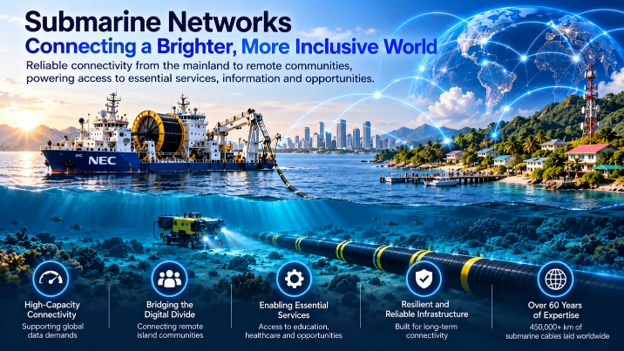
- What Are Submarine Cable Networks?
Submarine cable networks are communication systems that use undersea fibre-optic cables to transmit digital data between locations separated by oceans and other bodies of water.
Optical fibres carry information as pulses of light, enabling large volumes of data to travel over long distances. Specialised transmission equipment helps maintain signal quality across extensive underwater routes.
These networks form a critical part of international telecommunications infrastructure. They support internet traffic, business communications, cloud computing, digital transactions, and numerous other online services.
Although satellite communications also play an important role, submarine cables provide the high-capacity connections needed to carry much of the world’s international data traffic.
Their importance continues to grow as businesses, governments, and individuals depend on faster, more reliable digital communication. - Bridging the Digital Divide for Island Communities
Geographical isolation can create challenges for communities located on remote islands. Establishing dependable communication links may require substantial infrastructure investment, specialised engineering, and coordination across different networks.
Submarine cable systems can help bridge this gap by connecting island networks to mainland telecommunications infrastructure.
Reliable connectivity can support access to online education, digital public services, healthcare information, business platforms, and communication tools. It can also create opportunities for local enterprises to reach customers beyond their immediate geographical markets.
However, laying a submarine cable is only one part of the solution. Communities also need suitable local networks, affordable internet services, accessible devices, and digital skills to benefit fully from connectivity.
When these elements work together, submarine infrastructure can contribute to broader digital inclusion and help geographically isolated communities participate more effectively in the digital economy. - Why Reliable Global Connectivity Matters
Modern communication networks must support growing data volumes while maintaining dependable performance.
High-capacity submarine systems help telecommunications providers carry international traffic and connect networks across long distances. This infrastructure supports applications ranging from video conferencing and cloud-based business operations to digital entertainment and online collaboration.
Reliability is equally important. Businesses need stable connections to coordinate operations, while public institutions depend on digital communication to deliver services and share information.
A resilient connectivity environment requires careful network planning, effective maintenance, appropriate monitoring, and alternative routes where feasible.
By investing in dependable infrastructure, network operators can better prepare for changing demand and reduce the risks associated with relying on limited communication pathways. - Protecting Submarine Infrastructure and Network Resilience
Submarine cables operate in challenging underwater environments. Potential risks include accidental damage from maritime activities, seabed conditions, natural hazards, and the logistical complexity of repairing cables in remote locations.
Protecting this infrastructure requires route planning, ongoing monitoring, maintenance coordination, and effective repair capabilities.
Network resilience can also be strengthened through geographically diverse cable routes and alternative connections where practical. These arrangements can help maintain communication if an individual cable experiences disruption.
Resilience planning is particularly important for island communities and locations with limited alternative connectivity.
As global digital dependence increases, safeguarding submarine infrastructure becomes an important consideration for telecommunications providers, governments, and organisations responsible for critical digital services. - NEC’s Experience in Submarine Network Systems
Developing submarine communication infrastructure requires specialised expertise in optical transmission, system integration, marine engineering, and long-distance network design.
According to information shared by NEC, the company has more than 60 years of experience in submarine network systems and has laid over 450,000 kilometres of submarine cables worldwide.
This stated experience highlights the scale and technical complexity associated with building international communication infrastructure.
As data requirements continue to expand, established engineering expertise can play an important role in designing and implementing networks suited to evolving connectivity needs.
Explore how submarine network systems support global digital infrastructure and help extend reliable connectivity to remote island communities. - The Future of Submarine Cable Networks
The future of digital infrastructure will be shaped by growing data consumption, cloud computing, artificial intelligence, connected industries, and increasing demand for international communication.
These developments create a need for scalable network capacity, dependable transmission systems, and resilient connectivity architecture.
Submarine cable investments must also consider long-term maintenance, geographical diversity, environmental conditions, and the ability to integrate with terrestrial networks.
At the community level, improved connectivity can create opportunities for education, entrepreneurship, public services, and digital participation. Realising these benefits requires collaboration between infrastructure providers, telecommunications operators, governments, and local communities.
The long-term objective is to ensure that reliable communication infrastructure supports both established digital economies and regions that remain underserved.
Conclusion: Connecting Every Community to Opportunity
Submarine cable networks are an essential foundation of the modern digital world. By connecting continents, islands, and telecommunications systems, they enable international communication and support the services on which businesses and communities increasingly rely.
Their value extends beyond data transmission. Reliable connectivity can help expand access to information, support economic participation, and create opportunities for communities separated by geographical distance.
As digital demands continue to grow, investment in high-capacity, resilient submarine infrastructure will remain important for building a more connected global economy.