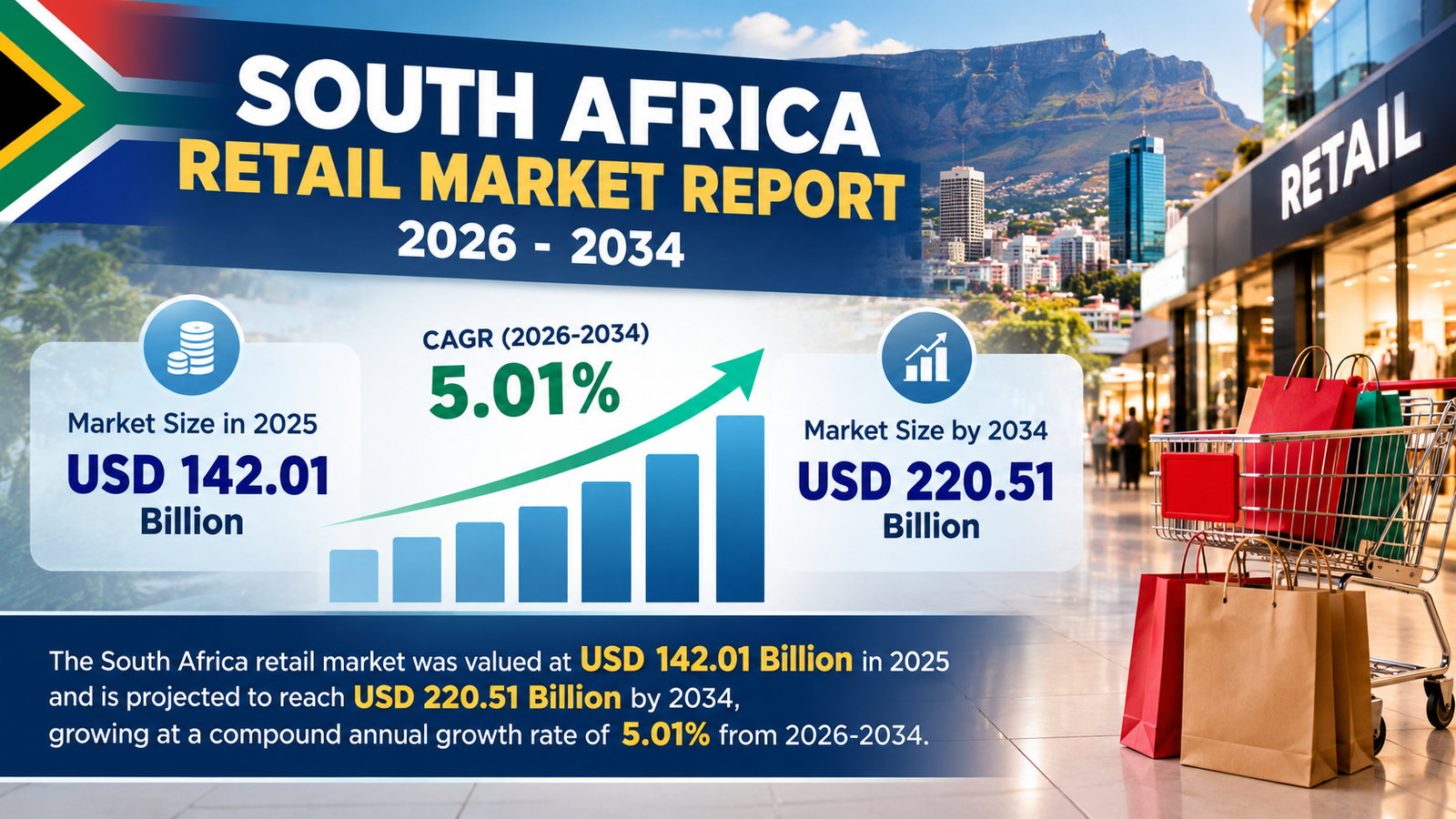
Retail Growth is driven by the rapid expansion of modern store networks, rising adoption of quick commerce and omnichannel shopping, easing inflation and lower interest rates, and the growing popularity of private label and value retailing. South Africa retail market sizewas valued at USD 142.01 Billion in 2025 and is projected to reach USD 220.51 Billion by 2034, growing at a compound annual growth rate of 5.01% from 2026-2034. Government economic relief measures and the arrival of global retail players are further strengthening consumer choice and market visibility.
How AI is Reshaping the Future of South Africa Retail Market?
- AI-powered demand forecasting is helping grocers and general merchandise chains plan stock at store level, reducing out-of-stocks and food waste across networks as large as Shoprite’s 3,478 outlets.
- Quick-commerce platforms use machine learning for route optimization, dark store replenishment, and personalized offers. Checkers Sixty60 sales rose by 47% to around R19 billion in the first half of 2025, showing how data-driven delivery models are changing grocery shopping.
- Retailers are deploying AI in loyalty programs to analyze purchase histories and send tailored promotions, which supports repeat visits among value-conscious shoppers who are watching every rand.
- Conversational AI assistants and chatbots are being added to retailer apps to handle product search, order tracking, and customer queries, improving the online shopping experience and reducing service costs.
- AI-driven pricing and private label analytics help retailers identify gaps in their own-brand ranges and set competitive price points against branded products and international platforms such as Amazon, Shein, and Temu.
Grab a sample PDF of this report: https://www.imarcgroup.com/south-africa-retail-market/requestsample
Market Growth Factors
The South Africa retail market is supported by easing inflationary pressure and a more favorable interest rate environment. Food inflation has fallen to some of its lowest levels in many years, and consecutive benchmark lending rate cuts by the South African Reserve Bank are reducing household debt servicing costs. Food and beverages account for 32% of retail value, so stable grocery prices directly free up spending for other categories. The latest Stats SA figures show real retail trade sales rising 3.4% year-on-year in July, led by general dealers, which contributed 1.3 percentage points of that growth. Government support also plays a role. The two-pot retirement system gave households access to a portion of their retirement savings, boosting liquidity ahead of the festive shopping season, while social grants such as the Child Support Grant, which reaches around 12.9 million children, provide a steady base of spending on essentials.
Aggressive store expansion and retail infrastructure investment are reshaping the competitive landscape. Shoprite, South Africa’s largest retailer, operates 3,478 stores, with 2,863 of them corporate-owned, and has crossed R250 billion in annual sales. The group spent R3.9 billion in a single half-year, largely on growing and upgrading its South African network, and opened 268 stores in that period. Boxer, the discount arm that Pick n Pay has partly listed, has reached roughly 600 stores and continues to open dozens of new outlets each half-year. The country has about 2,000 shopping centers, and discount supermarkets and hybrid wholesale-retail formats are capturing shoppers who previously relied on traditional supermarkets. In 2024, South African consumers spent nearly R637 Billion on fast-moving consumer goods, with food and liquor alone accounting for R359 Billion, showing the depth of demand that these networks serve.
Digital commerce, private label growth, and omnichannel retailing are creating new routes to market. Supermarkets and hypermarkets still hold 45% of the market, but online and quick-commerce services are widening access through buy-now-pay-later options, mobile payments, and click-and-collect. Private label ranges are outperforming total market growth as budget-conscious consumers trade down without giving up quality. At the same time, constraints remain. Unemployment above 32%, high household debt, and rising fuel prices are limiting discretionary spending, and lower-income households have cut volumes most sharply. Retailers are responding with compact store formats, such as Pick n Pay’s new stores of 2,300 to 2,500 square meters, along with value ranges and tighter cost control, while customs duty and VAT enforcement on cross-border parcels are narrowing the price advantage of international e-commerce platforms.
Market Segmentation
Product Insights:
- Food and Beverages
- Personal and Household Care
- Apparel, Footwear and Accessories
- Furniture, Toys and Hobby
- Electronic and Household Appliances
- Others
Food and beverages dominate with a 32% share of the total South Africa retail market, reflecting the essential nature of grocery purchases and the priority households give to food spending across all income levels.
Distribution Channel Insights:
- Supermarkets and Hypermarkets
- Convenience Stores
- Specialty Stores
- Online Stores
- Others
Supermarkets and hypermarkets lead with a 45% share, supported by one-stop shopping, competitive pricing, loyalty programs, and integrated services such as pharmacy and financial products.
Regional Insights:
- Gauteng
- KwaZulu-Natal
- Western Cape
- Mpumalanga
- Eastern Cape
- Others
Gauteng is the largest region with a 36% share, driven by the economic activity of the Johannesburg and Pretoria metropolitan areas, higher disposable incomes, and extensive mall and supermarket infrastructure.
Recent Development & News
- September 2025: Walmart announced plans to open its first Walmart-branded stores in South Africa by year-end, offering fresh groceries, household essentials, apparel, and technology products, with a focus on partnering with local suppliers and entrepreneurs.
- May 2026: Pick n Pay completed its store estate reset and raised R4.7 billion by selling a stake of roughly 12.5% in Boxer, with plans to open eight new, more compact stores and to lift group capital investment to R2.6 billion for the next financial year.
- June 2026: Shoprite reported that it had opened 268 stores after investing R3.9 billion in the first half of its financial year, widening its lead over Pick n Pay, SPAR, and Woolworths, which have been scaling back or restructuring parts of their store networks.
- October 2026: Boxer reported that it opened 24 new stores in the first half of its financial year and had opened 32 by the end of September, taking its footprint to around 600 grocery and liquor stores, and declared an interim dividend of 49.93 cents per share, up 10.2%.
If you require any specific information that is not covered currently within the scope of the report, we will provide the same as a part of the customization.
About Us
IMARC Group is a global management consulting firm that helps the world’s most ambitious changemakers to create a lasting impact. The company provide a comprehensive suite of market entry and expansion services. IMARC offerings include thorough market assessment, feasibility studies, company incorporation assistance, factory setup support, regulatory approvals and licensing navigation, branding, marketing and sales strategies, competitive landscape and benchmarking analyses, pricing and cost research, and procurement research.
Contact Us
IMARC Group,
134 N 4th St. Brooklyn, NY 11249, USA,
Email: sales@imarcgroup.com,
Tel No: (D) +91 120 433 0800,
United States: +1-201971-6302