
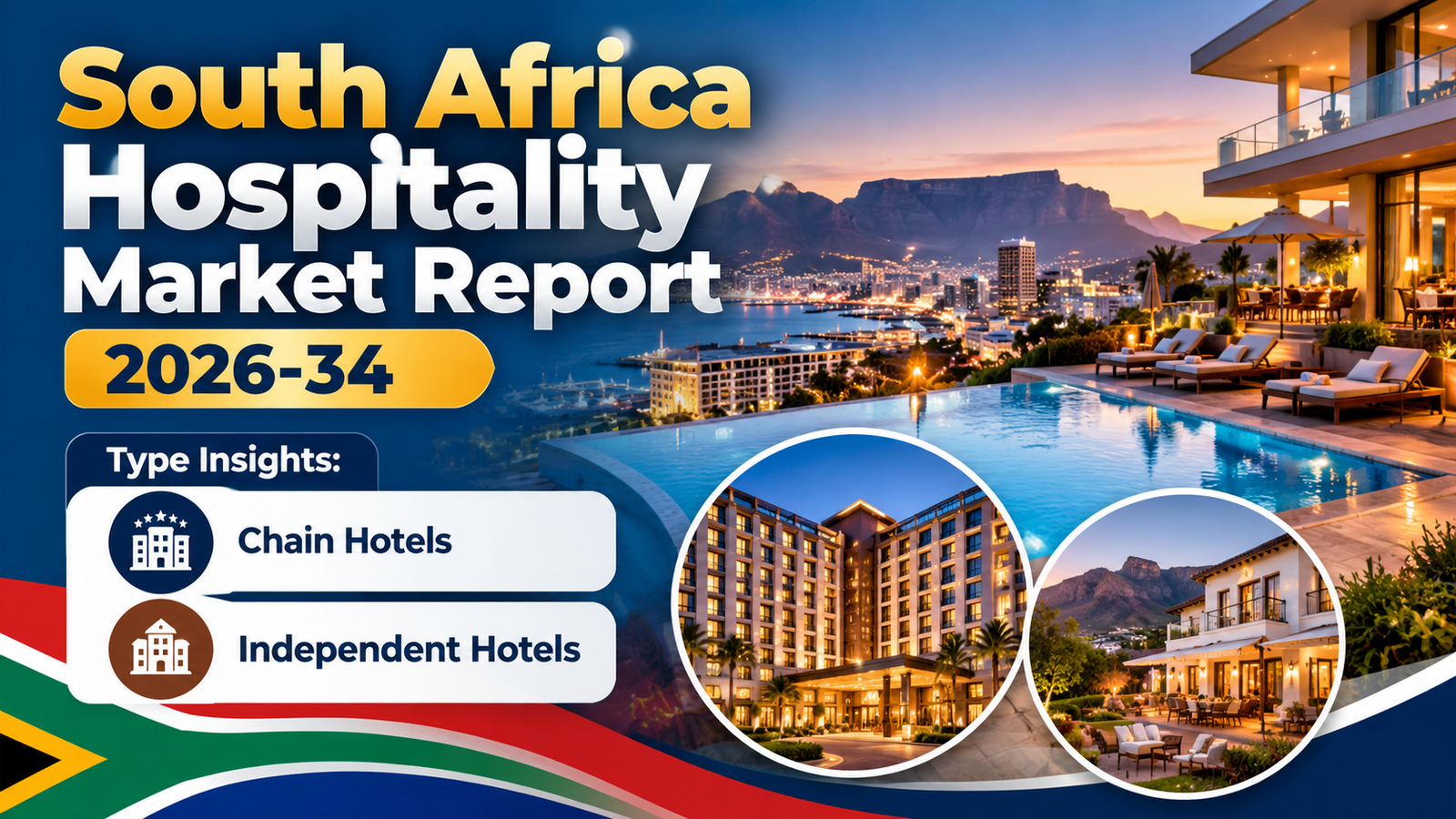
IMARC Group, a leading global market research and management consulting firm, has published its latest market intelligence report on the South Africa hospitality market size reached USD 8,422.4 Million in 2025. Looking forward, IMARC Group expects the market to reach USD 16,247.4 Million by 2034, exhibiting a growth rate (CAGR) of 7.35% during 2026-2034, driven by a sustained rebound in international tourist arrivals, massive infrastructure investment across the hotel and resort sector, rising domestic tourism spending, and government-backed tourism promotion campaigns positioning the country as one of Africa’s most diverse and appealing travel destinations.
The market is experiencing strong momentum as South Africa’s tourism sector consolidates its post-pandemic recovery. The country welcomed 10.5 million international tourists, marking a 17.7 percent increase compared to the prior year and surpassing pre-pandemic arrival levels for the first time. Tourism currently contributes close to 9 percent of South Africa’s GDP and supports approximately 1.8 million direct and indirect jobs nationwide, underscoring the sector’s outsized role in the broader economy. Much of this growth has been driven by travellers from other African countries, who now account for the majority of inbound arrivals, alongside recovering long-haul demand from Europe and North America.
How Investment and Digital Innovation are Reshaping the Future of the South Africa Hospitality Market?
- Regional Accommodation Capacity Expansion Beyond Major Cities: Hospitality investment is increasingly moving beyond Cape Town and Johannesburg into secondary coastal cities, with the Capital Hotels Group and the Industrial Development Corporation launching a R270 million hotel and apartment development in Gqeberha, adding 145 rooms and apartments and creating more than 200 jobs in a province facing high unemployment.
- International Hotel Brand Entry and Global Standards Adoption: Global hospitality groups are expanding their South African footprint, with Hilton’s portfolio growing to include newly opened properties such as Hampton by Hilton Sandton Grayston and Canopy by Hilton Cape Town Longkloof, introducing international service benchmarks that are lifting competitive standards across the domestic market.
- AI-Enabled Revenue and Occupancy Management: Hotel groups are increasingly relying on data-driven revenue management tools to optimize pricing amid strong demand recovery, with national hotel occupancy reaching 59.5 percent and average RevPAR climbing 16.0 percent year over year, while Cape Town’s market recorded occupancy above 72 percent with RevPAR growth exceeding 20 percent.
Grab a sample PDF of this report: https://www.imarcgroup.com/south-africa-hospitality-market/requestsample
South Africa Hospitality Market Trends and Drivers
The South Africa hospitality market is witnessing steady expansion, fueled by the convergence of infrastructure investment, improving air connectivity, and a resilient domestic travel base that is cushioning the sector from over-reliance on international arrivals alone. Business tourism is increasingly driving accommodation demand, supported by a growing calendar of conferences, exhibitions, and global events, while positive exchange rates continue to make South Africa an affordable destination for overseas travelers seeking Table Mountain, Kruger National Park, and the country’s wine routes.
Investment activity is accelerating across both public and private channels. The Industrial Development Corporation has backed multiple hospitality projects as a priority, high-growth investment sector, with the Gqeberha development representing Capital Hotel Group’s twelfth property in the country and the IDC’s second funded hospitality project following the Capital Mbombela launch in Mpumalanga. The IDC is also backing the KwaZulu-Natal-based Club Med South Africa Beach and Safari resort, located on the Dolphin Coast a short drive from King Shaka International Airport, which blends oceanfront accommodation with an all-inclusive safari experience and began taking official reservations in October.
Domestic tourism is emerging as a structural pillar of long-term market resilience. Affordability and convenience are driving South Africans toward regional destinations, with growing interest in eco-tourism, cultural tourism, and short holiday breaks. Middle-class travelers are seeking quality yet affordable accommodation, while younger travelers increasingly favor boutique hotels, lodges, and community-based tourism initiatives booked through online platforms. This domestic demand base is helping to counterbalance the sector’s historical dependence on inbound international volumes, reinforcing overall market stability even as global travel patterns fluctuate.
South Africa Hospitality Industry Segmentation
The report has segmented the market into the following categories:
Breakup By Type:
- Chain Hotels
- Independent Hotels
Chain hotels continue to expand their footprint as international brands such as Hilton and Marriott increase their South African presence, bringing standardized service quality and loyalty programs that appeal to business travelers, while independent hotels retain strong appeal among leisure travelers seeking distinctive, locally rooted experiences.
Breakup By Segment:
- Service Apartments
- Budget and Economy Hotels
- Mid and Upper Mid-Scale Hotels
- Luxury Hotels
Mid and upper mid-scale hotels capture a significant share of demand as both business and leisure travelers seek a balance of comfort and value, while luxury hotels are benefiting from strong RevPAR growth in premium coastal markets such as Cape Town, where high-end resorts and hotels are reporting some of the sector’s strongest earnings gains.
Breakup By Region:
- Gauteng
- KwaZulu-Natal
- Western Cape
- Mpumalanga
- Eastern Cape
- Others
The Western Cape remains the country’s most popular tourism market, with Cape Town hotels reporting occupancy above 72 percent and RevPAR growth exceeding 20 percent year over year, while Gauteng continues to anchor business travel demand and KwaZulu-Natal and the Eastern Cape are attracting fresh accommodation investment tied to coastal leisure development.
Competitive Landscape
The market research report has also provided a comprehensive analysis of the competitive landscape. Competitive analysis such as market structure, key player positioning, top winning strategies, competitive dashboard, and company evaluation quadrant has been covered in the report, along with detailed profiles of all major companies operating across South Africa’s hotel and hospitality sector, including international chains such as Hilton and Marriott alongside domestic groups such as Capital Hotels, Apartments and Resorts, Premier Hotels and Resorts, and Southern Sun.
Southern Sun reported rising earnings, particularly in the Cape and Gauteng regions, reflecting the broader industry-wide recovery in occupancy and room rates. Marriott International’s Sub-Saharan African operations have described the energy in the region’s hospitality industry as remarkable, supported by growing volumes of both business and leisure travel.
Recent News and Developments in South Africa Hospitality Market
- February 2026: Hilton Group’s South African portfolio expanded to feature newly opened properties including Hampton by Hilton Sandton Grayston and Canopy by Hilton Cape Town Longkloof, following President Cyril Ramaphosa’s announcement that international tourist arrivals reached a record 10.5 million for the prior year.
- May 2026: The Capital Hotels Group and the Industrial Development Corporation launched a R270 million hotel and apartment development in Gqeberha, Eastern Cape, adding 145 rooms and apartments near the Boardwalk precinct and marking the company’s twelfth hospitality development in the country.
- May 2026: South Africa’s tourism sector was confirmed to have recorded 10.5 million international visitors for the prior year, a 17.7 percent increase, with the IDC confirming that its backed Club Med South Africa resort project in KwaZulu-Natal was expected to open in July.
- April 2026: Cape Town hosted the Africa Tourism Investment Conference at the Cape Town International Convention Centre as part of World Travel Market Africa, bringing together tourism and investment leaders from across the continent to explore hospitality growth opportunities.
Note: If you require specific details, data, or insights that are not currently included in the scope of this report, we are happy to accommodate your request. As part of our customization service, we will gather and provide the additional information you need, tailored to your specific requirements. Please let us know your exact needs, and we will ensure the report is updated accordingly to meet your expectations.
About Us
IMARC Group is a global management consulting firm that helps the world’s most ambitious changemakers to create a lasting impact. The company provides a comprehensive suite of market entry and expansion services. IMARC offerings include thorough market assessment, feasibility studies, company incorporation assistance, factory setup support, regulatory approvals and licensing navigation, branding, marketing and sales strategies, competitive landscape and benchmarking analyses, pricing and cost research, and procurement research.
Media and Sales Contact
IMARC Group
Email: sales@imarcgroup.com
United States: +1-201-971-6302
India: +91-120-433-0800
United Kingdom: +44-753-714-6104