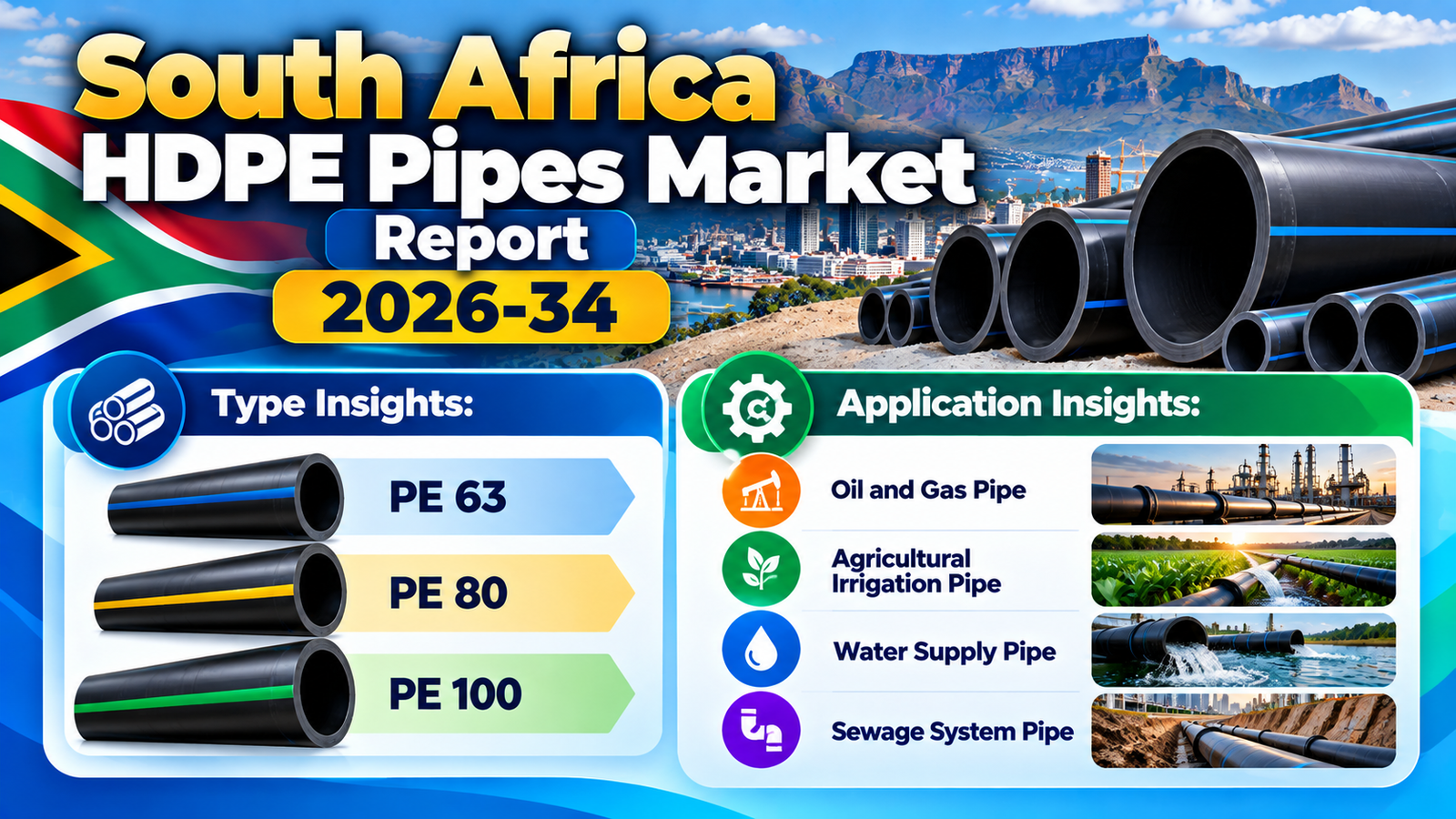
The South Africa HDPE pipes market, driven by ongoing infrastructure development, growing demand for trusted and durable piping materials, and rising awareness of sustainability and affordability in construction and water management. South Africa HDPE pipes market size increased from USD 155.9 Million in 2025 to USD 167.1 Million in 2026. The market is projected to reach USD 257.8 Million by 2034, exhibiting a growth rate (CAGR) of 5.57% during 2026-2034. The market is evolving as government agencies, municipalities, and private developers increasingly specify HDPE solutions for water supply, sewage, irrigation, and industrial applications across the country.
How Innovation is Reshaping the Future of South Africa HDPE Pipes Market?
- Government-Led Water Loss Reduction Programs: The Department of Water and Sanitation has prioritized upgraded pipeline systems in urban and peri-urban areas to minimize water losses, with HDPE increasingly specified for its leak-free fusion joints, chemical resistance, and suitability for South Africa’s mixed soil and water conditions.
- Trenchless Installation Technology: The adoption of trenchless techniques such as horizontal directional drilling is reducing the need for open-cut excavation in urban and environmentally sensitive locations, enabling faster project completion with minimal surface disruption for municipal and utility-scale HDPE installations.
- Local Manufacturing Capacity Expansion: Local manufacturers are scaling up production of both virgin and recycled HDPE pipe systems to meet rising demand, supported by growing investment in domestic production capability rather than reliance on imported piping systems.
Grab a sample PDF of this report: https://www.imarcgroup.com/south-africa-hdpe-pipes-market/requestsample
South Africa HDPE Pipes Market Trends and Drivers:
The South Africa HDPE pipes market is witnessing steady expansion, underpinned by the structural link between infrastructure investment and piping demand. According to the Southern African Plastic Pipe Manufacturers Association, the country currently consumes approximately 52,000 tonnes of HDPE pipes annually alongside roughly 94,900 tonnes of PVC pipes, underscoring the scale of plastic piping’s role in national service delivery. SAPPMA’s leadership has noted that demand for these materials is structurally linked to economic growth and infrastructure development, meaning that as GDP expands, so too does the need for reliable piping systems to support housing, industry, mining, and municipal services.
Government-backed infrastructure upgrades remain central to market momentum. National programs targeting water loss reduction and rural irrigation network improvements are driving specification of HDPE over legacy materials, particularly in areas where corrosion resistance and low maintenance requirements offer long-term cost advantages to municipalities operating under tight budgets. Private sector investment is reinforcing this trend, with BT Industrial committing R325 million toward manufacturing high-density polyethylene pipes and fittings aimed at enhancing water infrastructure and creating new jobs within local communities, reflecting the scale of capital being channeled into domestic HDPE production capacity.
Sustainability considerations are also reshaping material sourcing and manufacturing practices across the sector. The industry is moving toward incorporating recycled content in pipe manufacturing in line with national circular economy frameworks, reducing environmental impact while maintaining the performance standards required across water management, mining, and telecommunications applications. Regional demand is concentrated in Gauteng, KwaZulu-Natal, and the Western Cape, where dense populations, industrial activity, and ongoing municipal infrastructure renewal projects generate the highest procurement volumes, while Mpumalanga and the Eastern Cape are seeing gradual uptake tied to agricultural irrigation and rural water access initiatives.
South Africa HDPE Pipes Industry Segmentation
The report has segmented the market into the following categories:
Breakup By Type:
- PE 63
- PE 80
- PE 100
PE 100 pipes are increasingly favored for higher-pressure water supply and sewage applications due to their superior strength-to-wall-thickness ratio, allowing municipalities and industrial users to reduce material usage while maintaining durability and long-term performance.
Breakup By Application:
- Oil and Gas Pipe
- Agricultural Irrigation Pipe
- Water Supply Pipe
- Sewage System Pipe
- Others
Water supply and sewage system applications account for a significant share of demand, driven by government-led efforts to modernize aging municipal networks and reduce non-revenue water losses, while agricultural irrigation pipe demand is supported by the country’s ongoing focus on efficient water use in farming regions.
Breakup By Region:
- Gauteng
- KwaZulu-Natal
- Western Cape
- Mpumalanga
- Eastern Cape
- Others
Gauteng leads regional demand, reflecting its concentration of municipal infrastructure projects, industrial activity, and population density, which together generate the highest volumes of water supply and sewage-related HDPE pipe procurement in the country.
Competitive Landscape:
The market research report has also provided a comprehensive analysis of the competitive landscape. Competitive analysis such as market structure, key player positioning, top winning strategies, competitive dashboard, and company evaluation quadrant has been covered in the report, along with detailed profiles of all major companies operating in the sector.
Pipestar Africa, a South African manufacturer based just south of Johannesburg, has built a strong reputation for precision-engineered fittings including stub ends, concentric reducers, and seamless 3D Arc Bends, all produced under rigorous quality control and international certification. Serving infrastructure, mining, and water treatment sectors, the company reflects the growing capability of locally based HDPE fittings manufacturers to serve both domestic and continental demand.
Recent News and Developments in South Africa HDPE Pipes Market
- June 2024: Industry reporting highlighted that local manufacturers were increasing production capacity to address rising demand for both virgin and recycled HDPE pipe systems, reflecting growing investment confidence in domestic production.
- September 2024: The Department of Water and Sanitation reported ongoing efforts to minimize water losses through upgraded pipeline systems in urban and peri-urban areas, reinforcing HDPE specification in national water infrastructure renewal programs.
- July 2025: Pipestar Africa, a Johannesburg-based manufacturer, continued expanding its range of precision-engineered HDPE fittings, including stub ends, concentric reducers, and seamless 3D Arc Bends, serving infrastructure, mining, and water treatment clients across the region.
- April 2026: The Southern African Plastic Pipe Manufacturers Association reported that South Africa consumes approximately 52,000 tonnes of HDPE pipes annually, noting that while demand has remained relatively flat in recent years, anticipated growth in mining and civil infrastructure is expected to provide renewed uplift for the sector.
Note: If you require specific details, data, or insights that are not currently included in the scope of this report, we are happy to accommodate your request. As part of our customization service, we will gather and provide the additional information you need, tailored to your specific requirements. Please let us know your exact needs, and we will ensure the report is updated accordingly to meet your expectations.
About Us
IMARC Group is a global management consulting firm that helps the world’s most ambitious changemakers to create a lasting impact. The company provides a comprehensive suite of market entry and expansion services. IMARC offerings include thorough market assessment, feasibility studies, company incorporation assistance, factory setup support, regulatory approvals and licensing navigation, branding, marketing and sales strategies, competitive landscape and benchmarking analyses, pricing and cost research, and procurement research.
Contact Us
IMARC Group
134 N 4th St. Brooklyn, NY 11249, USA
Email: sales@imarcgroup.com
Tel No: (D) +91 120 433 0800
United States: +1-201-971-6302