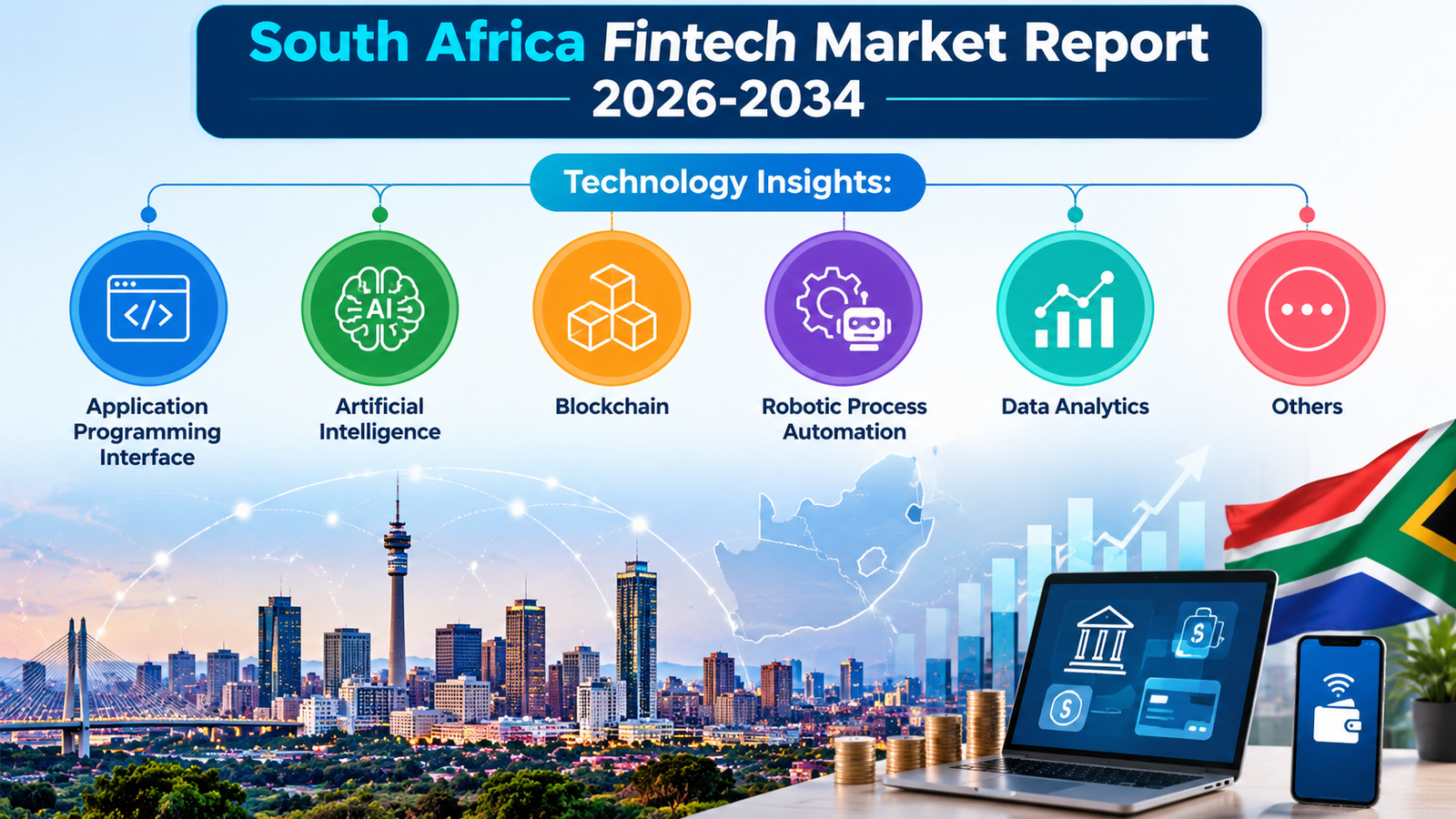
Growth is driven by rapid advances in digital payments, mobile banking, and online lending technologies, supportive regulation, and strong collaboration between incumbent banks and fintech players. South Africa fintech market size grew from USD 1,136.9 Million in 2025 to USD 1,349.9 Million in 2026. The market is projected to reach USD 4,017.4 Million by 2034, exhibiting a growth rate (CAGR) of 14.61% during 2026-2034. These factors are widening access to financial services, particularly for underserved and previously unbanked communities.
The market is expanding as consumers and businesses move steadily toward cashless, app-based financial services. Contactless payments, mobile wallets, and QR-code systems are now common tools for everyday transactions, helped by higher smartphone penetration and wider mobile network coverage across urban and rural areas. Banks are increasingly partnering with or acquiring fintech firms to extend their reach, while regulators are building frameworks for open finance and data sharing. Together, these developments are positioning South Africa as one of the most dynamic fintech hubs on the African continent.
How AI is Reshaping the Future of South Africa Fintech Market?
- AI-Powered Credit Scoring and Online Lending: Lending platforms are using machine learning models and alternative data sources to assess borrowers who have thin or no formal credit histories. Automated underwriting speeds up loan approvals and allows tailored loan products with flexible repayment. This extends credit to individuals and small businesses that traditional banks often exclude.
- Fraud Detection and Risk Management: AI algorithms monitor transaction patterns in real time to flag suspicious activity across mobile wallets, card payments, and fund transfers. Banks and payment providers use these tools to reduce fraud losses and strengthen consumer trust in digital channels as transaction volumes rise.
- Personalized Financial Services and Customer Engagement: AI-driven chatbots, recommendation engines, and personal finance tools help providers offer customized savings, insurance, and wealth management options. As open finance frameworks enable secure data sharing, these tools will deliver more relevant offers, better rates, and smoother digital experiences.
- Process Automation Across Banking, Insurance, and Securities: Robotic process automation and data analytics help financial institutions streamline onboarding, compliance checks, and claims processing. This lowers operating costs and speeds up service delivery, which supports faster adoption of fintech solutions.
Grab a sample PDF of this report: https://www.imarcgroup.com/south-africa-fintech-market/requestsample
Market Growth Factors
The South Africa fintech market is driven by the rapid expansion of digital payment solutions. Contactless payments, mobile wallets, and QR systems have become part of daily commerce, simplifying how people pay for goods and services. Official data from March 2025 showed a significant increase in digital transaction volumes across both urban and rural areas. Better mobile coverage, rising smartphone use, and demand for faster and more secure payments are accelerating this shift. Digital wallets are also bringing previously unbanked groups into the formal economy. Street Wallet, a South African startup, raised USD 350,000 in August 2025 to expand cashless payments for informal traders. Its model gives each vendor a lanyard-style card with a unique QR code linked to a payment page, so vendors can accept payments without a smartphone, mobile data, or a bank account.
The emergence of online lending platforms is another strong growth driver. These platforms use alternative data and automated underwriting to approve loans quickly and serve individuals and small businesses that conventional banks tend to exclude. Official regulatory reports from January 2024 recorded a significant rise in loans extended through digital channels, reflecting a move toward more inclusive credit. Providers offer tailored products with flexible repayment terms, and applicants avoid lengthy paperwork. This fills the credit gap for underserved populations and supports economic empowerment.
Regulatory support and collaboration between banks and fintech firms are further strengthening the market. In June 2024, the Financial Sector Conduct Authority (FSCA) published a policy recommendation paper setting out its open finance vision. The paper proposes mandatory regulation and licensing of open finance participants, standards for data protection and sharing, and consumer recourse mechanisms. Open finance lets third-party providers securely access customer data, with permission, to deliver innovative payment, lending, and personal finance services. Industry partnerships are also deepening. In August 2025, Nedbank acquired iKhokha, a fintech serving small and medium-sized enterprises. iKhokha became a wholly owned subsidiary while retaining its brand and leadership, a sign of growing cooperation between traditional banks and fintech innovators.
Market Segmentation
Deployment Mode Insights:
- On-Premises
- Cloud-Based
Cloud-based deployment is gaining ground as fintech providers and financial institutions seek scalable, cost-efficient platforms for payments, lending, and analytics. On-premises solutions remain relevant for institutions with strict data control and compliance requirements.
Technology Insights:
- Application Programming Interface
- Artificial Intelligence
- Blockchain
- Robotic Process Automation
- Data Analytics
- Others
APIs underpin open finance and bank-fintech integration, while artificial intelligence and data analytics power credit scoring, fraud detection, and personalization. Blockchain and robotic process automation support secure transactions and operational efficiency.
Application Insights:
- Payment and Fund Transfer
- Loans
- Insurance and Personal Finance
- Wealth Management
- Others
Payment and fund transfer solutions lead adoption through mobile wallets, QR payments, and contactless cards. Digital lending is expanding credit access, while insurance, personal finance, and wealth management tools are growing as consumers seek convenient, app-based financial services.
End User Insights:
- Banking
- Insurance
- Securities
- Others
Banks are central to fintech adoption through partnerships and acquisitions. Insurers and securities firms are also adopting digital platforms to improve customer experience and cut costs.
Regional Insights:
- Gauteng
- KwaZulu-Natal
- Western Cape
- Mpumalanga
- Eastern Cape
- Others
Gauteng and the Western Cape host major financial institutions, startups, and technology talent. KwaZulu-Natal, Mpumalanga, and the Eastern Cape are seeing rising adoption as mobile connectivity and digital payment acceptance expand.
Recent Development & News
- August 2025: South African fintech startup Street Wallet secured USD 350,000 in funding to expand digital payment solutions for informal traders and service providers. Founded by Kosta Scholiadis, the company enables vendors to accept secure, cashless payments without smartphones, data, or bank accounts, using a lanyard-style card with a unique QR code.
- August 2025: Apis Partners and Crossfin Holdings exited their investment in iKhokha following its acquisition by Nedbank. iKhokha became a wholly owned subsidiary while retaining its brand and leadership, and is positioned to expand its support for small and medium-sized enterprises.
- March 2025: Official data showed a significant increase in digital transaction volumes in South Africa, reflecting growing adoption of contactless payments, mobile wallets, and QR systems across urban and rural areas.
- June 2024: The Financial Sector Conduct Authority published a policy recommendation paper detailing its open finance vision, including licensing of open finance players, data protection and sharing standards, and consumer recourse channels.
- January 2024: Official regulatory reports recorded a significant rise in loans extended through digital channels, reflecting a shift toward more inclusive credit extension.
If you require any specific information that is not covered currently within the scope of the report, we will provide the same as a part of the customization.
About Us
IMARC Group is a global management consulting firm that helps the world’s most ambitious changemakers to create a lasting impact. The company provides a comprehensive suite of market entry and expansion services. IMARC offerings include thorough market assessment, feasibility studies, company incorporation assistance, factory setup support, regulatory approvals and licensing navigation, branding, marketing and sales strategies, competitive landscape and benchmarking analyses, pricing and cost research, and procurement research.
Contact Us
IMARC Group,
134 N 4th St. Brooklyn, NY 11249, USA,
Email: sales@imarcgroup.com,
Tel No: (D) +91 120 433 0800,
United States: +1-201971-6302