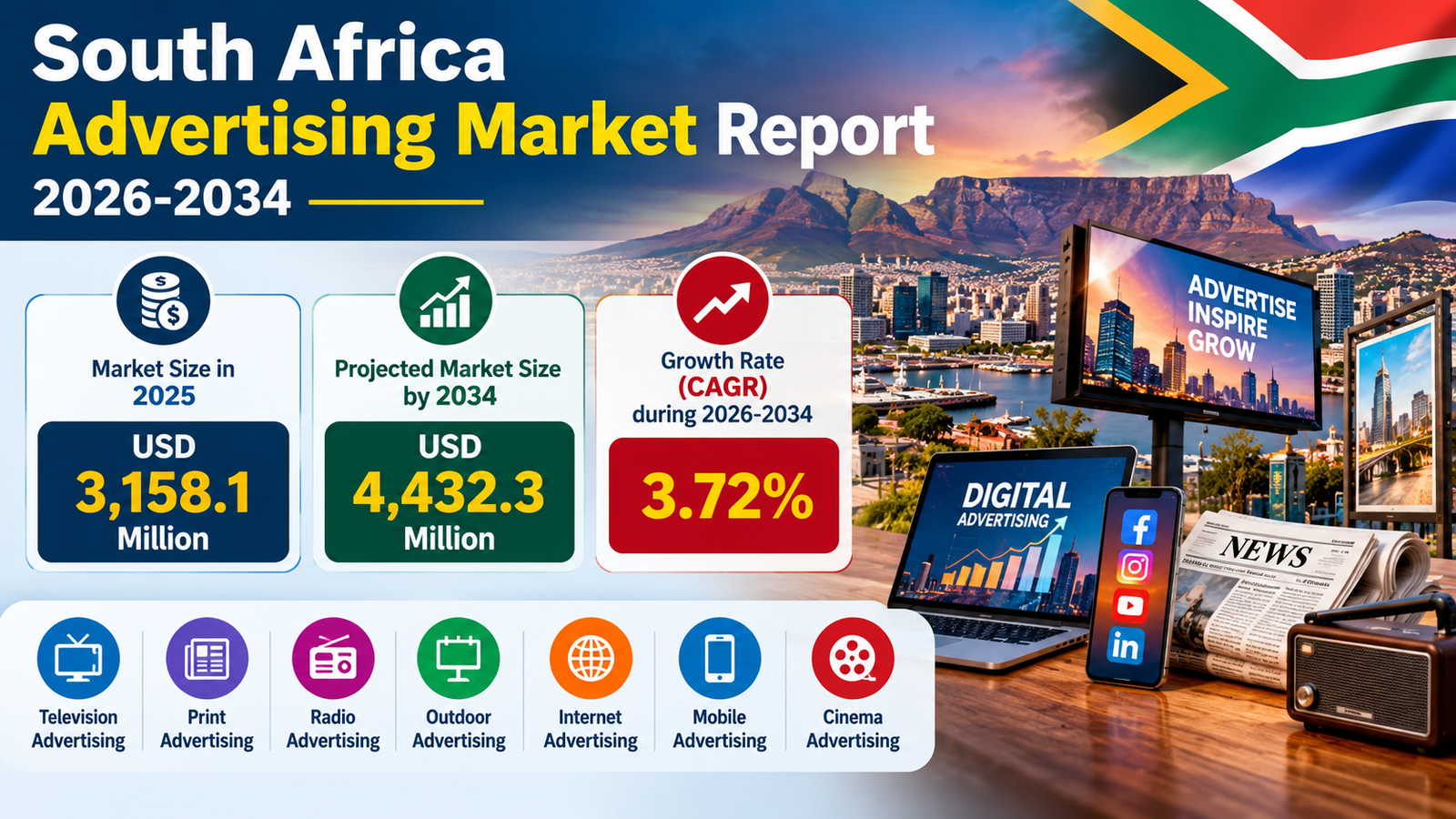
The South Africa advertising market driven by Rapid migration of budgets from traditional media to digital platforms, expanding internet access and e-commerce, and the rising use of data analytics and AI for targeting and creative production are driving advertiser spending. South Africa advertising market size reached USD 3,158.1 Million in 2025. The market is projected to reach USD 4,432.3 Million by 2034, exhibiting a growth rate (CAGR) of 3.72% during 2026-2034. In addition, the growth of small and medium enterprises and the strong influence of social media and peer recommendations continue to shape how brands plan campaigns and measure results.
How AI is Reshaping the Future of South Africa Advertising Market?
- AI is speeding up creative production, with 86% of South African agencies agreeing that it helps create diverse, engaging ad content faster, which lowers production costs and shortens campaign turnaround times.
- AI-driven search and chat tools are changing how consumers discover brands. ChatGPT is already the fourth most visited website in South Africa, pushing advertisers to rethink search, content, and attention strategies.
- Machine learning and programmatic platforms are improving audience targeting and bidding across display, video, and connected TV. Digital now accounts for 59% of total ad revenue in the country, giving AI models large volumes of performance data to optimize against.
- AI-enabled retail media and e-commerce platforms are creating closed-loop measurement that links ad exposure to purchases. South African retail media is estimated at ZAR 9 to 12 Billion, and Amazon’s sponsored ads on Amazon.co.za now give sellers another AI-optimized channel.
- Brands are balancing automation with authenticity. A backlash against AI-generated imagery has led some advertisers to promote “human-made” creative, which is shaping how agencies position AI in their workflows.
Grab a sample PDF of this report: https://www.imarcgroup.com/south-africa-advertising-market/requestsample
Market Growth Factors
The South African advertising market is driven by the steady shift of budgets toward digital channels, supported by expanding connectivity and mobile-first consumer behavior. PwC projects that digital advertising will account for about 74% of total ad spend by the end of its latest outlook period, as brands move toward performance-driven campaigns on social media, e-commerce sites, and connected TV. South Africa is also the largest and most mature entertainment and media market on the African continent, valued at ZAR 301.8 Billion and expected to reach ZAR 352.4 Billion by the end of the outlook period, which gives advertisers a deep and well-connected audience base.
Changing media consumption is reshaping budget allocation. South Africans spend an average of 1 hour 52 minutes per day streaming, one of the highest figures among measured markets worldwide. Google South Africa data shows roughly one-third of linear TV advertisers are actively reducing legacy linear budgets, with about 30% of the shifted spend captured by Google and YouTube. The e-commerce boom is reinforcing this shift, with the number of online shoppers expected to surpass 27 million, and advertisers are increasingly investing in retail media, paid search, and social platforms to reach shoppers at the point of purchase.
Out-of-home advertising is also modernizing. Digital formats now represent 47% of the global out-of-home medium and are close to overtaking static formats for the first time. In South Africa, operators are expanding digital billboard networks and installing backup power to keep screens running during outages. Regulatory enforcement is strengthening the legitimate market as well. The City of Johannesburg’s “No to Illegal Outdoor Advertising” campaign, launched in December 2025, has seen unauthorized billboards physically dismantled alongside a sharp rise in outdoor advertising revenue collected through legitimate channels.
Regulation and trust are shaping platform dynamics. The Protection of Personal Information Act (POPIA) requires advertisers to handle consumer data responsibly, which is accelerating adoption of first-party data and consent-based targeting. The Competition Commission of South Africa’s inquiry into digital platforms has also changed the balance between global platforms and local publishers. Google and YouTube agreed to a ZAR 688 Million (about USD 40 Million) media-support package, and Meta committed to a media-liaison office and wider monetization access, which supports a more sustainable local media ecosystem for advertisers.
Affordability remains a structural challenge. About 62% of entertainment and media spending in South Africa goes toward connectivity costs, which limits what consumers can spend on content and, in turn, the audience reach and monetization available to advertisers. Measurement is also evolving, with the industry rebuilding established television audience currencies and OOH operators adopting movement data and attention metrics to prove campaign impact.
Market Segmentation
Type Insights:
- Television Advertising
- Print Advertising
- Newspaper Advertising
- Magazine Advertising
- Radio Advertising
- Outdoor Advertising
- Internet Advertising
- Search Advertising
- Display Advertising
- Classified Advertising
- Video Advertising
- Mobile Advertising
- Cinema Advertising
Regional Insights:
- Gauteng
- Western Cape
- KwaZulu-Natal
- Eastern Cape
- Mpumalanga
- Others
Recent Development & News
- October 2026: PwC released its Africa Entertainment and Media Outlook, showing South Africa’s entertainment and media market rising from ZAR 301.8 Billion to ZAR 352.4 Billion over the outlook period, with growth concentrated in digital and connectivity-driven segments while traditional TV declines.
- December 2025: The City of Johannesburg launched its “No to Illegal Outdoor Advertising” campaign, with the Joburg Property Company dismantling unauthorized billboards and driving a sharp rise in revenue collected through legitimate outdoor channels.
- November 2025: The Competition Commission of South Africa announced remedies after its media inquiry. Google and YouTube agreed to a ZAR 688 Million media-support package, and Meta agreed to create a media-liaison office and expand monetization access for local media.
- October 2025: PwC’s Africa Entertainment and Media Outlook projected that digital advertising would account for 74% of total ad spend as brands shift budgets toward social media, e-commerce sites, and connected TV.
- July 2024: Amazon launched Sponsored Products, Sponsored Brands, Sponsored Display, and Stores on Amazon.co.za, giving South African sellers and vendors a new retail media channel.
If you require any specific information that is not covered currently within the scope of the report, we will provide the same as a part of the customization.
About Us
IMARC Group is a global management consulting firm that helps the world’s most ambitious changemakers to create a lasting impact. The company provide a comprehensive suite of market entry and expansion services. IMARC offerings include thorough market assessment, feasibility studies, company incorporation assistance, factory setup support, regulatory approvals and licensing navigation, branding, marketing and sales strategies, competitive landscape and benchmarking analyses, pricing and cost research, and procurement research.
Contact Us
IMARC Group,
134 N 4th St. Brooklyn, NY 11249, USA,
Email: sales@imarcgroup.com,
Tel No: (D) +91 120 433 0800,
United States: +1-201971-6302