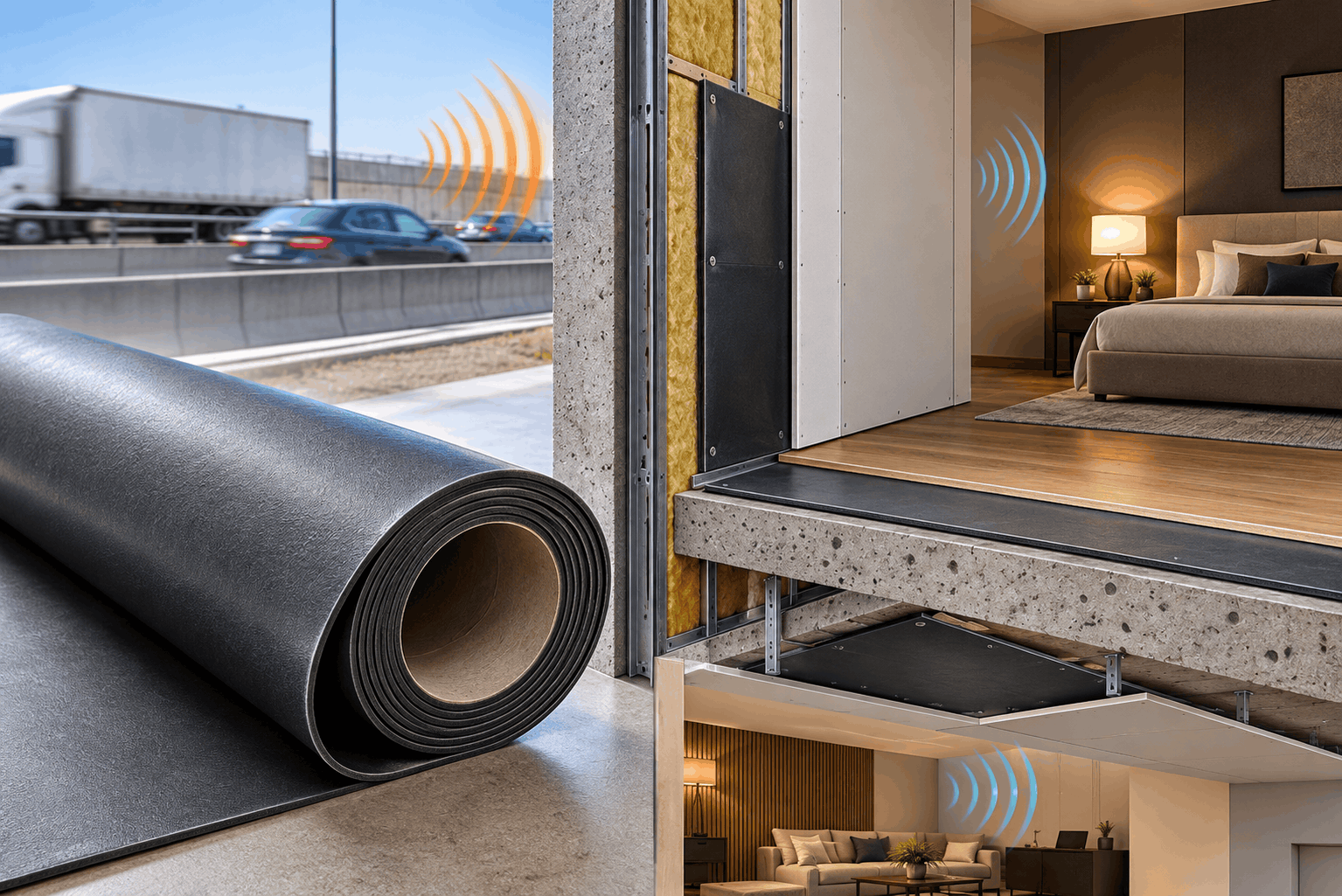
Noise complaints often trace back to one weak point: a thin wall, a hollow door, or a lightweight ceiling that lets sound pass straight through. Adding soft decor rarely fixes it, because blocking sound takes mass. A Sound Dampening Sheet delivers that mass in a slim, flexible layer, making it a practical solution for homes, offices, studios, and industrial facilities that need real sound isolation.
What Is a Sound Dampening Sheet?
A sound dampening sheet is a dense, bendable barrier that reduces how much sound travels through a surface. Foam and fibre panels absorb echo inside a room, but they do little to stop noise reaching the room next door. These sheets address that second problem, working as a hidden layer inside walls, floors, ceilings, enclosures, and ducts.
The most popular material is Mass Loaded Vinyl, widely known as MLV. It is made from vinyl blended with fine mineral fillers, which gives it high weight in a very thin profile.
How Mass Loaded Vinyl Works
Sound moves as vibration, and light structures such as hollow partitions and thin drywall vibrate easily. A heavy, limp layer makes the structure much harder to set in motion, so less sound energy reaches the other side. Because MLV is flexible rather than rigid, it also damps vibration instead of ringing like a stiff board.
Blocking performance is rated by the Sound Transmission Class (STC). Heavier sheets generally reach higher ratings, and results improve further when MLV is combined with drywall, cavity insulation, or resilient channels.
Where These Sheets Are Used
- Walls and partitions in homes, offices, and hotels
- Floors and ceilings above noisy areas
- Recording studios, home theatres, and podcast rooms
- Doors, enclosures, and equipment housings
- Generator rooms, plant rooms, and machinery covers
- Ducts and pipes to reduce rattle and breakout noise
Key Advantages
The main strength is high sound blocking without much added thickness, which helps where wall depth or ceiling height is limited. The sheet wraps around pipes and ducts and follows irregular surfaces without cracking.
Most sheets are durable, moisture-resistant, and fibre-free, so handling is clean and simple. Fire-retardant versions are available for commercial and public buildings. Compared with building an extra wall, fitting a sheet barrier is usually faster and more economical.
Installation Best Practices
Installation quality affects results as much as the product. Any gap or open seam lets sound leak through, so fit sheets tightly and use overlapping or taped joints. Fix the sheet over studs or a base layer, then cover it with drywall or another finish.
Seal edges, sockets, and penetrations with acoustic sealant, since small openings can undo much of the benefit. For the best outcome, treat the sheet as one layer in a complete system by adding absorptive insulation inside cavities and decoupling layers where possible.
What to Check Before Buying
Compare weight per square metre, thickness, STC performance, and fire certification. Check roll width and length to reduce the number of seams, and confirm the material suits the temperature and moisture conditions of your space.
Keep in mind that these sheets block sound passing through a surface but do not absorb echo inside a room. For complete acoustic control, pair them with wall panels, ceiling tiles, or acoustic clouds.
Final Thoughts
Effective noise control comes from matching the right material to the right problem and installing it with care. For projects that need a slim, flexible, high-performance barrier, choosing quality MASS LOADED VINYL SHEETS is a practical way to create quieter, more private, and more comfortable spaces.