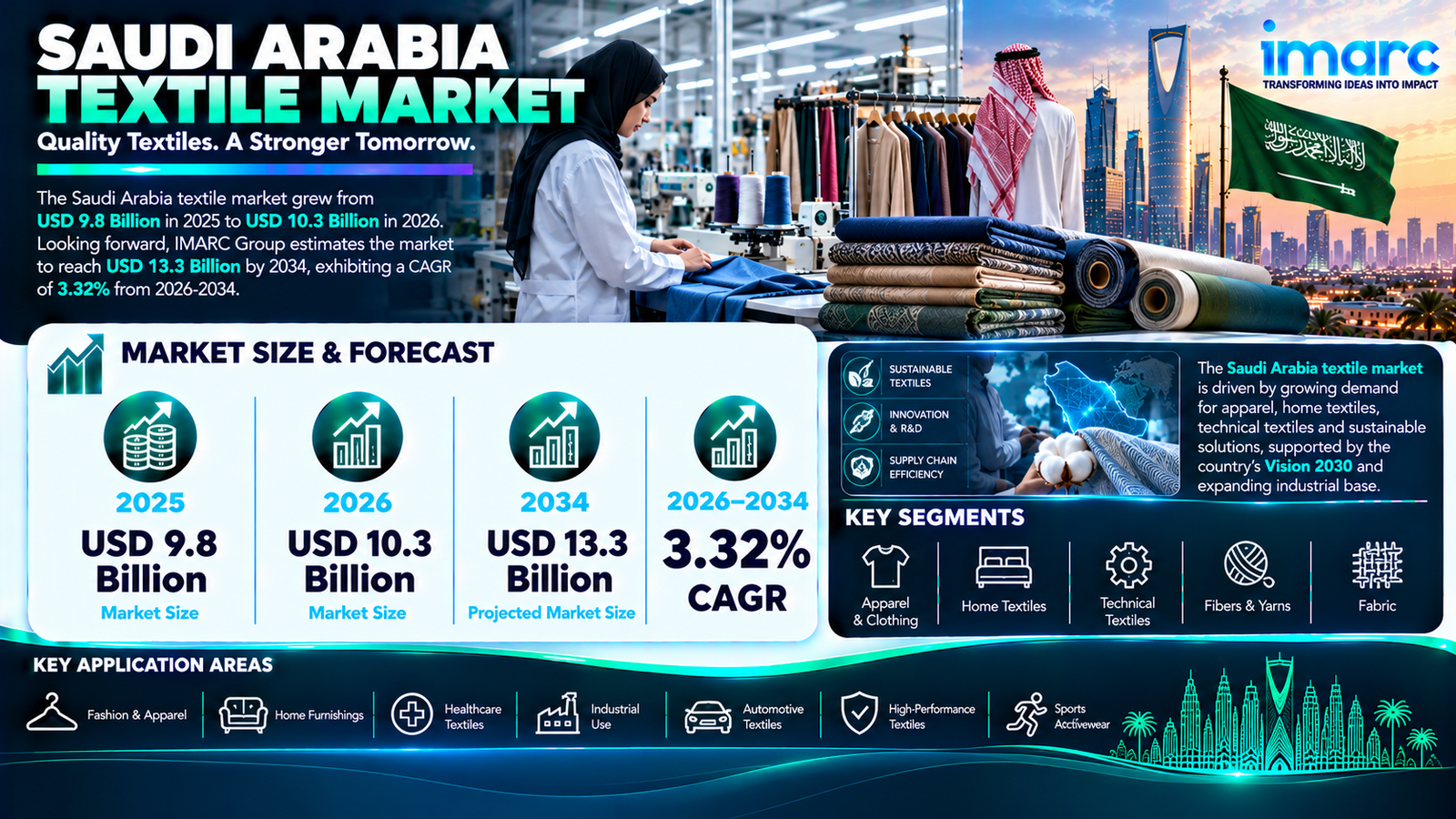
IMARC Group, a leading global market research and management consulting firm, has published its latest market intelligence report on the Saudi Arabia textile market. The Saudi Arabia textile market size increased from USD 9.8 Billion in 2025 to USD 10.3 Billion in 2026 and is projected to reach USD 13.3 Billion by 2034, exhibiting a CAGR of 3.32% during 2026-2034, driven by the growing shift toward online shopping, innovations in supply chain management, and the Kingdom’s expanding push for local textile manufacturing and self-sufficiency.
The market is riding sustained momentum as Saudi Arabia repositions its textile sector from an import-dependent model toward a more self-sufficient, locally manufactured base. Government-backed economic diversification programs, rising demand for traditional and culturally relevant designs such as thobes and abayas, and growing consumer appetite for sustainable and luxury fabrics are widening the addressable market across fashion, home textiles, and technical applications. Natural fibers remain central to everyday wear given the Kingdom’s hot desert climate, while polyester and nylon continue to serve activewear, upholstery, and industrial-grade products, together creating a textile base built on both cultural demand and functional diversification.
Saudi Arabia Textile Market at a Glance:
- Market Size (2025): USD 9.8 Billion
- Market Size (2026): USD 10.3 Billion
- Forecast Market Size (2034): USD 13.3 Billion
- CAGR (2026-2034): 3.32%
- Segments Covered: Product (Natural Fibers, Polyesters, Nylon, Others), Raw Material (Cotton, Chemical, Wool, Silk, Others), Application (Household, Technical, Fashion and Clothing, Others), Region (Northern and Central, Western, Eastern, Southern)
How AI is Reshaping the Future of the Saudi Arabia Textile Market
- AI-Driven Demand Forecasting and Production Planning: Saudi textile manufacturers are adopting AI and machine learning tools to predict seasonal demand shifts, optimize production schedules, and manage inventory more precisely, reducing wastage while improving responsiveness to fast-changing fashion and home textile trends across the Kingdom.
- IoT-Enabled Smart Manufacturing: Internet of Things sensors integrated into weaving, dyeing, and finishing lines are giving manufacturers real-time visibility into machine performance, enabling predictive maintenance and minimizing downtime, which helps Saudi producers improve efficiency and compete more effectively against established import suppliers.
- AI-Powered Personalization and E-Commerce Styling: As online textile and fashion retail grows, AI-based recommendation engines and virtual styling tools are helping local and international brands personalize offerings for Saudi shoppers, strengthening customer engagement while supporting the digital transformation of the Kingdom’s textile retail.
Grab a sample PDF of this report: https://www.imarcgroup.com/saudi-arabia-textile-market/requestsample
Saudi Arabia Textile Market Trends and Drivers:
The expansion of e-commerce platforms is one of the most significant drivers reshaping the Saudi Arabia textile market, giving consumers easier access to a wider range of fashion, home, and technical textile products from the comfort of their homes. This digital shift particularly favors niche and premium categories, such as luxury or eco-friendly fabrics, where shoppers previously had limited access through traditional retail channels. Local textile businesses are increasingly selling nationwide without the overhead of a physical storefront, lowering costs and widening profit margins, while payment options such as cash on delivery make online purchases more accessible to a broader consumer base. According to IMARC Group’s own research, the Saudi Arabia e-commerce market is projected to grow at a CAGR of 13.70% during 2024-2032, reinforcing textile’s digital retail trajectory.
Rising adoption of smart manufacturing technologies, including the Internet of Things, artificial intelligence, and automation, is improving production efficiency and reducing costs across the textile industry in Saudi Arabia. IoT-enabled real-time monitoring allows manufacturers to optimize machine performance and minimize downtime, while AI and machine learning tools help predict demand trends and adjust production schedules and inventory accordingly. Parallel to this technological shift, growing demand for local manufacturing is reducing the Kingdom’s dependency on imports and strengthening domestic production capabilities, aligned with government priorities around economic diversification and job creation. Local manufacturers are increasingly producing culturally relevant designs, including traditional attire, that resonate with Saudi consumers while reducing lead times and enabling faster retail turnaround for both domestic and regional buyers.
The rising shift toward sustainable and eco-friendly textiles, driven by growing environmental consciousness among manufacturers and consumers, is impelling market growth, with increasing demand for fabrics made from natural, biodegradable, and recycled materials such as organic cotton, bamboo, hemp, and recycled polyester. At the same time, the growing affluence of the Saudi population and cultural appreciation for premium goods is catalyzing demand for luxury textiles across fashion, interior design, and home decor, with high-end fabrics such as silk, high-thread-count cotton, and cashmere increasingly favored in upscale clothing and home furnishings. IMARC Group data shows that the Saudi Arabia luxury market overall is expected to reach USD 22.5 Billion by 2032, underscoring the parallel premiumization trend running through the textile industry.
Government Schemes and Vision 2030 Initiatives Driving Demand:
- National Industrial Development and Logistics Program (NIDLP): A core pillar of Vision 2030, NIDLP is driving industrial diversification and localization across manufacturing sectors, including textiles, through targeted incentives for industrial clusters, modernized machinery, and reduced reliance on imported fabrics and finished goods.
- Made in Saudi Program: The national branding initiative is positioning locally manufactured textiles as a mark of quality and authenticity, encouraging domestic producers to scale output and compete with imports while supporting Vision 2030’s goal of strengthening non-oil industrial contribution to GDP.
- Saudi Fashion Commission Sustainability Initiatives: Established to grow the Kingdom’s fashion and textile ecosystem, the Commission is backing material innovation and sustainability projects, such as a locally developed seaweed-based textile unveiled in 2026, aimed at positioning Saudi Arabia as a hub for textile innovation.
- MODON Industrial Land and Investment Support: The Saudi Authority for Industrial Cities and Technology Zones continues to facilitate textile manufacturing investment through developed industrial land, smart warehousing, and infrastructure support across the Kingdom’s industrial cities, lowering entry barriers for new production facilities.
Saudi Arabia Textile Industry Segmentation:
The report has segmented the market into the following categories:
Breakup By Product:
- Natural Fibers
- Polyesters
- Nylon
- Others
Natural fibers such as cotton, wool, silk, and linen remain preferred across the Saudi Arabia textile market for their breathability, softness, and comfort in the hot desert climate, commonly used in daily wear, household textiles, and traditional local attire, while polyester continues to see extensive use for its durability, flexibility, and affordability across clothing, upholstery, and industrial fabrics.
Breakup By Raw Material:
- Cotton
- Chemical
- Wool
- Silk
- Others
Cotton remains the most widely chosen raw material for its softness, light weight, and suitability for Saudi Arabia’s hot and humid climate, used extensively in casual wear, household textiles, and traditional attire such as thobes and abayas, while chemical fibers including polyester, nylon, and acrylic are favored for their flexibility, shape retention, and use in sportswear and technical fabrics.
Breakup By Application:
- Household
- Technical
- Fashion and Clothing
- Others
The household textiles segment benefits from consistent demand for bed linens, curtains, towels, and upholstery, supported by rising consumer emphasis on quality home decor, while the fashion and clothing segment continues to serve strong demand for both traditional and modern attire, with Saudi consumers showing a particular preference for luxury brands and premium textile products.
Breakup By Region:
- Northern and Central Region
- Western Region
- Eastern Region
- Southern Region
The Northern and Central Region benefits from well-established urban centers that drive large-scale textile manufacturing and demand for both local and international products, while the Western Region, anchored by Jeddah’s commercial hub status and proximity to key ports, supports extensive retail-driven textile demand, and the Eastern and Southern Regions continue to see steady demand shaped by premium preferences and locally rooted cultural attire, respectively.
Competitive Landscape:
The report provides a comprehensive analysis of the competitive landscape in the Saudi Arabia textile market with detailed profiles of all major companies, including:
- Arabian Textile Company
- Zamil Industrial
- Naseej International Trading Co
- National Spinning Company (NSC)
- Al-Hokair Group (Textile Division)
- Saudi Garment Manufacturing Co. (SGMC)
- Alfanar Textile Company
- Omar Kassem Alesayi Textiles Company Limited
Market Concentration Analysis:
- Fragmentation: The Saudi Arabia textile market remains import-intensive and fragmented, with no single domestic manufacturer commanding a dominant share, as the sector continues to rely heavily on finished goods and raw materials sourced from overseas suppliers.
- Localization Push: Government-backed localization initiatives are encouraging consolidation around a smaller group of scaled domestic producers, exemplified by joint ventures such as Alujain Corporation’s proposed tie-up with Belgium’s Beaulieu International Group to expand local nonwoven and geotextile production.
- Capital and Partnership Activity: Strategic partnerships between local industrial groups and international textile technology providers are reshaping competitive dynamics, as manufacturers seek to combine global process expertise with Saudi Arabia’s expanding industrial infrastructure and incentive programs.
What Does The Full Report Cover?
If you are tracking the Saudi Arabia textile market for investment decisions, market entry planning, competitive benchmarking, or strategic advisory, IMARC Group’s report gives you everything in one place:
- Complete market sizing in value terms with forecasts covering the full 2026-2034 projection period
- Quantified growth driver analysis across product, raw material, application, and regional markets
- Sub-segment breakdowns for Natural Fibers, Polyesters, and Nylon products, Cotton, Chemical, Wool, and Silk raw materials, and Household, Technical, and Fashion and Clothing applications
- Regional data across the Northern and Central, Western, Eastern, and Southern regions of Saudi Arabia
- Competitive profiles of leading textile manufacturers and producers operating in the Kingdom
- Value chain analysis, market concentration assessment, and investment and growth opportunity mapping
- Latest technology trends covering AI-driven production planning, smart manufacturing, e-commerce expansion, and sustainability-led material innovation shaping the Saudi Arabia textile industry
Recent News and Developments in Saudi Arabia Textile Market
- September 2025: The third edition of the Saudi Fashion & Tex Expo was held at the Jeddah International Exhibition & Convention Center, bringing together exhibitors from more than 20 countries across fashion, textiles, and leather goods to strengthen the Kingdom’s position as a regional textile trade hub.
- March 2026: Alujain Corporation signed a Memorandum of Understanding with Belgium’s Beaulieu International Group to explore a joint venture expanding local production of synthetic fibers and nonwovens, building on Alujain’s existing GEONATPET geotextile operations in Yanbu.
- April 2026: The Saudi Fashion Commission unveiled a Red Sea seaweed-based textile at the Misk Global Forum, marking a step forward in the Kingdom’s strategy to drive material innovation and build a sustainable fashion and textile industry.
Note: If you require specific details, data, or insights that are not currently included in the scope of this report, we are happy to accommodate your request. As part of our customization service, we will gather and provide the additional information you need, tailored to your specific requirements. Please let us know your exact needs, and we will ensure the report is updated accordingly to meet your expectations.
Key Questions This Report Answers
- What is the current Saudi Arabia textile market size and what is its projected value?
- Which product and raw material segments hold the largest share in the Saudi Arabia textile market?
- What are the key drivers of Saudi Arabia textile market growth?
- Which region dominates demand within the Saudi Arabia textile market and why?
- How is e-commerce expansion, smart manufacturing adoption, and Vision 2030-driven localization reshaping competitive strategy in the Saudi Arabia textile industry?
- Who are the top companies in the Saudi Arabia textile market and what are their competitive strategies?
- What are the investment and market entry opportunities across sustainable fibers, local manufacturing, and luxury textile segments in Saudi Arabia?
About Us
IMARC Group is a global management consulting firm that helps the world’s most ambitious changemakers to create a lasting impact. The company provides a comprehensive suite of market entry and expansion services. IMARC offerings include thorough market assessment, feasibility studies, company incorporation assistance, factory setup support, regulatory approvals and licensing navigation, branding, marketing and sales strategies, competitive landscape and benchmarking analyses, pricing and cost research, and procurement research.
Media and Sales Contact
IMARC Group
Email: sales@imarcgroup.com
United States: +1-201-971-6302
India: +91-120-433-0800
United Kingdom: +44-753-714-6104